Wass, Molitor & Company Subseries
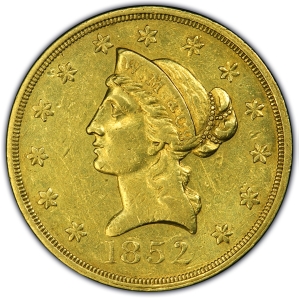
Obverse
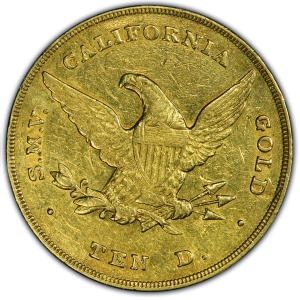
Reverse
Wass, Molitor & Company emerged as one of the most significant and reputable private minters during the chaotic height of the California Gold Rush. Founded by two Hungarian immigrants, Count Samuel C. Wass and Agoston P. Molitor, their firm brought a level of metallurgical expertise and integrity that was desperately needed in the gold fields. The California economy was drowning in gold dust but starved for a stable, reliable medium of exchange. The U.S. Assay Office and, later, the fledgling San Francisco Mint were overwhelmed and could not meet the commercial demand for coinage. This created a vacuum that private minters filled. Wass, Molitor & Co. distinguished themselves from many competitors by producing coins whose intrinsic value was consistently honest, closely matching their face value. Their initial 1852 issues of $5 and $10 gold pieces were well-received. The firm temporarily ceased operations in 1853 as the U.S. Assay office ramped up, but the financial panic of 1855, caused by the failure of the bank Page, Bacon & Co., created a new crisis of confidence and a renewed, desperate need for coinage. Responding to pleas from bankers and businessmen, Wass, Molitor & Co. reopened and began striking coins again, this time including larger $10 and $20 denominations and, most famously, two distinct types of massive $50 gold coins. These large 'slugs' were instrumental in stabilizing the regional economy during the panic and are now considered legendary rarities. Their coinage was so trusted that it circulated at par with federal issues until sufficient government coins finally saturated the market, after which most were melted down.
Assayer/MinterCount Samuel C. Wass and Agoston P. Molitor
Minter HistoryCount Samuel C. Wass and Agoston P. Molitor were Hungarian patriots and political exiles who had fled their homeland after the failed revolution of 1848. Both were highly skilled metallurgists and assayers. They arrived in California with a deep technical knowledge that surpassed many of their contemporaries. This expertise was the foundation of their firm's success. They established their assaying office in San Francisco in 1851 and began their coining operations in 1852. Their reputation for honesty and technical proficiency made them leaders in the field, trusted by bankers and merchants alike. Their decision to resume coining in 1855 at the behest of the banking community underscores their critical role in the financial stability of Gold Rush-era San Francisco.
Reason for MintingTo convert raw gold dust into a trusted, standardized medium of exchange amidst a severe shortage of federal coinage in California.
Historical SignificanceWass, Molitor & Co. represents the pinnacle of private assaying and coinage during the California Gold Rush. Their coins were not merely tokens of convenience but a vital component of the region's monetary system, circulating freely and helping to stabilize a volatile economy, particularly during the Panic of 1855. The high quality and consistent fineness of their issues set a standard for private minters and provided a necessary bridge until the San Francisco Mint could fully meet the demands of commerce. Their massive $50 pieces are iconic artifacts of American economic history and Manifest Destiny, representing the immense wealth and ambition of the era.
Geographic OriginSan Francisco, California
The obverse designs typically feature a classical Liberty Head motif, styled after the contemporary federal gold coinage but with a distinct artistic flair. The 1852 issues have a smaller, more delicate portrait ('Small Head'), while later issues feature a more robust, larger portrait ('Large Head'). The portrait is surrounded by thirteen stars representing the original colonies.
Obverse InscriptionInscriptions vary slightly by issue but commonly include 'WASS MOLITOR & CO.' in an arc above the portrait and 'SAN FRANCISCO CALIFORNIA' below. The date appears below the bust truncation.
Reverse DescriptionThe reverses are dominated by a heraldic eagle with a shield on its breast, clutching an olive branch and arrows, again echoing the design of federal gold coins. A scroll with 'S.M.V.' (Standard Mint Value) is sometimes seen above the eagle, a testament to their commitment to quality.
Reverse InscriptionCommon inscriptions include the denomination spelled out (e.g., 'TEN D.' or 'FIFTY DOLLARS') and often the stated fineness, such as '900 THOUS.'.
CompositionGold
Denomination$5, $10, $20, $50
Stated FinenessThe firm consistently stated a fineness of .900 on their later issues, which was a direct claim of equivalence to federal gold coinage.
Actual FinenessWass, Molitor & Co. coins are renowned for their honest weight and fineness. Analysis has shown their actual fineness to be very close to, and sometimes slightly exceeding, their stated .900 standard, which is the primary reason they were so widely accepted in commerce.
Precise mintage figures were not recorded and are unknown. However, historical accounts suggest that their output, particularly in 1855, was substantial to meet commercial demand. All issues are considered rare today, with some being of the highest rarity.
Survival EstimateThe survival rate for all Wass, Molitor & Co. issues is very low. Because their coins were of honest weight and fineness, they were not discounted like the coinage of less scrupulous minters. This led to heavy and prolonged circulation, followed by mass melting in the late 1850s once the San Francisco Mint was producing enough federal coinage to meet the region's needs. The vast majority of their output was destroyed, leaving only a small fraction for modern collectors.
Rarity ScaleThe rarity of the series ranges from R-4 (Rare) for the most common varieties in low grades to R-8 (Unique or Nearly So) for high-grade examples and especially for the large denomination pieces. The 1855 $50 issues are legendary rarities, with only a handful of each type known to exist.
This series is highly prized for its beautiful classical designs, its direct connection to the tumultuous California Gold Rush, and the unimpeachable integrity of its minters. The great rarity of all issues, especially the iconic $50 pieces, makes them trophy coins for advanced collectors of territorial gold.
Key VarietiesKey varieties include: 1852 $5 Small Head; 1852 $10 Small Head and Large Head varieties; 1855 $10; 1855 $20; and the two legendary 1855 $50 pieces (K-17 with plain border, K-18 with beaded border). The Large Head vs. Small Head varieties of 1852 are a primary focus for specialists.
Kagin #K-9 to K-19
Authentication TipsAuthenticity should be confirmed by top-tier grading services. Diagnostics include the specific style of the lettering and date punches, which are distinct from federal issues. Die cracks and other markers are well-documented on genuine specimens. Counterfeits often have a soft, cast-like appearance, incorrect weight, or tooling marks in the fields. The luster on original pieces should be vibrant and cartwheeling, not dull or prooflike.
Shopping ConsiderationsFor this series, 'good value' lies in acquiring a problem-free coin with strong eye appeal, even in circulated grades. Originality of the surfaces is paramount; avoid examples that have been harshly cleaned, polished, or repaired. A strong strike, particularly on the high points of Liberty's hair and the eagle's feathers, commands a significant premium. Given the rarity, any example is a prize, but collectors should prioritize quality over a slightly lower price for an impaired specimen.
A coin's grade is its condition, rated on a 1-70 scale. For rare coins, this is the most critical factor in determining value, as a tiny difference in preservation can mean a huge difference in price.
Relevant Grade TypesAll original Wass, Molitor & Co. coins are business strikes intended for circulation. No proofs were originally struck. Any coin with prooflike surfaces is a result of a polished planchet or early die state and is not a true proof.
Mint State CharacteristicsUncirculated examples are exceptionally rare. When found, they are judged on the quality of their strike, the brilliance of their original mint luster, and the absence of contact marks. Many issues, even in Mint State, may exhibit some softness in the central strike due to the technical challenges of private minting. Luster is typically satiny or slightly frosty.
Circulated Wear PatternsWear first appears on the highest points of the design. On the obverse, this includes Liberty's hair above the eye and ear, the cheek, and the coronet. On the reverse, the eagle's head, neck, and the upper edges of the wings are the first areas to show friction and loss of detail.
Key Factors for ValueThe primary value drivers are the specific Kagin variety (with the $50 issues being exponentially more valuable than the smaller denominations), the coin's numerical grade, and its surface quality. Rarity is paramount. A coin with a bold strike, minimal distracting marks, and attractive original color will always command a premium. For world-class examples, a documented provenance tracing back to famous collections like Garrett, Norweb, or Bass can add significantly to the coin's value and desirability.