U.S. Assay Office / Humbert Subseries
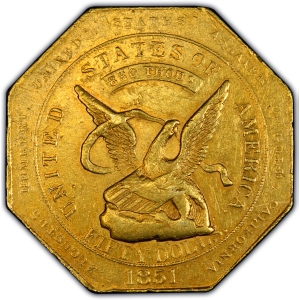
Obverse
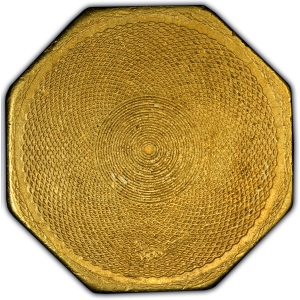
Reverse
The U.S. Assay Office coinage struck under the authority of Augustus Humbert represents the federal government's first major, albeit temporary, solution to the monetary chaos of the California Gold Rush. In the wake of the 1848 discovery of gold at Sutter's Mill, California was flooded with raw gold dust but lacked a sanctioned, uniform medium of exchange. This vacuum was filled by a dizzying array of private minters, whose coins were often underweight, of inconsistent fineness, and met with deep public distrust. This situation severely hampered commerce. Responding to political pressure, Congress passed an act in 1850 establishing a U.S. Assay Office in California to assay gold and form it into ingots and coins of specified fineness. Augustus Humbert, a respected New York watchcase maker known for his integrity and skill, was appointed U.S. Assayer. Arriving in San Francisco in early 1851, he partnered with the private firm of Moffat & Co. to begin operations. The resulting coins, particularly the large and impressive $50 octagonal 'slugs,' were not legal tender in the same sense as U.S. Mint products but were receivable for customs duties. Their guaranteed weight and fineness, backed by federal authority, immediately instilled confidence. They effectively drove the debased private issues from circulation, stabilized the regional economy, and served as the de facto federal currency until the official San Francisco Branch Mint opened its doors in 1854.
Assayer/MinterUnited States Assay Office of Gold / Augustus Humbert
Minter HistoryAugustus Humbert (1810-1871) was a prominent and highly esteemed artisan from New York City, a partner in the firm of Humbert & Son, which specialized in manufacturing watchcases. His reputation for absolute integrity and his expertise in working with precious metals made him an ideal candidate for the critical role of U.S. Assayer for California. Appointed by Treasury Secretary Thomas Corwin, Humbert's task was to bring order to the monetary chaos of the Gold Rush. He was not a traditional mint master but rather a federal agent whose stamp guaranteed the metallic value of the gold pieces produced. His personal authority and the federal backing of his office were the keys to the public's acceptance of the coinage. After his initial contract, the Assay Office was reorganized, and he later worked with the firm of Kellogg & Co. before returning to New York.
Reason for MintingTo provide a federally sanctioned, reliable, and standardized gold coinage to stabilize California's economy before a branch mint could be established.
Historical SignificanceThe Humbert coinage is of paramount historical importance as it represents a crucial bridge between the era of chaotic private coinage and official U.S. federal coinage in the West. The massive $50 slugs are among the most iconic artifacts of the Gold Rush, physically representing the immense wealth flowing from the California mines. By providing a trusted medium of exchange, Humbert's office stabilized commerce, facilitated large transactions, and restored faith in the monetary system. This success paved the way for, and demonstrated the urgent need for, the permanent U.S. Branch Mint that opened in San Francisco in 1854, after which most Assay Office issues were systematically melted down.
Geographic OriginSan Francisco, California
The obverse designs are dominated by a large, defiant heraldic eagle clutching an olive branch and arrows, with a shield on its breast. A ribbon in its beak on early issues bears the name of Augustus Humbert; on later issues, this ribbon is removed. The legend 'UNITED STATES OF AMERICA' typically encircles the eagle. The most iconic feature is the finely reeded or 'engine turned' border on the initial $50 issues, giving it a distinctive and ornate appearance.
Obverse InscriptionCommon inscriptions include 'UNITED STATES OF AMERICA,' the denomination (e.g., 'FIFTY DOLLS' or 'TEN D.'), and the fineness (e.g., '887 THOUS.' or '.900 FINE'). Early issues also prominently feature 'AUGUSTUS HUMBERT UNITED STATES ASSAYER OF GOLD CALIFORNIA' and the date.
Reverse DescriptionThe reverse of the earliest and most famous $50 octagonal issues is renowned for its striking 'engine turned' design, a series of intricate radial lines emanating from a plain center. This was a security feature, difficult to replicate. Later issues feature a simpler 'target' reverse with concentric circles. The $10 and $20 pieces have a similar target-style reverse. This was intentionally done to make them look more like ingots than official U.S. coins.
Reverse InscriptionThe reverse is typically devoid of major inscriptions. Some varieties may feature a small counterstamp or the assayer's initials, but the primary design is the geometric pattern.
CompositionGold
Denomination$10, $20, $50
Stated FinenessThe stated fineness varied as the office refined its processes. Initial issues were marked '.880 THOUS.' or '.887 THOUS.', reflecting the composition of native California gold with a small amount of silver and copper. Later, in 1852, the fineness was adjusted to the U.S. standard of '.900 FINE'.
Actual FinenessA key to their success was their accuracy. The actual fineness consistently matched or slightly exceeded the stated fineness, a stark contrast to many private issues and the primary reason for their universal acceptance in commerce.
Official mintage figures were not recorded, but production was substantial, especially for the $50 slugs, which were the workhorses of large-scale commerce. It is estimated that millions of dollars' worth were struck. However, the $10 and $20 denominations of 1852 are considerably rarer.
Survival EstimateSurvival rates are very low relative to the large mintages. As soon as the San Francisco Mint opened in 1854 and began producing official U.S. gold coins, the Assay Office issues were aggressively recalled and melted down. Their high intrinsic value sealed their fate. Furthermore, the large, heavy, and soft gold pieces were susceptible to damage, making high-grade, problem-free survivors exceptionally scarce.
Rarity ScaleThe series spans a wide range of rarities. The most common varieties, such as the 1851 .887 fineness Reeded Edge $50 slug (K-5), are relatively available in circulated grades (R-4). Other varieties, like the 1851 Lettered Edge $50 (K-4), are among the great rarities of U.S. numismatics (R-7). All issues are extremely rare in Mint State condition, with choice uncirculated examples being true condition census coins.
The U.S. Assay Office series is intensely sought after for its historical gravity, direct link to the federal government's role in the Gold Rush, and the impressive size and unique design of the $50 octagonal 'slug.' They are tangible, high-value relics of a pivotal moment in American economic history.
Key VarietiesMajor varieties include: the 1851 $50 Lettered Edge (K-4, extremely rare); the 1851 $50 Reeded Edge issues with various finenesses (.880, .887); the 1852 $50 issues with '.900 FINE' and the denomination '50' omitted from the obverse; the scarce 1852 $10 and $20 denominations. The transition from Humbert's name on the obverse ribbon to its removal is a key design change.
Kagin #K-1 to K-16
Authentication TipsGenuine examples exhibit extremely precise and sharp details in the eagle's feathers and the engine-turned reverse lathe work. Lettering punches have a specific, known style. Be wary of cast counterfeits which will have a porous or soapy texture and soft details. Weight and specific gravity are critical tests. Look for characteristic parallel die polishing lines on genuine pieces, especially in the fields. The rims and reeding should be sharp and uniform, unlike the often-weak or tooled edges of forgeries.
Shopping ConsiderationsFor this series, 'good value' is often found in an attractive, problem-free coin in a slightly lower grade (e.g., a choice XF) over a higher-grade coin with significant surface problems like major rim bumps, scratches, or harsh cleaning. On the $50 slugs, the vast, open fields are unforgiving; pay a premium for clean surfaces. Eye appeal, original color, and a strong strike on the eagle are paramount and often command prices far above guide levels for a technically equivalent but less attractive specimen.
A coin's grade is its condition, rated on a 1-70 scale. For rare coins, this is the most critical factor in determining value, as a tiny difference in preservation can mean a huge difference in price.
Relevant Grade TypesAll U.S. Assay Office coins were business strikes intended for heavy commercial use. No proofs were ever struck. Any coin advertised as a 'proof' is either a modern replica or a misrepresentation of a business strike with prooflike surfaces.
Mint State CharacteristicsAn uncirculated specimen is defined by having full, unbroken mint luster. Quality is further refined by the strength of the strike; a sharp strike will show full detail on the eagle's head, neck feathers, and talons. Given their size and softness, contact marks are common. A premium Mint State coin will have minimal, well-hidden marks, vibrant luster, and strong eye appeal.
Circulated Wear PatternsWear first appears on the highest points of the design. On the obverse, this includes the eagle's head, the upper line of its wings, and the edge of the shield. On the reverse, the center of the engine-turned or 'target' design will show friction and flattening first. For the octagonal $50 slugs, the eight corners and raised rims are extremely susceptible to contact marks, nicks, and wear.
Key Factors for ValueValue is determined by a combination of factors: 1) The specific Kagin variety and its inherent rarity. 2) The certified numerical grade. 3) Surface quality – a coin with minimal distracting marks and original skin will always command a premium. 4) Strike – a sharply struck coin is more desirable than a weakly struck one of the same grade. 5) Eye Appeal – coins with attractive original color and luster are prized. 6) Provenance – for exceptional examples, a documented history of ownership in famous collections can significantly enhance value.