U.S. Assay Office Subseries
From the U.S. Assay Office (1852-1853) Series
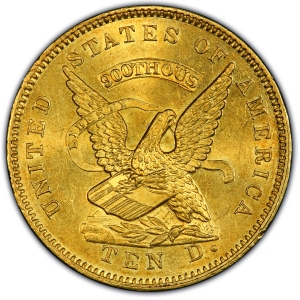
Obverse
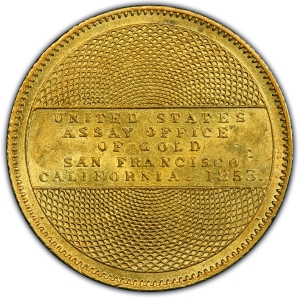
Reverse
The U.S. Assay Office of Gold coinage of 1852-1853 represents a critical and orderly transition between the chaotic private gold period and the establishment of the San Francisco Mint. Following the California Gold Rush of 1849, the West Coast was flooded with gold dust but starved for a reliable, standardized medium of exchange. Private minters filled the void, but many of their coins were underweight or of debased fineness, leading to economic instability. Recognizing the crisis, the federal government in 1850 appointed Augustus Humbert as U.S. Assayer for California. He initially placed his stamp on large $50 octagonal 'slugs' produced by the private firm of Moffat & Co., giving them a federal guarantee of weight and fineness. This greatly improved public confidence. By 1852, the partnership evolved. Moffat & Co. effectively became the U.S. Assay Office, under contract to the government, and began striking coins that more closely resembled official U.S. coinage. These new $10 and $20 pieces, bearing the name 'U.S. Assay Office of Gold,' were produced to federal standards. The initial 1852 issues were .884 fine, but by 1853, they were struck at the standard .900 fineness, making them virtually identical in intrinsic value to federal gold. This coinage effectively drove the less-reputable private gold from circulation, stabilized the regional economy, and paved the way for the San Francisco Mint, which opened in 1854 and immediately began melting these territorial issues to strike new federal coins.
Assayer/MinterU.S. Assay Office of Gold (Operated under contract by Moffat & Co., and its successors Curtis, Perry & Ward)
Minter HistoryWhile bearing a federal name, the U.S. Assay Office was a government-sanctioned private enterprise. It was initially operated by John L. Moffat, a respected assayer who had been producing private gold since 1849. His firm, Moffat & Co., was contracted to handle the physical minting operations under the supervision of U.S. Assayer Augustus Humbert. In late 1852, Moffat and his partners retired, and the business was succeeded by three of their former employees: Joseph R. Curtis, Philo H. Perry, and Samuel H. Ward. They continued the contract, producing the .900 fine issues of 1853 until the federal San Francisco Mint was ready to begin operations in 1854.
Reason for MintingTo convert raw gold into a federally-sanctioned, standardized coinage for commerce in California prior to the opening of the San Francisco Mint.
Historical SignificanceThis series is of immense historical importance as it was the bridge between private territorial gold and official U.S. branch mint coinage. These coins stabilized the volatile California economy by providing a trustworthy medium of exchange based on federal standards. Their widespread acceptance and success demonstrated the urgent need for a permanent federal mint in San Francisco and directly led to its establishment. They are tangible artifacts of the federal government's efforts to project monetary authority and economic order during the era of Manifest Destiny.
Geographic OriginSan Francisco, California
The obverse features a classic Liberty Head design, facing left, closely modeled on Christian Gobrecht's Coronet Head motif used on contemporary federal gold coinage. A coronet inscribed 'LIBERTY' is on her hair, which is tied in a bun at the back. The bust is surrounded by thirteen stars representing the original colonies, with the date positioned below.
Obverse InscriptionTypically consists of the thirteen surrounding stars and the date of issue (e.g., 1852 or 1853) below the bust.
Reverse DescriptionThe reverse displays a large, majestic heraldic eagle with a shield on its breast, clutching an olive branch in its right talon and arrows in its left. This design was also meant to evoke official U.S. coinage and inspire public trust.
Reverse InscriptionThe periphery is inscribed 'U.S. ASSAY OFFICE OF GOLD' and 'SAN FRANCISCO CALIFORNIA'. The denomination ('TEN D.' or 'TWENTY D.') appears below the eagle. Critically, the fineness is explicitly stated on the reverse, either as '884 THOUS.' on the earliest issues or '900 THOUS.' on the later, federally-standardized coins.
CompositionGold
Denomination$10, $20
Stated FinenessTwo distinct standards were used and clearly stated on the coins: .884 fine for the 1852 $10 issue, and .900 fine for all 1853 issues, which matched the federal standard for gold coinage.
Actual FinenessThe stated fineness was highly accurate, a hallmark of the Humbert and Moffat-related operations. This reliability was the key reason they were preferred in commerce and ultimately drove out less trustworthy private gold.
Mintage figures were not recorded by variety, but historical records indicate enormous production values for the time, with millions of dollars' worth of gold being coined. For example, over $12 million in $20 pieces were struck in 1853 alone. Despite this, all issues are scarce today.
Survival EstimateSurvival rates are exceptionally low, likely less than 0.1% of the original mintage. Because they were of full and reliable value, they circulated extensively. When the San Francisco Mint opened in 1854, these coins were actively deposited, melted down, and officially recoined into new federal issues, erasing the vast majority from existence.
Rarity ScaleThe entire series ranges from scarce to very rare. In circulated grades, the 1853 .900 THOUS. $10 and $20 are the most available, though still highly sought after. The 1852 .884 THOUS. $10 is the rarest of the four major varieties. All issues are extremely rare in Mint State, with choice uncirculated examples being major numismatic prizes.
These coins are pillars of the territorial gold series, combining the romance of the Gold Rush with the authority of a federal assay. Their close resemblance to official U.S. coinage and their role as the direct precursor to the San Francisco Mint make them a cornerstone of any serious collection of American coinage.
Key VarietiesThe major varieties are defined by date, denomination, and fineness: - 1852 $10, .884 THOUS. (K-13): The rarest major type. - 1853 $10, .900 THOUS. (K-14) - 1853 $20, .900 THOUS. (K-15, K-16): Distinguished by minor variations in the 'SAN FRANCISCO' lettering.
Kagin #K-13 to K-16
Authentication TipsGenuine examples exhibit sharp, well-defined details, especially in the lettering, which was applied with high-quality punches. Compare the font style to known genuine specimens. Counterfeits are often cast, showing a porous or soapy texture and a lack of fine detail. A seam or tool mark on the edge is a red flag. All genuine pieces are struck in gold and will have the correct specific gravity. Weighing the coin is a critical first step, though be aware of tolerances.
Shopping ConsiderationsFor this series, 'good value' is often found in attractive, problem-free coins in the VF-XF grade range. Given their history of heavy circulation, an example with honest wear, original surfaces, and good eye appeal is often a better acquisition than a higher-grade coin that has been cleaned, damaged, or repaired. Always prioritize surface quality and strike over the absolute grade on the holder.
A coin's grade is its condition, rated on a 1-70 scale. For rare coins, this is the most critical factor in determining value, as a tiny difference in preservation can mean a huge difference in price.
Relevant Grade TypesAll coins from this series were business strikes intended for general circulation. No proof versions were ever officially struck. Some early strikes from fresh dies may exhibit prooflike surfaces, but these are exceptionally rare and are not considered true proofs.
Mint State CharacteristicsUncirculated examples are defined by the presence of original mint luster. Quality is judged by the strength of this luster, the sharpness of the strike (the centers are often weak), and the presence or absence of contact marks and scratches from mint handling and storage. A well-struck, lustrous, and clean U.S. Assay Office gold coin is a major rarity.
Circulated Wear PatternsOn the obverse, wear first appears on the high points of Liberty's cheek, the hair just above her eye and ear, and on the letters of the coronet. On the reverse, the eagle's head and neck, the top of the shield, and the upper edges of the wings are the first areas to show friction and lose detail.
Key Factors for ValueThe primary drivers of value are the specific Kagin variety (rarity), the certified grade (condition), and the coin's overall eye appeal. For high-grade specimens, factors like strike quality, luster, and the color of the gold play a major role. For the finest known examples, a documented provenance tracing back to major historical collections (e.g., Bass, Garrett, Norweb) is of paramount importance and can add a substantial premium to the coin's value.