State of California Subseries
From the State of California (1851) Series
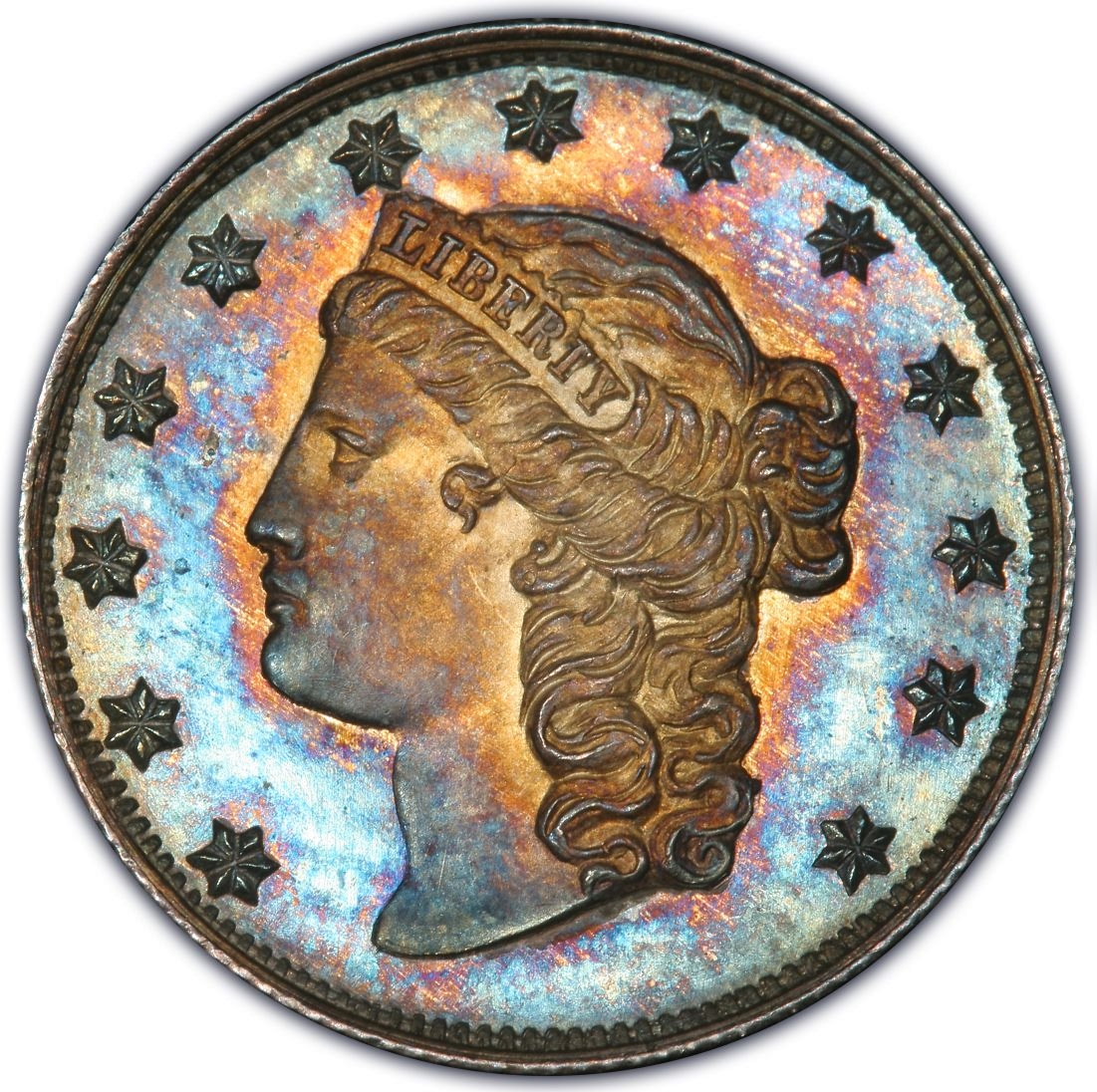
Obverse
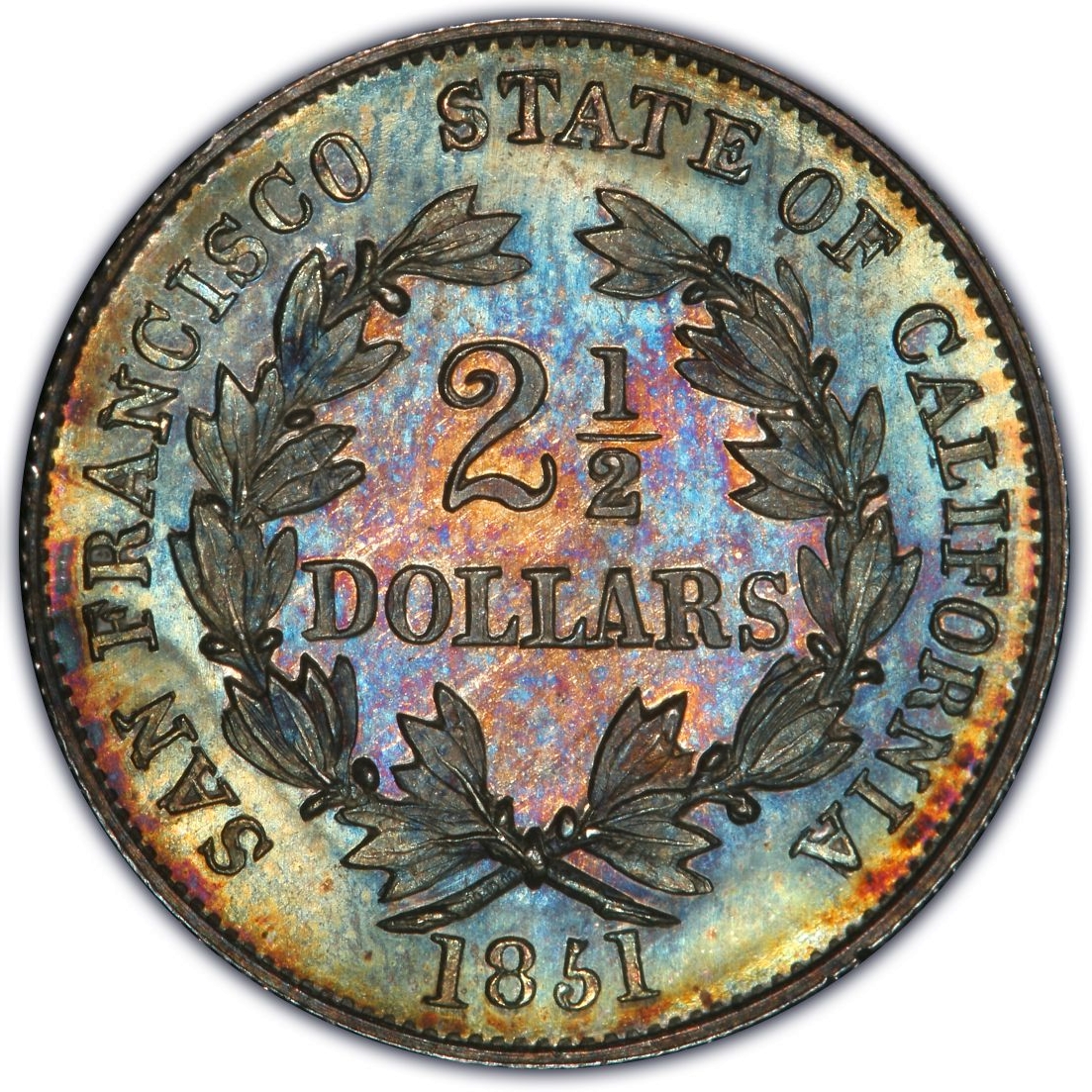
Reverse
The massive gold discoveries in California beginning in 1848 created an acute economic crisis. An immense quantity of raw gold dust and nuggets flooded the local economy, but there was a severe shortage of official United States coinage for commerce. This forced merchants to accept gold dust by weight, a cumbersome and often fraudulent process. Various private minters attempted to fill the void, but their products were often underweight, of inconsistent fineness, and traded at a discount. The chaos led California's business leaders and politicians to demand federal intervention. In 1850, Congress passed a bill creating a U.S. Assay Office in California to assay and stamp gold ingots, which would circulate as legal tender. Augustus Humbert, a highly respected New York watch-case maker known for his precision and integrity, was appointed U.S. Assayer. He arrived in San Francisco in early 1851 and partnered with the private firm Moffat & Co. to begin operations. The first issues were massive $50 gold octagonal ingots, colloquially known as 'slugs'. These pieces were not technically coins but government-sanctioned ingots of verified weight and purity, intended to stabilize commerce and standardize the value of California's gold. Their production immediately provided a trusted medium of exchange, driving out the debased private coinage and becoming the lifeblood of West Coast finance until the establishment of the San Francisco Mint in 1854, at which point most were recalled and melted.
Assayer/MinterAugustus Humbert, U.S. Assayer of Gold
Minter HistoryAugustus Humbert was not a traditional minter but a U.S. government official with the title 'United States Assayer of Gold.' He was chosen for his unimpeachable reputation for honesty and his expertise in metallurgy and precision engraving, gained from his successful watch-case manufacturing business in New York. Humbert did not operate his own mint; instead, he contracted with the existing, respected private firm of Moffat & Co. for the facilities and manpower to produce the coinage. He personally oversaw the assaying process and applied his official stamp, lending federal authority to the coins. His tenure was brief but pivotal, ending with the establishment of a full U.S. Mint in San Francisco, but his work set the standard for quality and integrity in a chaotic era.
Reason for MintingTo provide a federally-sanctioned, high-value medium of exchange to stabilize California's gold-rich but coin-poor economy.
Historical SignificanceThe Humbert $50 'slugs' were instrumental in stabilizing the volatile economy of Gold Rush California. They represented the first successful federal intervention in the region's monetary crisis, providing a reliable, high-denomination store of value that was universally accepted. This drove out suspect private coinage and facilitated large-scale commerce. As direct precursors to the official coinage of the San Francisco Mint (which ultimately took over the Moffat & Co. facilities), they are a physical link between the 'Wild West' period of private territorial gold and the establishment of formal federal coinage on the West Coast.
Geographic OriginSan Francisco, California
The obverse design is dominated by a finely detailed American eagle, wings spread, clutching a shield and ribbon. The ribbon bears the inscription 'LIBERTY'. Above the eagle are the words 'UNITED STATES OF AMERICA', and below are the denomination and fineness. The minter's name, 'AUGUSTUS HUMBERT', is prominently stamped in a straight line just above the eagle's head. The entire central device is on a field of intricate, engine-turned radial lines.
Obverse InscriptionUNITED STATES OF AMERICA / AUGUSTUS HUMBERT UNITED STATES ASSAYER OF GOLD CALIFORNIA / 880 THOUS. (or 887 THOUS.) / 50 D C
Reverse DescriptionThe reverse is starkly utilitarian, featuring the same intricate engine-turned radial line pattern as the obverse. Early varieties (K-1 to K-4) have a simple target-like design of concentric circles at the center. The key later variety (K-5, K-6) has the denomination '50' stamped within the central target, added to make the value immediately clear.
Reverse InscriptionNo inscriptions on most varieties. K-5 and K-6 have '50' stamped in the center.
CompositionGold
Denomination$50
Stated FinenessInitially stamped '880 THOUS.' or '887 THOUS.' representing .880 or .887 fineness. Later issues were intended to be .900 fine, conforming to the U.S. standard.
Actual FinenessThe stated fineness was generally accurate, a hallmark of Humbert's integrity. Small variations exist, but they were a dramatic improvement over the wildly inconsistent purity of earlier private issues.
Mintages were not meticulously recorded, but production was substantial, with an estimated value of over $9 million struck in 1851 alone. Despite the high output, survival rates are very low.
Survival EstimateThe survival estimate is very low, likely less than 1% of the original mintage. As official U.S. Assay Office products, they were systematically recalled and melted to provide bullion for the new San Francisco Mint when it opened in 1854. Unlike private issues which might have been hoarded, these were viewed as legitimate government money and were readily turned in for conversion into federal double eagles.
Rarity ScaleAll varieties are rare to extremely rare in any condition. The most 'common' variety, K-5 (with '50' on reverse, .887 Thou.), is merely scarce in low grades and becomes very rare in AU or better. The K-4 'No 50' variety is significantly rarer, and the K-1 'Lettered Edge' variety is of the highest rarity, with only a few known.
The $50 Humbert slug is one of the most iconic and desirable coins in all of U.S. numismatics. Its massive size, unique octagonal shape, direct connection to the California Gold Rush, and status as a quasi-federal issue make it a cornerstone piece for any advanced collector of Territorial gold or U.S. coinage.
Key VarietiesK-1: Lettered Edge, '880 THOUS.' - Extremely rare. K-2 to K-4: Reeded Edge, '887 THOUS.', Reverse without '50' - Very rare. K-5 & K-6: Reeded Edge, '887 THOUS.', Reverse with '50' - The most collectible type, though still rare.
Kagin #K-1 to K-6
Authentication TipsGenuine examples have a distinctive look. The engine-turned fields are exceptionally fine and difficult to reproduce accurately. The eagle's details should be sharp and match known die states. Pay close attention to the Humbert name punch – the letters have a specific style and placement. Reeding should be parallel and evenly spaced. Counterfeits often have a cast appearance, with mushy details, tooling marks, or incorrect weight and specific gravity.
Shopping ConsiderationsValue for a Humbert slug is highly dependent on surface preservation. Due to their size and heavy use, most examples are plagued with contact marks, scratches, and significant rim bumps. A 'premium quality' example will have relatively clean fields and a strong, unimpaired octagonal edge. Luster is rare and commands a huge premium. Given the high value, purchasing examples certified by PCGS or NGC is essential. Look for coins with minimal graffiti and damage, as a technically lower grade but cleaner coin can be more desirable than a higher grade but heavily marked specimen.
A coin's grade is its condition, rated on a 1-70 scale. For rare coins, this is the most critical factor in determining value, as a tiny difference in preservation can mean a huge difference in price.
Relevant Grade TypesAll Humbert $50 pieces are business strikes. No proofs were ever made. They were utilitarian pieces intended for large-scale commerce and banking transactions.
Mint State CharacteristicsUncirculated examples are exceptionally rare. A true Mint State specimen would exhibit strong luster in the protected areas of the engine-turned fields. Strike quality varies; the eagle's head and neck feathers are often softly struck. Adjustment marks, which are small file marks made at the mint to correct the planchet's weight before striking, are common and generally accepted by collectors on this series.
Circulated Wear PatternsWear first appears on the highest points: the eagle's head, wings, and the upper part of the shield on the obverse. On the reverse, the concentric rings of the 'target' design will wear down first, appearing flat. The octagonal edges and corners are very susceptible to bumps and dings, which should be carefully evaluated.
Key Factors for ValueThe primary drivers of value are the specific Kagin variety (rarity), the numerical grade assigned by a top-tier grading service, and the coin's eye appeal. For these massive gold coins, significant detractors from value include major edge bumps, deep scratches, graffiti, or signs of cleaning or tooling. For world-class examples, a documented chain of ownership (provenance) tracing back to famous collections like Garrett, Norweb, or Eliasberg can add a substantial premium to the coin's value.