Schultz & Company Subseries
From the Schultz & Company (1851) Series
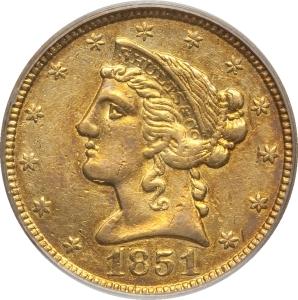
Obverse
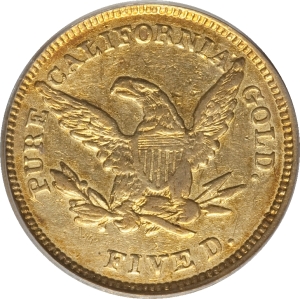
Reverse
Schultz & Company represents a classic, albeit brief, chapter in the saga of California's private gold coinage. Established in San Francisco by German immigrants William T. and G.W.T. Schultz, the firm operated as assayers and minters during the chaotic economic boom of 1851. At this time, gold dust was the primary medium of exchange, but it was cumbersome, inconsistent, and prone to theft and fraud. Private minters filled a critical void by converting this dust into standardized coins, providing a much-needed lubricant for commerce. The Schultz $5 gold piece, with its professional and handsome design, was well-received initially. However, their operation was short-lived. Their timing was unfortunate, as their coinage coincided with the establishment of the U.S. Assay Office in San Francisco, run by Augustus Humbert. Humbert, acting as a federal agent, actively campaigned against private coiners, declaring their products illegal and refusing them at the customs house. Compounding their problems, assays revealed Schultz & Co. coins to be approximately .880 fine, slightly below the federal standard and the value implied on the coin, giving Humbert the justification he needed to discredit them. Consequently, the coins were systematically withdrawn from circulation and melted, leading to their extreme rarity today.
Assayer/MinterSchultz & Company
Minter HistorySchultz & Company was a firm of assayers and coiners founded by two brothers, William T. and G.W.T. Schultz. They entered the burgeoning San Francisco market in 1851, capitalizing on the immense demand for coinage. Their operation was sophisticated enough to produce dies and coins of a quality comparable to other prominent private minters of the day. However, their business was quickly extinguished by the powerful competition and legal opposition from the newly established U.S. Assay Office under Augustus Humbert, which effectively rendered their coinage unacceptable for official transactions and led to its rapid demise.
Reason for MintingTo satisfy the urgent need for a reliable circulating medium by converting raw gold dust into standardized coins for commerce in 1851 San Francisco.
Historical SignificanceThe Schultz & Company coinage is historically significant as a prime example of the high-stakes, competitive, and ultimately transient nature of private minting during the California Gold Rush. Their story highlights the critical period of transition from a chaotic, privately-managed monetary system to one of federal control. The coins themselves are tangible relics of this struggle, and their extreme rarity is a direct consequence of the U.S. Assay Office's successful campaign to suppress private competition.
Geographic OriginSan Francisco, California
The obverse features a classical bust of Liberty facing left. She wears a plain coronet or diadem inscribed with the firm's name, 'SCHULTZ & Co.'. Her hair is tied in a bun, and she is surrounded by ten six-pointed stars.
Obverse InscriptionSCHULTZ & Co. (inscribed on the diadem).
Reverse DescriptionThe reverse design is clearly inspired by the federal gold coinage of the era. It features a heraldic eagle with outstretched wings, clutching an olive branch in its right talon and three arrows in its left. A shield is emblazoned on the eagle's breast.
Reverse InscriptionCALIFORNIA GOLD is arched over the eagle, with the denomination FIVE D. inscribed below.
CompositionGold
Denomination$5
Stated FinenessNo fineness is stated on the coin itself.
Actual FinenessAssays conducted in 1851 by the U.S. Assay Office revealed the coins to be approximately .880 fine. This was slightly below the .900 federal standard and the fineness of many of their competitors, which contributed to their being discredited.
Mintage figures were never recorded, but based on the extreme rarity of surviving specimens, the original output was undoubtedly very small.
Survival EstimateExtremely low, with fewer than 20 examples believed to exist today across all grades. This minuscule survival rate is a direct result of a systematic recall and melting campaign orchestrated by the U.S. Assay Office in 1851, which deemed the coins to be of insufficient value and a threat to its own operations.
Rarity ScaleConsidered a great rarity, typically classified as R-7 (meaning 4 to 12 specimens are known). It is one of the rarest and most desirable of all California private gold issues.
This issue is a 'trophy coin' for advanced specialists in territorial gold. Its appeal lies in its extreme rarity, its direct connection to the turbulent financial history of 1851 San Francisco, and its attractive, classical design.
Key VarietiesThere is only one known die variety for the Schultz & Company $5 gold piece, cataloged as Kagin-23.
Kagin #K-23
Authentication TipsAuthentication is paramount and should be left to top-tier experts. Genuine examples exhibit a specific die state, including a faint die crack that often appears near 1 o'clock on the obverse. The style of the lettering, particularly the ampersand, and the engraving of Liberty's portrait are distinctive. Counterfeits may be cast (showing porosity and softness of detail) or die-struck from modern dies (showing incorrect tool marks and a different overall 'feel'). Compare any potential purchase against high-resolution images of known genuine examples.
Shopping ConsiderationsThe appearance of a Schultz & Co. $5 at auction is a significant numismatic event. A 'good value' is difficult to define; the primary goal is simply acquisition. A premium quality example would be one that is well-struck for the issue, free of significant, distracting marks or rim damage, and possesses a pleasing, original color. Given that most survivors are in the VF to AU grade range, a problem-free coin in this tier is highly desirable. Provenance is a major value driver; a specimen traced to a famous collection like Garrett, Eliasberg, or Norweb will command a substantial premium.
A coin's grade is its condition, rated on a 1-70 scale. For rare coins, this is the most critical factor in determining value, as a tiny difference in preservation can mean a huge difference in price.
Relevant Grade TypesAll known examples are business strikes intended for circulation. No proofs, patterns, or presentation pieces are known to exist.
Mint State CharacteristicsA true Mint State example is a monumental rarity, with perhaps only one or two pieces arguably qualifying. Such a coin would display sharp details, particularly in Liberty's hair curls and the eagle's feathers. Luster would be frosty and unbroken. However, nearly all known specimens show evidence of circulation, and even high-end pieces may exhibit some weakness in strike, as is common with privately minted coinage.
Circulated Wear PatternsWear first becomes evident on the highest points of the design. On the obverse, this includes Liberty's cheek, the hair above her eye, and the coronet. On the reverse, friction will first appear on the eagle's head and neck, the tops of its wings, and the central part of the shield.
Key Factors for ValueFor a Schultz & Co. $5, the primary value drivers are, in order: 1) Authenticity. 2) Rarity (which is a given). 3) Grade and surface quality – a coin in the AU range is vastly more valuable than one in VF, and a piece without significant scratches or rim impairments is highly prized. 4) Eye Appeal – coins with original, attractive coloration command a premium. 5) Provenance – a documented history of ownership in major, well-known collections can add tremendously to a coin's value and desirability.