Pacific Company Subseries
From the Pacific Company (1849) Series
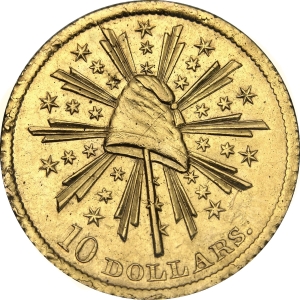
Obverse
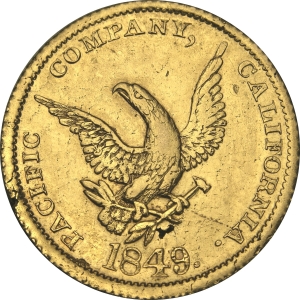
Reverse
The Pacific Company coinage represents one of the earliest and most enigmatic attempts to strike private gold coins during the chaotic onset of the California Gold Rush. Formed in the summer of 1849, the firm's partners are believed to have been members of Colonel Jonathan D. Stevenson's 7th Regiment of New York Volunteers, who had arrived in California two years prior. As gold dust inundated San Francisco, the lack of official U.S. coinage created a severe bottleneck for commerce, forcing merchants to weigh gold dust for every transaction. The Pacific Company was one of several ventures that emerged to meet this urgent need by converting raw gold into coins with a stated value. However, their operation was incredibly brief and mysterious. Their coins, crudely designed and struck with primitive equipment, likely circulated for only a very short time before being rejected due to their inconsistent weight and purity. Most were undoubtedly melted down once more reputable private issues (like those of Moffat & Co.) and, eventually, official U.S. coins became available. The company vanished as quickly as it appeared, leaving behind only a handful of extremely rare coins as evidence of its existence.
Assayer/MinterPacific Company
Minter HistoryVery little is definitively known about the Pacific Company. Historical accounts suggest it was established by former military men who saw a commercial opportunity in the currency vacuum of early Gold Rush San Francisco. Operating with rudimentary equipment, they lacked the sophisticated assaying and minting technology of later, more successful firms. Their enterprise was short-lived, likely failing due to the poor quality and questionable intrinsic value of their coins, which could not compete in a marketplace that quickly learned to value trust and consistency.
Reason for MintingTo convert raw gold dust into a standardized, transportable, and spendable medium of exchange for commerce in 1849 San Francisco, which lacked any significant supply of official United States coinage.
Historical SignificanceThe Pacific Company's coinage is historically significant precisely because of its rarity and primitivism. It serves as a tangible artifact from the very dawn of the Gold Rush, a period of immense economic chaos and improvisation. These coins represent one of the first attempts to impose monetary order on a frontier economy drowning in gold but starved of currency. Their extreme rarity and crude manufacture tell a story of entrepreneurial ambition and ultimate failure in one of the most dynamic economic environments in American history.
Geographic OriginSan Francisco, California
The obverse design across the series is characterized by its stark simplicity and symbolic imagery. The central device is a Phrygian cap, or Liberty Cap, set atop a pole. This classic symbol of freedom is flanked by the initials 'P C' for 'Pacific Company'. This entire central design is enclosed within a ring of ten or eleven five-pointed stars, which are often unevenly spaced and crudely punched into the die.
Obverse InscriptionP C
Reverse DescriptionThe reverse is equally crude and functional. It features the denomination, either '5' or '10', and the word 'DOLLARS' arranged horizontally. Some varieties include a design element of rocks below the denomination, presumably symbolizing the gold-bearing lands of California.
Reverse Inscription5 DOLLARS or 10 DOLLARS
CompositionGold
Denomination$5, $10
Stated FinenessNo fineness or weight is stated on the coins.
Actual FinenessThe actual fineness of Pacific Company gold is known to be inconsistent and significantly below the U.S. standard of .900 fine. The coins were struck from native California gold, which naturally contains a high percentage of silver. This lower intrinsic value was a key reason for their swift rejection in commerce and subsequent melting.
Mintages were never recorded and are presumed to be exceptionally small, likely numbering in the dozens for each denomination. The operation was too brief and small-scale for any significant production.
Survival EstimateThe survival rate is minuscule. Today, fewer than five examples of the $10 coin (K-2) are confirmed to exist, and perhaps a dozen of the primary $5 variety (K-1). Their low intrinsic value, crude appearance, and the establishment of more trusted mints ensured that nearly the entire mintage was melted down, making them among the rarest of all Territorial gold issues.
Rarity ScaleAll Pacific Company issues are of the highest rarity. The $5 varieties (K-1, K-3) are generally considered R-7 (4-12 known), while the $10 (K-2) is considered R-8 (2-3 known). They are landmark rarities in American numismatics.
The allure of Pacific Company gold lies in its extreme rarity, its direct connection to the legendary '49ers, and its wonderfully primitive aesthetic. These coins are ghostly relics from the very beginning of the Gold Rush, offering a tangible link to a chaotic and foundational moment in American history. For advanced collectors of Territorial gold, owning a Pacific Company coin is a pinnacle achievement.
Key VarietiesThe series consists of three primary varieties: $5 (K-1) with 11 stars on the obverse; the exceedingly rare $10 (K-2) with 10 stars; and a unique $5 (K-3) also with 10 stars. The $10 coin is the rarest and most valuable of the series.
Kagin #K-1 to K-3
Authentication TipsAuthentication is paramount. Genuine examples exhibit a distinctive crude style, with unevenly spaced letters and stars from hand-punched dies. The surfaces should have a slightly granular texture, not the smooth or pitted look of a cast counterfeit. Microscopic examination for known die markers, cracks, and the specific shape of the letter and number punches is essential. All known examples have a well-documented provenance, and any piece appearing without a solid history should be treated with extreme suspicion.
Shopping ConsiderationsAcquiring a Pacific Company coin is an event. Value is driven almost entirely by rarity and provenance. A potential buyer should prioritize authenticity above all, followed by surface quality and the strength of the coin's pedigree. 'Good value' in this context means securing a problem-free, well-documented example when the rare opportunity arises. These are not coins found in dealer cases; they appear at auction only once every several years. A coin with a history in a famous collection like Garrett, Norweb, or Bass carries a significant premium.
A coin's grade is its condition, rated on a 1-70 scale. For rare coins, this is the most critical factor in determining value, as a tiny difference in preservation can mean a huge difference in price.
Relevant Grade TypesAll Pacific Company coins are business strikes. No proofs or presentation pieces were ever made. The surviving population consists entirely of circulated coins, many of which have impairments such as scratches, rim bumps, or evidence of cleaning. Even a low-grade, damaged but genuine example is a major numismatic treasure.
Mint State CharacteristicsA true Mint State specimen is unknown to exist. A theoretical MS example would exhibit a very weak and uneven strike, with softness in the center of the cap and the numerals on the reverse. The luster would be subdued and slightly matte-like due to the alloy and primitive planchet preparation. Significant planchet adjustment marks or flaws would be expected and considered characteristic, not impairments.
Circulated Wear PatternsOn the obverse, wear first appears on the high points of the Liberty Cap and the letters 'PC'. On the reverse, the tops of the numerals ('5' or '10') and the letters of 'DOLLARS' will show initial friction and smoothing. Due to the generally weak strikes, distinguishing slight wear from a lack of original detail can be challenging.
Key Factors for ValueFor Pacific Company coinage, value is determined by a hierarchy of factors. First is absolute rarity (the $10 is rarer than the $5). Second is authenticity and a solid pedigree. Third is the assigned grade, with any piece avoiding a 'details' designation commanding a premium. Finally, eye appeal—a coin with relatively clean surfaces and a decent strike for the issue—will always be more desirable. A documented provenance tracing back to a major 19th or 20th-century collection is arguably as important as the grade itself.