Norris, Gregg & Norris Subseries
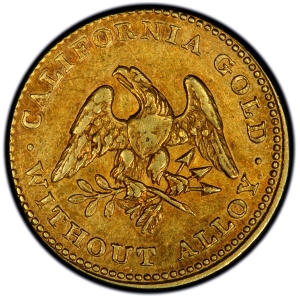
Obverse
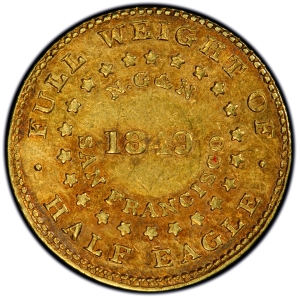
Reverse
The firm of Norris, Gregg & Norris holds the distinction of being among the very first private minters to strike coins during the chaotic, initial phase of the California Gold Rush. Arriving in 1849 amidst a primitive barter economy struggling to absorb an immense influx of gold dust, the partners recognized an immediate and desperate need for a standardized circulating medium. At the time, gold dust was the primary currency, but it was inconvenient, prone to spillage, and easily adulterated, creating friction in every transaction. The partners, associated with the Stockton Mining Company, established a rudimentary minting operation to convert raw gold into five-dollar coins. Their coinage was initially welcomed by a commerce-starved public. However, this acceptance was short-lived. It was quickly discovered that their coins were significantly debased with copper, containing only about $4 worth of gold. This revelation, combined with their crude appearance, led to public outcry and a rapid collapse in confidence. The coins were soon refused by merchants or accepted only at a steep discount, forcing the firm to cease operations within the year. The Norris, Gregg & Norris episode serves as a quintessential example of the economic instability and lack of federal oversight that defined early Gold Rush California, underscoring the urgent need that would eventually be met by the U.S. Assay Office and, later, the San Francisco Mint.
Assayer/MinterNorris, Gregg & Norris
Minter HistoryThomas Norris, H. H. Gregg, and Charles Norris were merchants and speculators who ventured to California to capitalize on the Gold Rush. Recognizing the opportunity in the monetary vacuum, they leveraged their connection with the Stockton Mining Company to quickly set up a coining press. Their operation was brief and controversial, lasting only part of 1849. Their reputation was permanently tarnished by the debased quality of their gold pieces, and they quickly faded from the numismatic and historical record after their minting enterprise failed.
Reason for MintingTo meet the urgent commercial demand for a standardized medium of exchange by converting raw gold dust into coins in the absence of federal coinage.
Historical SignificanceThe primary historical significance of the Norris, Gregg & Norris coinage lies in its status as one of California's first private gold issues. The series is a tangible artifact of the economic chaos of 1849. Its failure due to debasement was a critical early lesson for the region's economy, fueling public demand for reliable, government-sanctioned assays and coinage and highlighting the pitfalls of unregulated currency.
Geographic OriginStockton, California (though often associated with San Francisco)
The obverse design is notably crude, featuring a somewhat primitive eagle with outstretched wings, head turned left. Thirteen stars typically encircle the eagle, often unevenly spaced and struck. The design is reminiscent of the earlier Bechtler coinage from the Carolina Gold Rush, suggesting a possible stylistic influence or the use of similar die-sinking talent.
Obverse InscriptionThe typical obverse inscription is 'CALIFORNIA GOLD' arched above the eagle and the date '1849' below.
Reverse DescriptionThe reverse is simple and utilitarian. The denomination '5' and 'DOLLARS' are centrally located, often with the '5' being a large, prominent numeral. The firm's name encircles the denomination.
Reverse InscriptionThe reverse inscription is 'NORRIS GREGG & NORRIS'. A key diagnostic and variety involves the presence or absence of a period after the final 'S' in 'NORRIS'.
CompositionGold
Denomination$5
Stated FinenessNo fineness or weight is stated on the coins themselves.
Actual FinenessThe actual fineness was notoriously low and was the primary cause of the firm's failure. Contemporary assays and modern analysis show the coins were significantly debased with copper, with a gold content that was often 20% or more below their face value.
Mintage was never recorded, but it is believed a substantial quantity was produced in a very short time to meet initial demand before public confidence collapsed.
Survival EstimateThe survival rate is very low. Once their debased nature became public knowledge, the coins were actively rejected, heavily discounted, and melted down for their bullion content. The few that remained in circulation saw heavy use in a harsh frontier environment, leading to further attrition. Surviving examples are scarce in all grades.
Rarity ScaleThe series is considered scarce to rare overall. The two major varieties, K-2 (With Period) and K-3 (Without Period), are both difficult to acquire. High-grade, problem-free examples are exceptionally rare and seldom appear on the market.
This series is highly sought after for its immense historical significance as a 'first of its kind' from the California Gold Rush. Collectors are drawn to its crude charm and the compelling story of its controversial but important role in the economic development of the West.
Key VarietiesThe two primary, well-recognized varieties are: 1. K-2: 'With Period.' A period is present after the final S in NORRIS on the reverse inscription. 2. K-3: 'Without Period.' The reverse inscription lacks the final period. This variety is considered slightly scarcer than the K-2.
Kagin #K-2 to K-3
Authentication TipsAuthentication requires careful study. Genuine examples have a characteristic soft, slightly greasy luster and a somewhat crude but consistent strike style. Look for specific die markers, such as small cracks or chips that are known on authenticated specimens. The letter punches are distinctive. Counterfeits are often cast, showing surface pitting or a soapy appearance, or are struck from modern dies that fail to replicate the unique, crude character of the originals. Pay close attention to the style of the eagle and the shape of the number '5'.
Shopping ConsiderationsFor this series, 'good value' often means finding a technically lower-grade coin (e.g., VF) that has honest, even wear, original surfaces, and no significant damage like harsh cleanings, tooling, or large rim bumps. A premium quality example would be one that, regardless of grade, possesses superior eye appeal and is free of distracting marks. Given the rarity, any problem-free, original example is a major acquisition.
A coin's grade is its condition, rated on a 1-70 scale. For rare coins, this is the most critical factor in determining value, as a tiny difference in preservation can mean a huge difference in price.
Relevant Grade TypesAll Norris, Gregg & Norris coins are business strikes intended for circulation. No proofs or presentation pieces are known to exist. Due to their history, it is common to find examples that have been damaged or improperly cleaned, so third-party grading is crucial to verify authenticity and originality.
Mint State CharacteristicsUncirculated examples are exceedingly rare. A true Mint State specimen would likely exhibit a weak strike in certain areas, particularly on the eagle's head and claws, and parts of the lettering. Luster would be soft and frosty, not brilliant. Minor planchet flaws or adjustment marks from the crude manufacturing process would be common and are not necessarily considered defects.
Circulated Wear PatternsWear typically first appears on the highest points of the design. On the obverse, this includes the eagle's head, breast, and the upper parts of the wings. On the reverse, the numeral '5' and the central letters of the firm's name show the first signs of abrasion. The rims are also highly susceptible to wear and contact marks.
Key Factors for ValueThe primary drivers of value for this series are: 1) Absolute Rarity of the specific Kagin variety. 2) Grade (Condition), with sharp jumps in price for higher-grade specimens. 3) Surface Quality and Originality – an example with honest wear and original surfaces will always be worth more than a cleaned or damaged coin of the same grade. 4) Strike – well-struck examples showing more detail than usual are highly prized. 5) Provenance – a pedigree to a famous historical collection (e.g., Garrett, Eliasberg, Norweb) can add a significant premium.