Mormon Gold (Utah) Subseries
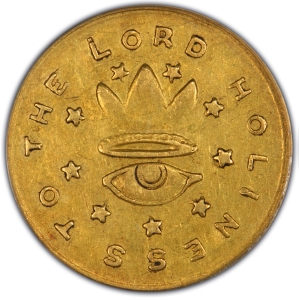
Obverse
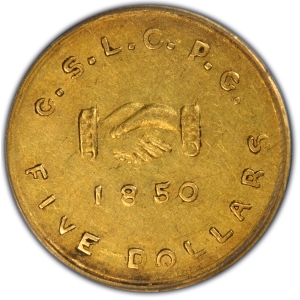
Reverse
The Mormon coinage of the State of Deseret is a direct consequence of the California Gold Rush and the unique economic isolation of the Latter-day Saints in the Salt Lake Valley. After members of the Mormon Battalion, who had served in the Mexican-American War, were discharged in California, many found work at Sutter's Mill and were present for the 1848 gold discovery. They sent and brought back significant quantities of gold dust to the fledgling settlement in Utah. This influx of raw gold, combined with a severe shortage of circulating federal currency, created a barter-based economy that was inefficient and unstable. Brigham Young, the leader of the church and territory, recognized the need for a local medium of exchange to facilitate trade and establish economic self-sufficiency. In 1848, he authorized the creation of a private mint. Using primitive, locally-fabricated equipment, coining began in 1849 under the direction of John Kay. The coins were intended to be of pure gold, but the minters lacked the necessary equipment for parting, resulting in a product of lower-than-stated fineness (as California gold is a natural alloy). This led to their being accepted only at a discount outside Utah and ultimately contributed to their widespread melting. The coinage ceased after 1850, but a final $5 issue was struck in 1860 from refined Colorado gold, bearing a different design. This series is a powerful symbol of frontier ingenuity and the quest for economic and religious autonomy in 19th-century America.
Assayer/MinterThe Church of Jesus Christ of Latter-day Saints (Brigham Young)
Minter HistoryThe Deseret Mint was an ecclesiastical operation sanctioned by Brigham Young. The key figures were John Kay, a skilled mechanic and metallurgist responsible for the dies and presses, and Alfred B. Lambson, who assisted in the minting process. The dies were engraved by Robert Campbell and John Kay. The entire operation was a community effort, reflecting the collective and theocratic nature of the early settlement. The mint was not a for-profit enterprise but a public utility designed to serve the economic needs of the 'Saints'.
Reason for MintingTo convert California gold dust into a standardized medium of exchange to alleviate a severe currency shortage in the isolated Utah Territory.
Historical SignificanceMormon gold represents one of the most distinctive and historically rich series in American numismatics. It is the only coinage in U.S. history to feature inscriptions in a non-standard script (the Deseret alphabet) and to bear explicitly theological symbols like the 'All-Seeing Eye' and the motto 'Holiness to the Lord'. The coins are tangible relics of the Mormon pioneers' struggle for survival and self-determination, bridging the history of American religion, the California Gold Rush, and the economic development of the American West.
Geographic OriginSalt Lake City, Utah Territory
The 1849-1850 issues feature the All-Seeing Eye of Jehovah surmounted by a Phrygian cap (often mistaken for a bishop's mitre), symbolizing divine oversight and liberty. The 1860 five-dollar piece features a reclining Lion of Judah with a beehive in the background, symbolizing strength (Tribe of Judah) and industry.
Obverse InscriptionThe 1849-1850 coins bear the inscription 'HOLINESS. TO. THE. LORD.' The 1860 coin is inscribed 'DESERET ASSAY OFFICE PURE GOLD' and '5 D.'
Reverse DescriptionThe common reverse design for the 1849-1850 issues features the Clasped Hands of Friendship, symbolizing unity and brotherhood among the Mormon community and their hope for peace with outsiders.
Reverse InscriptionInscriptions include 'G.S.L.C.P.G.' for 'Great Salt Lake City Pure Gold' and the denomination spelled out (e.g., 'TWO AND HALF DO.'). The 1849 ten-dollar piece uses the Deseret alphabet for 'P.G.C.' (Pure Gold, Coin).
CompositionGold
Denomination$2.50, $5, $10, $20
Stated FinenessThe coins were inscribed 'Pure Gold', reflecting the intent of the minters.
Actual FinenessThe actual fineness of the 1849-1850 issues was approximately .899 fine, as they were struck from unrefined California gold, a natural electrum containing silver. The 1860 issue was struck from properly refined gold and is of a higher purity.
Mintages for the 1849 issues are unknown but presumed to be very small. An estimated 4,072 of the 1850 $5 coins were struck. The 1860 mintage is also very small. All issues are rare.
Survival EstimateSurvival rates are extremely low across the series. The coins saw heavy, utilitarian circulation. Their lower-than-stated purity led to them being melted down when they reached assay offices on the coasts. Brigham Young also recalled the coinage, and many were turned in and recoined, further reducing the surviving population.
Rarity ScaleThe series ranges from rare to unobtainable for most collectors. The 1850 $5 (K-4) is the most 'common' issue but is still very scarce. The 1849 $10 (K-3) is extremely rare. The 1849 $20 (K-1) is a legendary rarity, with only a few examples known, most of which are impounded in institutions.
This series is prized for its immense historical importance, unique religious designs, connection to the Mormon pioneers and the Gold Rush, and extreme rarity. The distinctive 'All-Seeing Eye' and 'Clasped Hands' motifs make them visually compelling artifacts of the American West.
Key VarietiesThe primary varieties are the six distinct date and denomination combinations: K-1 ($20 1849), K-2 ($10 1849), K-3 ($5 1849), K-4 ($2.50 1849), K-5 ($5 1850), K-6 ($5 1860), and the K-7a restrike. Each is a major rarity in its own right.
Kagin #K-1 to K-7a
Authentication TipsAuthentication is critical. Look for characteristically soft strikes, especially on the central devices. The letter punches are crude and have specific diagnostic markers. The gold color of the 1849-50 issues is often a paler yellow due to the high silver content, and the specific gravity will be lower than that of pure gold. Compare against high-resolution images from major auction archives. Spurious and counterfeit examples are well known; professional authentication by PCGS or NGC is mandatory.
Shopping ConsiderationsFor this series, any example is a prize. 'Good value' means acquiring a problem-free coin with honest, original surfaces, even with significant wear. A premium quality example would be one with an unusually bold strike on the central hands and eye, minimal distracting marks, and a pleasing original color. Avoid coins that have been harshly cleaned, tooled, or repaired, as this severely impacts their value and desirability.
A coin's grade is its condition, rated on a 1-70 scale. For rare coins, this is the most critical factor in determining value, as a tiny difference in preservation can mean a huge difference in price.
Relevant Grade TypesAll original Mormon gold coins are business strikes. No proofs were ever made. Later-date restrikes of the 1860 $5 coin exist (K-7a) and should be identified as such.
Mint State CharacteristicsMint State examples are virtually non-existent for most of the series. An uncirculated specimen would be characterized by full, original mint luster, likely with a soft, frosty texture. However, even a theoretical MS-65 example would likely exhibit weakness in the center of the strike due to the primitive coining press used. Bag marks would be expected.
Circulated Wear PatternsWear first appears on the highest points of the design. For the 1849-50 issues, this is the knuckles and cuffs of the Clasped Hands on the reverse, and the brow and rays of the All-Seeing Eye on the obverse. For the 1860 issue, the high points are the lion's mane and hip. Inscriptions near the protected rim often remain clear even on heavily worn examples.
Key Factors for ValueThe primary driver of value is the specific K-number, as the rarity varies enormously between issues. The coin's numerical grade is the second factor. Beyond this, value is determined by surface quality (originality vs. cleaning), strike sharpness (a bold central strike commands a huge premium), and overall eye appeal. For the great rarities like the K-1 $20, a documented, unbroken provenance tracing back to famous collections like Garrett, Eliasberg, or Norweb is of paramount importance and can add significantly to the coin's value.