Moffat & Co. Subseries
From the Moffat & Co. (1849-1853) Series
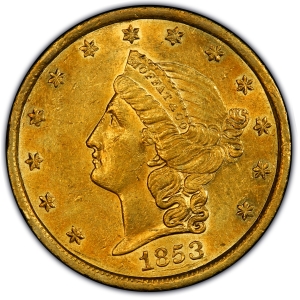
Obverse
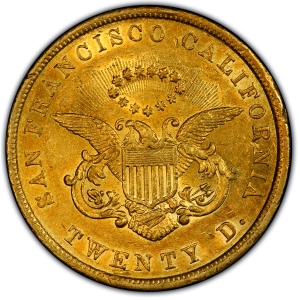
Reverse
Moffat & Co. stands as arguably the most important and respected of all private minters during the California Gold Rush. Arriving in San Francisco in 1849, John Little Moffat, a respected assayer from Georgia and North Carolina with prior experience assaying for the U.S. Mint, established a firm that quickly gained a reputation for absolute integrity. In the chaotic, currency-starved environment of early San Francisco, where gold dust was the unwieldy medium of exchange and federal coinage was virtually non-existent, Moffat's firm provided a desperately needed service. Their coins were known to contain their stated value in gold, a rarity among private issuers, which made them widely accepted and trusted in commerce. The firm's success and reliability were so profound that in 1850, the U.S. government designated Moffat & Co. as the official United States Assay Office for California. This semi-official status allowed them to strike coins, including the iconic $50 octagonal 'slugs' under the Humbert Assay Office name, effectively serving as the de facto mint for the region until the formal establishment of the San Francisco Branch Mint in 1854. The history of Moffat & Co. is a microcosm of California's transition from a lawless frontier to an integral part of the U.S. economy, bridging the gap between raw gold dust and federal coinage.
Assayer/MinterMoffat & Company
Minter HistoryJohn Little Moffat was a seasoned assayer with connections to the U.S. Mint before heading west. His partners included Joseph R. Curtis, P.H. W. Perry, and Samuel H. Ward. Unlike many fly-by-night operations, Moffat & Co. was a well-capitalized and professionally run enterprise. Their reputation for honesty was their greatest asset, leading to their selection as the U.S. Assay Contractor. After their contract ended and the San Francisco Mint opened, the firm dissolved, having fulfilled its crucial historical role. Moffat himself did not remain in California for the rest of his life, but his firm's legacy is foundational to the study of U.S. territorial gold.
Reason for MintingTo convert raw gold dust into a standardized, reliable, and convenient medium of exchange for commerce in currency-starved California.
Historical SignificanceMoffat & Co. provided the most stable and trusted currency in California before the establishment of a U.S. Mint. Their coinage facilitated commerce, stabilized the regional economy, and set a standard for integrity that few other private minters could match. Their transition into the U.S. Assay Office represents a critical step in the federal government's efforts to formalize the monetary system on the West Coast, making their issues direct predecessors to official U.S. Branch Mint coinage.
Geographic OriginSan Francisco, California
Designs vary significantly across denominations. The initial 1849 $10 features a Liberty-like head surrounded by stars. The 1849-1850 $5 coins have a similar but cruder obverse. The later, more common $10 and $20 coins from 1851-1852 feature a federal-style eagle with a shield on its breast, often with a banner in its beak.
Obverse InscriptionCommon inscriptions include 'MOFFAT & CO.' above the central design and the date below. On the U.S. Assay Office issues, the inscription changes to reflect the government's authority.
Reverse DescriptionThe reverse designs typically state the denomination. The 1849 $10 reverse is simple, with 'TEN DOL.' within a wreath. The later eagle coins have a simple reverse with the denomination spelled out, such as 'TEN D.' or 'TWENTY D.'. Some early issues feature engine turning on the reverse.
Reverse InscriptionInscriptions are primarily focused on the denomination, such as '5 DOLLARS', 'TEN DOL.', or '20 D.'. The fineness of the gold is sometimes included on later issues associated with the U.S. Assay Office.
CompositionGold
Denomination$5, $10, $16, $20, $50
Stated FinenessThe firm prided itself on honesty. Fineness was generally around .897 to .900 fine, closely matching federal standards, though early issues could vary slightly.
Actual FinenessAssay reports consistently show that Moffat & Co. coins met or slightly exceeded their stated gold content and value, a key reason for their widespread acceptance in commerce.
No precise mintage records were kept for Moffat & Co. issues. Production was driven entirely by the amount of gold dust brought in by miners for conversion. It is known that millions of dollars in face value were struck, but survival rates are a tiny fraction of the original output.
Survival EstimateThe survival rate is extremely low. Because the coins were trusted and contained full value, they circulated heavily until the opening of the San Francisco Mint in 1854. At that point, they were systematically withdrawn from circulation and melted down to be recoined into official U.S. currency, destroying the vast majority of the original population.
Rarity ScaleThe rarity ranges from R-4 (Rare) for the most common varieties of the $10 eagle issues to R-7 (Extremely Rare, 4-12 known) or higher for specific varieties and denominations. The 1849 $5 and the extremely rare 1849 $16 rectangular ingot are among the rarest and most coveted issues.
Moffat & Co. coinage is a cornerstone of any serious Territorial gold collection. Its direct connection to the U.S. Assay Office and the San Francisco Mint, combined with its reputation for integrity and importance in Gold Rush history, makes it exceptionally desirable.
Key VarietiesMajor varieties include: 1. The 1849 $5 (K-1), 2. The 1849 'TEN DOL.' $10 (K-2, K-3, K-4), 3. The 1849 $16 Rectangular Ingot (K-5, legendary rarity), 4. The 1851-52 $10 with 'MOFFAT & CO.' above the eagle (K-9 to K-12), and 5. The $20 issues which are often collected alongside their U.S. Assay Office counterparts.
Kagin #K-1 to K-22
Authentication TipsGenuine Moffat coins exhibit specific die characteristics. Look for known die cracks, repunching, or file marks from die preparation that match known genuine examples. Letter punches have a distinct style that is difficult for forgers to replicate. Many counterfeits are cast and will have a soft, porous appearance under magnification. Edges should be examined for tooling marks or seams indicative of a fake. Due to high values, certification by a top-tier grading service is essential.
Shopping ConsiderationsFor this series, 'good value' often means a problem-free, original coin even in a lower circulated grade (e.g., VF). Many surviving examples have been cleaned, damaged, or repaired. A coin with honest wear and attractive, original surfaces will command a significant premium over a higher-grade but less appealing specimen. Strike quality is paramount; a sharply struck example showing details in the eagle's feathers or Liberty's hair is far more desirable than a weakly struck coin of the same grade.
A coin's grade is its condition, rated on a 1-70 scale. For rare coins, this is the most critical factor in determining value, as a tiny difference in preservation can mean a huge difference in price.
Relevant Grade TypesAll original Moffat & Co. coins were business strikes intended for circulation. No proofs were originally made. Collectors should be aware of modern copies or fantasy pieces that are not authentic historical issues.
Mint State CharacteristicsUncirculated (Mint State) examples are exceedingly rare for most Moffat issues. A true MS coin would exhibit full mint luster, typically with a satiny texture. Strike weakness is common, especially on the high points of the designs. Contact marks from bag handling are to be expected, but large, distracting marks will diminish the grade and value.
Circulated Wear PatternsWear typically first appears on the highest points. For the eagle designs, this includes the eagle's head, the top of the shield, and the upper edges of the wings. For the Liberty-style designs, wear is first seen on the hair above the ear and on the cheek. On the reverse, the letters of the denomination and the leaves of the wreath are the first elements to show flatness.
Key Factors for ValueValue is determined by a combination of factors: 1. Rarity of the specific Kagin number. 2. The coin's certified grade (condition). 3. Surface quality and eye appeal (originality, color, lack of distracting marks or damage). 4. Strike sharpness. 5. Provenance, as a documented history of ownership in a famous collection can add immense value, especially for high-grade or extremely rare examples.