Miners' Bank Subseries
From the Miners' Bank (1849) Series
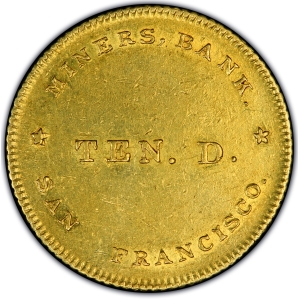
Obverse
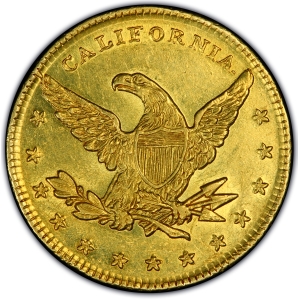
Reverse
The Miners' Bank Ten Dollar gold piece is a quintessential artifact of the chaotic, unregulated dawn of the California Gold Rush. Formed in San Francisco in early 1849 by prominent citizens Stephen A. Wright, Samuel W. Haight, and J.C.L. Wadsworth, the Miners' Bank was one of the very first private entities to attempt to solve the region's acute currency shortage. In the absence of a federal mint and with gold dust being an inconvenient and often untrustworthy medium of exchange, private coiners stepped into the breach. The bank announced its intention to strike coins in July 1849, and production began shortly thereafter. However, the enterprise was plagued by immediate controversy. The coins were crudely designed and, more importantly, quickly found to be underweight and of debased fineness, valuing significantly less than their stated ten-dollar face value. This led to widespread public distrust and rejection. Merchants began refusing them, and by September 1849, public outcry led the bank to cease coining operations and offer to redeem the pieces. Most were turned in and promptly melted, solidifying their status as one of the great rarities of the Territorial gold series. The bank itself dissolved by January 1850, a classic example of a Gold Rush-era enterprise that failed due to a combination of poor quality control and a loss of public confidence.
Assayer/MinterMiners' Bank (Stephen A. Wright, Samuel W. Haight, J.C.L. Wadsworth)
Minter HistoryThe Miners' Bank was not primarily a minting operation but a banking house established by influential early San Franciscans. Stephen A. Wright was a respected merchant, and the other partners were similarly involved in the city's burgeoning commercial scene. Their venture into coinage was a response to a clear economic need but was executed without the requisite skill or, as public opinion swiftly concluded, integrity. Their lack of assaying expertise and the decision to produce underweight coins for profit quickly destroyed their reputation and led to the bank's swift failure. Their story serves as a cautionary tale from the 'Wild West' phase of American finance.
Reason for MintingTo convert raw gold dust into a more convenient and standardized medium of exchange in the absence of a federal branch mint.
Historical SignificanceThe Miners' Bank $10 holds immense historical significance as one of the very first private gold coins struck in California. Its rapid rise and fall perfectly encapsulate the economic turmoil and desperate need for a stable currency during the Gold Rush. The public's vehement rejection of these underweight coins was a key event that led to increased demand for trustworthy assayers and, ultimately, the establishment of the U.S. Assay Office and a branch mint in San Francisco. It is a tangible link to the initial, chaotic attempts to bring monetary order to the gold fields.
Geographic OriginSan Francisco, California
The obverse design is starkly simple and utilitarian, a characteristic of the earliest California issues. It features the words 'MINERS' BANK' in a straight line across the center, with 'SAN FRANCISCO' in an arc below it. There is no date or other imagery on the obverse.
Obverse InscriptionMINERS' BANK / SAN FRANCISCO
Reverse DescriptionThe reverse features a primitive, somewhat crude depiction of an American eagle with outstretched wings, clutching an olive branch and arrows. The eagle's design is a key diagnostic point for authentication.
Reverse InscriptionTEN D.
CompositionGold
Denomination$10
Stated FinenessNo fineness is stated on the coin itself.
Actual FinenessThe actual fineness was notoriously low, often assayed at approximately .865 fine, and the coins were significantly underweight. An average piece contained only about $9.65 worth of gold, making them immediately unacceptable in commerce.
Mintage figures were never recorded and are unknown, but based on the extreme rarity of surviving examples, the total number struck was undoubtedly very small.
Survival EstimateThe survival estimate is exceptionally low, with perhaps only two dozen or so examples known across all varieties. The vast majority of the original mintage was recalled and melted within months of issue due to their debased value and the public's refusal to accept them. This immediate and widespread destruction is the primary reason for their rarity today.
Rarity ScaleAll varieties are considered extremely rare. The K-1 is the 'most common' variety, while K-2 through K-4 are of the highest rarity, with only a few examples known for each.
The Miners' Bank $10 is prized for its extreme rarity and immense historical importance as a pioneering, albeit failed, California gold issue. It represents the raw, unregulated beginnings of the Gold Rush and is a cornerstone piece for any advanced collection of U.S. Territorial gold.
Key VarietiesFour primary varieties are recognized (K-1 to K-4), differentiated by die states and punch characteristics. K-1 is known for a prominent die crack on the reverse that develops through the eagle's right wing. Later states and other varieties show differences in the positioning and style of the lettering punches used.
Kagin #K-1 to K-4
Authentication TipsAuthentication requires expert examination. Key diagnostics include the specific crude style of the eagle, the unique letter punches with their characteristic shapes and serifs, and the presence of known die markers, such as the famous reverse die crack on K-1. Counterfeits from the 19th century and modern era exist; many are cast and will show softness of detail and a porous surface texture. Die-struck fakes can be identified by comparing the letter and eagle punches to known genuine examples.
Shopping ConsiderationsFor a coin of this rarity, originality and problem-free surfaces are paramount. Most known examples are in circulated grades (VG-EF). A prospective buyer should prioritize a coin with honest wear, good eye appeal, and no significant impairments like harsh cleaning, tooling, or repairs. Given the rarity, any example without major problems is a prize. 'Good value' lies in acquiring a sound, aesthetically pleasing coin over one with a slightly higher technical grade but distracting flaws.
A coin's grade is its condition, rated on a 1-70 scale. For rare coins, this is the most critical factor in determining value, as a tiny difference in preservation can mean a huge difference in price.
Relevant Grade TypesAll original Miners' Bank coins are business strikes intended for circulation. No proofs were made. Due to their immediate rejection and melting, the vast majority of survivors saw at least some circulation.
Mint State CharacteristicsA true Mint State (uncirculated) example of a Miners' Bank $10 is a legendary rarity, with perhaps only one or two specimens qualifying. Such a coin would exhibit full mint luster, a sharp strike from early-state dies, and only minimal marks from the minting process or brief bag handling. The quality of strike was often weak, so a well-struck example commands a significant premium.
Circulated Wear PatternsWear first appears on the highest points of the design. On the reverse, this includes the eagle's head, the upper parts of the wings, and the talons. On the simple obverse, the lettering will show gradual flattening and loss of definition, starting from the center and spreading outwards.
Key Factors for ValueThe primary drivers of value for a Miners' Bank ten dollar are: 1) Absolute Rarity (all are rare, but some varieties are nearly unique), 2) Grade/Condition (the difference between an AU and an EF is substantial), 3) Surface Quality (coins free of damage, cleaning, or corrosion are highly sought), and 4) Provenance. A documented history of ownership in famous collections (e.g., Garrett, Norweb, Eliasberg) can add a massive premium to the coin's value, as it provides a guarantee of authenticity and a link to numismatic history.