Massachusetts & California Company Subseries
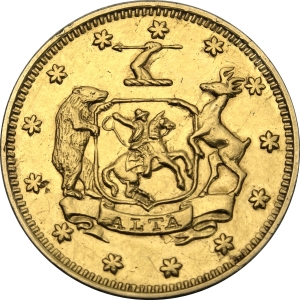
Obverse
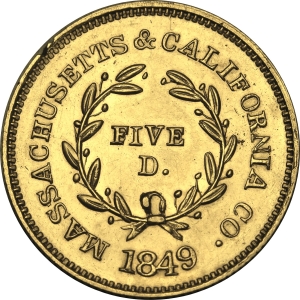
Reverse
The Massachusetts & California Company five-dollar piece represents one of the earliest and most primitive attempts to solve the acute currency shortage during the initial chaos of the 1849 California Gold Rush. Formed by a group of men from Northampton, Massachusetts, the company sailed for California aboard the *Henry Lee*, arriving with mining equipment and rudimentary coining machinery. In the gold fields, gold dust was the primary medium of exchange, but it was inconvenient, prone to spillage, and difficult to value consistently. The company saw a commercial opportunity to convert this dust into standardized coins. However, their operation was short-lived and ultimately a failure. Their coins were crudely produced from unrefined gold of low purity, making their intrinsic value significantly less than their face value. Merchants and the public quickly rejected the pieces, and the venture was likely suppressed by the military governor, Bennet Riley, as part of a broader effort to clamp down on underweight private coins that were undermining public confidence. The vast majority of their small output was melted, cementing the issue's legendary rarity.
Assayer/MinterMassachusetts & California Company
Minter HistoryThe Massachusetts & California Company was a joint-stock company typical of the era, formed by easterners seeking fortune in the West. Unlike established assayers like Moffat or Kellogg, this group consisted of enterprising adventurers with limited minting experience. Their coining operation was brief, lasting only a short period in 1849 before public rejection and official scrutiny forced them to cease production. The company itself dissolved, its members likely turning to mining or other pursuits, leaving behind only a handful of numismatic relics as evidence of their brief and ill-fated coining venture.
Reason for MintingTo convert raw gold dust into a more convenient and standardized medium of exchange for commerce in the specie-starved economy of 1849 California.
Historical SignificanceThis coinage is historically significant as one of the very first private issues of the Gold Rush. Its crude design, low-quality gold, and ultimate failure are emblematic of the chaotic, unregulated economic environment of early California. It stands as a testament to the immediate and desperate need for coinage and the trial-and-error process that eventually led to more reputable private minters and the establishment of a U.S. Branch Mint in San Francisco. Its extreme rarity makes it a direct link to the earliest days of American economic activity on the Pacific coast.
Geographic OriginSan Francisco, California
The obverse design is exceptionally crude, reflecting the primitive equipment and haste of its production. It features a simple, thin wreath or vine-like device in the center, with the company's name arranged in an arc around the periphery.
Obverse InscriptionThe typical obverse inscription is 'MASSACHUSETTS & CALIFORNIA Co'. The lettering is often irregular in its spacing and alignment.
Reverse DescriptionThe reverse is purely functional, dominated by the denomination. There are no other design elements.
Reverse InscriptionThe denomination is expressed simply as 'FIVE D.' in the center of the reverse. Some lettering punches may appear broken or crudely formed.
CompositionGold
Denomination$5
Stated FinenessNo fineness is stated on the coin.
Actual FinenessThe actual fineness was notoriously low, estimated to be around .750 to .800. This unrefined gold contained significant amounts of silver and other base metals, making its bullion value well below five dollars and leading to its rejection in commerce.
Mintage was not recorded, but based on the minuscule number of survivors, it was undoubtedly extremely small.
Survival EstimateFewer than 15 examples are believed to exist today. The near-total disappearance of the mintage is attributed to its immediate and widespread rejection by the public and subsequent melting. Its low intrinsic value meant it was worth more as bullion to be re-coined by a more reputable assayer than as a circulating coin.
Rarity ScaleConsidered a premier rarity of R-7 to R-8. Any appearance of an example at auction is a major numismatic event.
This issue holds immense appeal for advanced specialists in Territorial gold. It represents a tangible piece of the 'Wild West' aspect of the Gold Rush—a raw, failed, yet historically poignant attempt at creating money. Its legendary rarity makes it a capstone coin for a world-class collection.
Key VarietiesOnly one major type, Kagin-1, is known. Any variation among the surviving specimens is relegated to minor die states or striking idiosyncrasies rather than distinct design changes.
Kagin #K-1
Authentication TipsAuthentication is paramount. Study high-resolution photos of known genuine examples from major auction archives. Key diagnostics include the specific shapes and positions of the crude lettering punches, the unique granularity of the planchet surface, and the overall softness of the strike. Counterfeits often appear either too well-made or exhibit casting evidence (pits, bubbles) and tooling marks not consistent with the originals.
Shopping ConsiderationsAcquisition is a rare opportunity. 'Good value' is almost entirely dictated by auction results. A premium quality example would be one that, despite its crude manufacture, has a relatively bold strike for the issue, problem-free surfaces, and pleasing color. A strong, documented provenance tracing back to famous collections like Garrett, Eliasberg, or Norweb adds significant desirability and value.
A coin's grade is its condition, rated on a 1-70 scale. For rare coins, this is the most critical factor in determining value, as a tiny difference in preservation can mean a huge difference in price.
Relevant Grade TypesAll known examples are business strikes. No proofs, restrikes, or presentation pieces were made. The surviving population ranges from heavily circulated grades like VG and Fine to a few choice examples in the AU range. No Mint State specimen is known.
Mint State CharacteristicsA Mint State example is not known to exist. If one were discovered, it would be evaluated based on the strength of its strike (many are weakly impressed), any remaining mint luster, and a lack of wear or significant contact marks. Given the crude planchets, some natural imperfections would be expected.
Circulated Wear PatternsWear is first evident on the highest points of the obverse wreath and the letters of the denomination on the reverse. The fields, being broad and unprotected, are highly susceptible to contact marks and abrasions. The soft, low-purity gold alloy resulted in coins that wore down quickly and were easily damaged.
Key Factors for ValueThe primary driver of value is the coin's sheer existence and rarity. Beyond that, key factors include the technical grade (condition), surface quality (freedom from distracting marks or damage), the strength of the strike, and overall eye appeal. For a historic rarity of this caliber, a documented provenance linking the coin to significant past numismatic collections is a crucial, and highly valuable, attribute.