Kellogg & Company Subseries
From the Kellogg & Company (1854-1855) Series
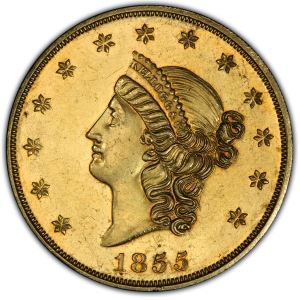
Obverse
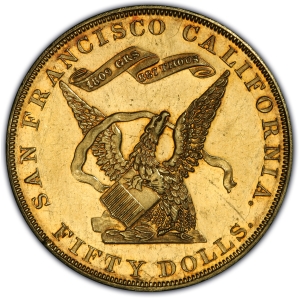
Reverse
The coinage of Kellogg & Company emerged from a crisis of confidence and commerce in Gold Rush San Francisco. When the U.S. Assay Office of Gold, the successor to Moffat & Co., ceased operations in December 1853, the city was plunged into an economic emergency. The new federal San Francisco Mint was not yet operational, and the private coiners who had previously filled the void were largely distrusted, their coins trading at a discount. This created a severe shortage of an acceptable medium of exchange, threatening to paralyze the region's economy. Into this vacuum stepped John G. Kellogg, a highly respected former assayer for both Moffat & Co. and the U.S. Assay Office. Leveraging his impeccable reputation for honesty and accuracy, he partnered with G.F. Richter to form Kellogg & Company. Beginning in February 1854, they struck twenty-dollar gold pieces that closely mimicked the federal design, an intentional choice to inspire public trust. Their coins were of full weight and fineness, often slightly exceeding the federal standard. The public's faith was immediate and absolute; Kellogg's coins were accepted without question and traded at par, effectively saving the California economy. The firm became the most prolific of all the private California coiners, striking over $6 million in gold in 1854 alone before dissolving in 1855 as the federal mint finally came into its own.
Assayer/MinterKellogg & Company
Minter HistoryJohn Glover Kellogg was a New York native who arrived in California with a strong background in assaying. His key attribute was his unimpeachable integrity, earned through his work with the highly respected firms of Moffat & Co. and its successor, the U.S. Assay Office. When the official assay office closed, leaving a monetary void, Kellogg's reputation was his primary asset. He formed Kellogg & Co. with assayer G.F. Richter and began producing $20 gold coins that were so faithful to federal standards that they immediately commanded public trust. His firm's output was immense, making it the most significant private mint in U.S. history by production value. After the firm dissolved, Kellogg partnered with Augustus Humbert to form Kellogg & Humbert, continuing his work as a leading assayer in the region.
Reason for MintingTo alleviate a severe coinage shortage and crisis of confidence in San Francisco following the closure of the U.S. Assay Office in late 1853.
Historical SignificanceKellogg & Company's coinage was not merely a convenience; it was the financial bedrock that stabilized the California economy during the critical transition period between the U.S. Assay Office and the full-scale operation of the San Francisco Mint. By producing a massive quantity of trustworthy, full-value coins, Kellogg prevented economic paralysis and maintained faith in the local money supply. The 1854 Kellogg $20 is the most common surviving territorial gold coin today, a testament to its crucial role as the workhorse currency of the later Gold Rush era.
Geographic OriginSan Francisco, California
The obverse design is a direct and intentional copy of the federal Coronet Liberty Head motif by Christian Gobrecht. It features a left-facing bust of Liberty, her hair tied in a bun, wearing a coronet inscribed 'KELLOGG & CO.'. The portrait is surrounded by thirteen six-pointed stars, with the date positioned below.
Obverse InscriptionKELLOGG & CO. on the coronet, surrounded by 13 stars, with the date (1854 or 1855) below the bust.
Reverse DescriptionThe reverse closely mimics the federal Type I Double Eagle design, featuring a heraldic eagle with a shield on its breast. The eagle clutches an olive branch and three arrows in its talons. A flowing ribbon inscribed with 'E PLURIBUS UNUM' is held in its beak and appears above its head.
Reverse InscriptionUNITED STATES OF AMERICA surrounds the upper periphery, with the denomination (TWENTY D. or FIFTY DOLLARS) below. The words SAN FRANCISCO CALIFORNIA are located above the denomination.
CompositionGold
Denomination$20, $50
Stated FinenessNo fineness is stated on the coins, but they were publicly advertised and known to be produced at or slightly above the federal standard of .900 fine.
Actual FinenessKellogg's coins are renowned for their honesty. Assays consistently show them to be between .897 and .900 fine, with an intrinsic value equal to or slightly exceeding their face value. This reliability was the key to their widespread acceptance.
Mintages were very large for a private entity. It is estimated that over 300,000 $20 pieces were struck in 1854. The 1855 $20 had a much smaller mintage, estimated at around 10,000-15,000. The 1855 $50 is an extreme rarity with perhaps 20 pieces coined.
Survival EstimateDespite the large initial mintages, the vast majority of Kellogg coins were melted down by the government once the San Francisco Mint was fully operational. However, due to the sheer number produced, the 1854 $20 remains the most common of all U.S. territorial gold issues. Most survivors saw extensive circulation, so problem-free, high-grade examples are much scarcer than the total survival numbers would suggest. The 1855 issues are significantly rarer, and the $50 is a legendary rarity, with most of the approximately 13 known examples held in museums.
Rarity ScaleThe 1854 $20 is common for the series (Kagin R-3). The 1855 $20 is very scarce (Kagin R-5). The 1855 $50 is a famous classic rarity (Kagin R-7), considered one of the 'trophy' coins in all of American numismatics.
Kellogg & Co. coinage represents the pinnacle of private minting during the California Gold Rush. The 1854 $20 is often called the 'King of Territorials' because it is the most accessible and affordable entry point into the series, allowing collectors to own a genuine, high-denomination 'Pirate Gold' coin that circulated widely in San Francisco.
Key Varieties$20 Gold (1854): The common, high-mintage issue and the quintessential type coin for the series. $20 Gold (1855): A much scarcer and more valuable date. $50 Gold (1855): An iconic and extremely rare round fifty-dollar piece, a highlight of the most advanced collections.
Kagin #K-16 to K-19a
Authentication TipsGenuine Kellogg coins have distinctive features. The letter punches used for 'KELLOGG & CO.' on the coronet are different from federal issues and should be carefully examined. On the 1854 $20, a small die flaw (the 'cracked die' variety) often appears through the date. The overall fabric should show the characteristics of a struck coin, not the porous or soft details of a cast counterfeit. The reeding on the edge should be sharp and uniform.
Shopping ConsiderationsFor the 1854 $20, value is found in acquiring a specimen with the best possible surfaces for the grade. Look for examples with minimal distracting marks, original skin, and strong eye appeal. Avoid coins that have been harshly cleaned, polished, or have significant rim damage. A coin graded XF-45 with original surfaces is often a better value and more desirable than a cleaned AU-55. Third-party certification by PCGS or NGC is essential for authenticity and liquidity.
A coin's grade is its condition, rated on a 1-70 scale. For rare coins, this is the most critical factor in determining value, as a tiny difference in preservation can mean a huge difference in price.
Relevant Grade TypesAll original Kellogg issues are business strikes intended for heavy circulation. No proofs were ever struck by the company. Some early strikes may exhibit prooflike surfaces, but these are not intentional proofs and are valued as exceptionally well-made business strikes.
Mint State CharacteristicsUncirculated examples are exceptionally rare and highly prized. A true Mint State Kellogg coin will exhibit vibrant, frosty luster. The strike can be slightly weak on the central hair details of Liberty and the eagle's feathers, which is typical for the issue. The absolute key for an MS coin is the near absence of contact marks and abrasions, as these large, heavy coins were handled roughly from the moment they were minted.
Circulated Wear PatternsWear patterns are predictable and mirror those on federal Double Eagles. Friction first appears on the highest points: Liberty's cheek, the hair above her eye and ear, and the top of the coronet. On the reverse, the eagle's head, neck, and the top edges of its wings show the first signs of wear. On heavily worn examples, the inscription 'KELLOGG & CO.' can become faint.
Key Factors for ValueFor the common 1854 $20, value is driven by grade and surface quality. An example with minimal marks and original color commands a strong premium. For the rare 1855 issues, sheer rarity is the primary driver of value. Across the series, eye appeal is paramount. A well-struck coin with pleasing, unadulterated surfaces will always be more valuable than a poorly struck or heavily marked example of the same technical grade. For the ultra-rare $50, a documented provenance tracing back to famous collections (e.g., Eliasberg, Garrett) adds immense historical significance and value.