John Parsons & Co. Subseries
From the John Parsons & Co. (1861) Series
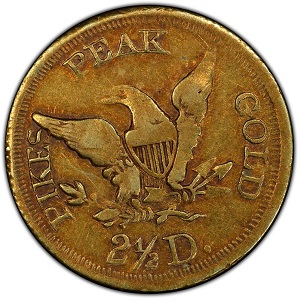
Obverse
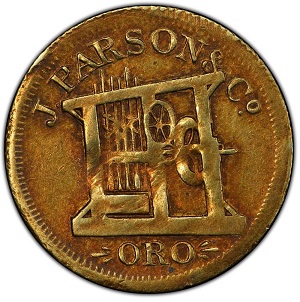
Reverse
The John Parsons & Co. coinage is a direct and ephemeral product of the Pikes Peak Gold Rush and the concurrent outbreak of the American Civil War. As prospectors flooded into the newly organized Colorado Territory, they found themselves rich in gold dust but critically short on a reliable medium of exchange. The great distance to the nearest Federal mint and the disruption caused by the Civil War made regular U.S. coinage exceptionally scarce on the frontier. Spotting a commercial opportunity, John Parsons, a jeweler and assayer, partnered with others to establish a rudimentary mint in the Tarryall mining district near Hamilton in 1861. Their operation was one of several private mints in Colorado, including the more famous Clark, Gruber & Co. However, Parsons' mint was far smaller and more primitive. Using locally sourced, unrefined gold, they produced a small quantity of $2.50 and $5 coins. These pieces were essential for local commerce but were short-lived, as their crude nature and often slightly deficient weight led to a lack of confidence. The operation ceased within the year, making their coinage an artifact of a specific, chaotic moment in American expansion and economic history.
Assayer/MinterJohn Parsons & Co.
Minter HistoryJohn Parsons was an assayer and jeweler who, along with his partners, capitalized on the acute shortage of coinage in the Colorado Territory in 1861. Their minting equipment was notoriously primitive, resulting in some of the crudest and most stylistically naive coins in the Territorial series. The venture was extremely brief, lasting only a portion of 1861 before fading into obscurity, leaving behind a legacy of immense numismatic rarity.
Reason for MintingTo convert raw gold dust into a circulating medium for commerce in the isolated Colorado Territory during the onset of the Civil War.
Historical SignificanceThe John Parsons & Co. coinage is significant as a tangible representation of frontier capitalism and necessity during the Pikes Peak Gold Rush. It exemplifies how private enterprise filled the vacuum left by the federal government, which was preoccupied with the Civil War. Its extreme rarity and crude appearance are a direct reflection of the harsh, isolated, and makeshift economic conditions of a 19th-century American mining camp.
Geographic OriginTarryall Mines (Hamilton), Colorado Territory
The obverse designs are famously primitive. The $2.50 (K-1) features a mining stamp mill, a direct symbol of the gold extraction process. The $5 (K-2) displays a crudely rendered eagle. Both are surrounded by the inscription 'PIKES PEAK GOLD' and the denomination.
Obverse InscriptionTypically 'PIKES PEAK GOLD' arched above the central device, with the denomination '2 1/2 D.' or 'FIVE D.' below.
Reverse DescriptionThe reverse is simple and uniform across both denominations. It features the company's name arranged peripherally with the Spanish word for gold, 'ORO', in the center.
Reverse InscriptionThe full inscription is 'JOHN PARSONS & Co' around the rim with 'ORO' centered.
CompositionGold
Denomination$2.50, $5
Stated FinenessNo fineness is stated on the coins. They were struck from largely unrefined placer gold.
Actual FinenessThe actual fineness was inconsistent, reflecting the native purity of the local gold. The coins were known to be slightly underweight and of lower fineness than their face value would imply, which contributed to their short circulation life.
Mintage figures were never recorded, but based on the minuscule number of survivors, production was exceptionally small, likely numbering only in the very low hundreds for each denomination.
Survival EstimateExtremely low, with perhaps fewer than 15-20 examples known for each denomination. The coins were heavily used, distrusted for their low weight, and rapidly withdrawn from circulation to be melted down once more reliable coinage (like that of Clark, Gruber & Co. or Federal issues) became available.
Rarity ScaleAll John Parsons & Co. issues are considered great rarities, typically classified as R-6 (Very Rare) to R-7 (Extremely Rare). They are among the most difficult of all U.S. Territorial gold coins to acquire.
This series is sought by the most advanced collectors of Territorial gold due to its extreme rarity, its direct link to the 'Wild West' mystique of the Pikes Peak Gold Rush, and its charmingly crude and historic design.
Key VarietiesThe series consists of only two major varieties: the K-1 $2.50 with a stamp mill obverse and the K-2 $5 with an eagle obverse.
Kagin #K-1 to K-2
Authentication TipsAuthentication is paramount and requires expert examination. Key diagnostics include the uniquely crude style of the lettering and devices, which are difficult to replicate. Genuine examples have a characteristic soft, uneven strike on irregular, handmade planchets. The surfaces often show file marks or other adjustment evidence from the primitive minting process. Most forgeries are either cast (showing softness and pitting) or are struck from modern dies that impart a sharper, more uniform look inconsistent with originals.
Shopping ConsiderationsAcquisition of any genuine John Parsons coin is a major numismatic event. Given their rarity, collectors must prioritize authenticity and a problem-free planchet over a high numerical grade, as most survivors are heavily worn (typically grading VF or below). A 'premium quality' piece is one with a bold strike for the issue (many are weakly struck), minimal distracting marks, and pleasant overall eye appeal. A strong, documented provenance is highly desirable and adds significant value.
A coin's grade is its condition, rated on a 1-70 scale. For rare coins, this is the most critical factor in determining value, as a tiny difference in preservation can mean a huge difference in price.
Relevant Grade TypesAll were produced as business strikes intended for general circulation. No proofs, special strikings, or presentation pieces are known or believed to exist.
Mint State CharacteristicsA true Mint State specimen is a numismatic unicorn, with none currently traced. If one were to surface, it would still exhibit manufacturing characteristics that would be considered impairments on other coins, such as a weak and uneven strike, planchet flaws, and possible adjustment marks. Luster would likely be soft and irregular rather than brilliant.
Circulated Wear PatternsOn the $2.50, wear first appears on the highest points of the stamp mill. On the $5, the eagle's head and the high points of the wings show the first signs of friction. The crudely punched peripheral lettering is also prone to rapid wear.
Key Factors for ValueThe value of a John Parsons & Co. coin is determined first by its authenticity. Beyond that, the key factors are rarity (both denominations are extremely rare), grade (even a small step up from VF to EF can mean a dramatic price increase), and surface quality. A coin free of significant damage, with a better-than-average strike and attractive eye appeal, will command a massive premium. For coins of this caliber, a well-documented provenance tracing back to famous historical collections is a critical component of its value and desirability.