J.S. Ormsby Subseries
From the J.S. Ormsby (1849) Series
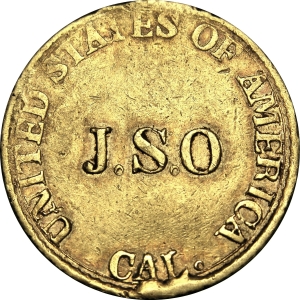
Obverse
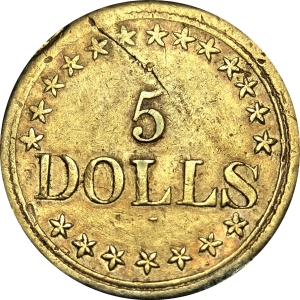
Reverse
The J.S. Ormsby coinage represents one of the earliest and most fascinating failures of the California Gold Rush private minting era. In the chaotic, monetary vacuum of 1849 Sacramento, before the establishment of a U.S. Branch Mint, gold dust was the primary medium of exchange. This was inconvenient and prone to waste and fraud, creating immense demand for standardized coins. Major John S. Ormsby, a recent immigrant to California, partnered with other speculators to establish a rudimentary mint. Their operation was ill-equipped and their understanding of metallurgy and public trust was poor. They produced a small number of $5 and $10 gold coins from unrefined placer gold, resulting in a product that was underweight, low in fineness, and crudely executed. The public, already wary of private issues after the failure of the similar Pacific Company coins, immediately rejected the Ormsby pieces. Merchants refused to accept them at face value, and the enterprise collapsed almost as soon as it began. The vast majority of their output was quickly melted, cementing the series's legendary rarity and making it a powerful artifact of the trial-and-error nature of frontier economics during the Gold Rush.
Assayer/MinterJohn S. Ormsby & Company
Minter HistoryJohn S. 'Major' Ormsby was an adventurer and entrepreneur who, like countless others, sought his fortune in California in 1849. Recognizing the critical need for coinage, he formed a partnership to establish a private mint. However, the enterprise was plagued by a lack of proper equipment and expertise. Using crude dies and unrefined gold, the resulting coins were of such poor quality and low intrinsic value that they were immediately refused by the public. The business was a swift and total failure. Ormsby himself moved on to other ventures and later became a prominent figure in the early history of Nevada, where Ormsby County was named in his honor before his death at the Battle of Pyramid Lake in 1860.
Reason for MintingTo convert raw gold dust into a more convenient, standardized coinage for commerce in the burgeoning gold fields of Sacramento.
Historical SignificanceThe Ormsby coinage is historically significant precisely because of its failure. It serves as an archetypal example of the most primitive 'pioneer' issues and a stark lesson in early American economics: without public trust in its stated value and intrinsic worth, a currency cannot function. Its immediate rejection and subsequent melting are the direct cause of its extreme rarity today. Surviving examples are among the most coveted relics of the '49er period, offering a tangible link to the desperate, unregulated, and often-unsuccessful attempts to create order out of monetary chaos on the American frontier.
Geographic OriginSacramento, California
The obverse design is notoriously crude and simple. The coins are typically struck on irregular, hand-cut planchets. The central design element is the assayer's mark 'J.S.O.' stamped incuse within a plain circle.
Obverse InscriptionThe typical obverse inscription, surrounding the central mark, is 'UNITED STATES OF AMERICA' and the denomination spelled out, such as '5 DOLLS.' or '10 DOLLS.' The lettering is often weakly struck, unevenly spaced, and crude.
Reverse DescriptionThe reverse of all known J.S. Ormsby coins is blank and unstruck (uniface).
Reverse InscriptionNone.
CompositionGold
Denomination$5, $10
Stated FinenessNo fineness is stated on the coins.
Actual FinenessThe actual fineness is known to be very low for a gold coin, as Ormsby used unrefined placer gold containing a high percentage of silver and other base metals. This low intrinsic value was the primary reason for their public rejection.
Mintage figures were never recorded and are completely unknown, but based on the immediate failure of the company, the output was certainly minuscule.
Survival EstimateThe survival estimate is exceptionally low, with fewer than a dozen specimens known in total for both the $5 and $10 denominations combined. The coins were almost universally melted down within days of their issuance due to being rejected by the public, resulting in one of the lowest survival rates of any U.S. Territorial issue.
Rarity ScaleLegendary Rarity. Both the $5 (K-12) and $10 (K-12a) are considered among the greatest rarities in the entire field of U.S. numismatics. Any appearance at auction is a major event.
The appeal lies in their extreme rarity, their raw and primitive appearance which screams 'Gold Rush,' and their compelling story of immediate failure. Owning an Ormsby coin is owning a key piece of California's chaotic monetary birth.
Key VarietiesThere are two fundamental varieties which are distinct issues: - $5 DOLLS. (K-12) - $10 DOLLS. (K-12a) Both are of the highest rarity, with the $10 being slightly rarer than the $5.
Kagin #K-12 to K-12a
Authentication TipsAuthentication is paramount. Key diagnostics include the unique, crude style of the hand-punched lettering and the 'J.S.O.' mark. Planchets should be irregular, often thin, and show evidence of being hand-cut or clipped. The specific gravity will be lower than that of federal gold coins due to the low fineness. Due to their high value and crude nature, they are a target for forgers, and authentication by a leading expert or top-tier grading service is non-negotiable.
Shopping ConsiderationsAcquiring a J.S. Ormsby coin is a once-in-a-generation opportunity for most collectors. 'Good value' is almost entirely divorced from the coin's technical grade. The primary consideration is authenticity, followed by provenance. A specimen with a long and well-documented pedigree (e.g., ex: Garrett, Norweb) commands a significant premium. Buyers should focus on securing a genuine, problem-free (or minimally impaired) example, as even a damaged but authentic Ormsby coin is a world-class numismatic treasure.
A coin's grade is its condition, rated on a 1-70 scale. For rare coins, this is the most critical factor in determining value, as a tiny difference in preservation can mean a huge difference in price.
Relevant Grade TypesOnly business strikes were ever produced. No proofs, restrikes, or presentation pieces are known or were ever contemplated. All known survivors are in circulated and often impaired grades.
Mint State CharacteristicsThis is a purely hypothetical category, as no Mint State examples are known to exist. A theoretical MS specimen would still exhibit a very crude strike, an irregular planchet, and probably adjustment marks, with its 'uncirculated' status defined by the presence of original mint luster.
Circulated Wear PatternsDue to the soft, low-purity gold and the flatness of the design, wear is rapid and affects the entire surface. The highest points of the crude lettering of the inscriptions would show wear first, followed by the edges of the incuse 'J.S.O.' stamp.
Key Factors for ValueFor a legendary rarity like an Ormsby coin, the value hierarchy is: 1) Unquestionable authenticity. 2) A documented, prestigious provenance. 3) The severity of any impairments (scratches, bends, edge damage). 4) The technical circulated grade (e.g., Fair-2 vs. Good-4). Eye appeal, while always a factor, is judged on a curve, with collectors forgiving many flaws that would be unacceptable on a more common coin.