J.H. Bowie Subseries
From the J.H. Bowie (1849) Series
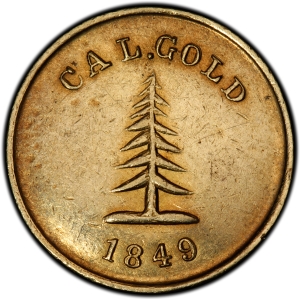
Obverse
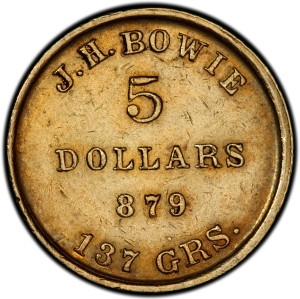
Reverse
The J.H. Bowie & Co. $5 piece is one of the most enigmatic and legendary issues of the entire Territorial gold series. Struck in the chaotic, earliest days of the California Gold Rush, it represents a primitive and ultimately unsuccessful attempt to address the critical lack of a circulating medium in San Francisco. In 1849, the city was flooded with miners and gold dust but had almost no official coinage. Commerce was conducted with pinches of dust, nuggets, and a motley assortment of foreign coins, creating a desperate need for a standardized form of money. J.H. Bowie, a local jeweler and watchmaker, attempted to fill this void. His coinage, likely produced with simple hand punches and a screw press, was exceedingly crude even for the era. The venture was incredibly short-lived, and it is widely believed that the coins were never produced in quantity for circulation, but rather served as pattern or trial pieces to test the feasibility of a private mint. Its existence is a direct reflection of the entrepreneurial, unregulated, and frantic economic environment that defined pre-statehood California.
Assayer/MinterJoseph H. Bowie
Minter HistoryJoseph H. Bowie was a jeweler, watchmaker, and gunsmith who operated a shop on Clay Street in San Francisco during the Gold Rush. Like other craftsmen with metallurgical skills, he saw a business opportunity in converting raw gold into coin. His operation was extremely small-scale and brief, likely ceasing before the end of 1849 as more professional and better-capitalized private mints like Moffat & Co. began to dominate the market. Little else is known about Bowie, and his numismatic legacy is confined entirely to this single, extraordinarily rare issue.
Reason for MintingTo create a standardized medium of exchange from raw gold dust during the initial monetary crisis of the California Gold Rush.
Historical SignificanceThe Bowie $5 is historically significant as one of the very first, if not the first, private gold coins struck in San Francisco. It serves as a tangible artifact of the most primitive phase of the Gold Rush economy, before any form of regulation or established minting practice had taken hold. As a 'prototype' territorial coin, its crude manufacture and near-mythical rarity provide a unique window into the ad-hoc solutions devised to solve the region's monetary problems.
Geographic OriginSan Francisco, California
The obverse design is exceptionally simple and crude, reflecting its hasty and primitive manufacture. The central device is a small screw press. The legend and date are individually hand-punched around the periphery.
Obverse InscriptionThe inscription reads 'J.H. BOWIE' in an arc above the central device and '1849' in a straight line below it. The letters are uneven in their placement and depth, characteristic of hand-punching.
Reverse DescriptionThe reverse is entirely blank and flat, making the coin a uniface issue.
Reverse InscriptionNone (Uniface).
CompositionGold
Denomination$5
Stated FinenessNo fineness or weight is stated on the coin.
Actual FinenessThe actual fineness of the known specimens has not been definitively published, but like many of the earliest 1849 issues, it was likely of a lower purity than federal standards, produced directly from unrefined native gold.
Mintage is unknown but presumed to be minuscule; it is considered a trial or pattern piece. Fewer than five were likely ever struck.
Survival EstimateOnly two examples are confirmed to exist. One is in the National Numismatic Collection at the Smithsonian Institution (ex-Garrett Collection), and the other was in the Pogue Collection (ex-Eliasberg Collection). Survival is virtually zero due to the presumed tiny mintage and the high probability that any others were melted.
Rarity ScaleR-8. This is considered one of the foremost rarities in American numismatics, often mentioned in the same tier as the 1804 Dollar or 1913 Liberty Nickel.
The J.H. Bowie $5 is a 'trophy coin' of the highest order, appealing to the most advanced collectors of American historical artifacts and numismatics. Its allure comes from its legendary rarity, its direct connection to the birth of Gold Rush San Francisco, and its uniquely primitive design.
Key VarietiesOnly one variety is known (Kagin-1). No other denominations or major design variations were ever produced.
Kagin #K-1
Authentication TipsAuthentication is paramount and relies on comparison with the two known specimens. Key diagnostics include the exact shape, style, and position of the individual letter and number punches, the specific die characteristics of the screw press punch, and the planchet's fabric and composition. Forgeries would likely fail to replicate the precise 'signature' of Bowie's crude tooling. Any potential example would require examination by the world's leading experts on Territorial gold.
Shopping ConsiderationsThis coin is essentially uncollectible. Should the single privately-held specimen ever come to market, it would be an internationally significant auction event, with a price in the millions of dollars. 'Value' would be determined by its story and its place in numismatic history. Any buyer would demand an ironclad, unbroken provenance tracing back through the most famous collections in American history (Eliasberg, Pogue).
A coin's grade is its condition, rated on a 1-70 scale. For rare coins, this is the most critical factor in determining value, as a tiny difference in preservation can mean a huge difference in price.
Relevant Grade TypesAll examples are considered business strikes, though given their likely function as patterns, this is a loose definition. The concept of 'Proof' is not applicable. Both known specimens are in circulated grades.
Mint State CharacteristicsNo Mint State (uncirculated) example is known to exist. A theoretical MS example would be judged on the originality of the planchet's surface and the sharpness of the hand-stamped impressions, not on traditional concepts of mint luster or strike from coining dies.
Circulated Wear PatternsWear is first apparent on the highest points of the screw press device and the lettering. The uniface reverse is highly susceptible to contact marks, scratches, and dings from any handling or time in circulation.
Key Factors for ValueFor a coin of this extreme rarity, authenticity and provenance are the absolute primary drivers of value. The coin's mere existence dictates its multi-million dollar status. Minor differences in grade between the known specimens would influence the price, but the primary factor remains its status as one of only two examples of a legendary Territorial issue. An unbroken chain of ownership is not just a value-add; it is an essential requirement.