Hawaii Regular Issues Subseries
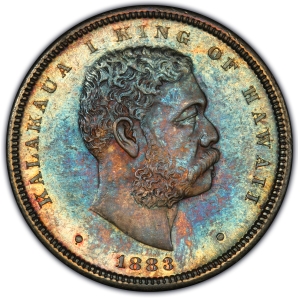
Obverse
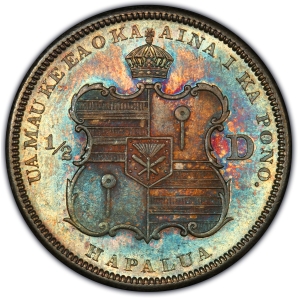
Reverse
The coinage of the Kingdom of Hawaii represents two distinct chapters in the nation's struggle for sovereignty and modernization. The first issue, the 1847 Keneta or Cent, was authorized by King Kamehameha III to address a chaotic commercial environment dominated by barter and a mix of foreign coins. Struck privately in New England, the copper cents were of poor quality, featuring a crude portrait of the king, and were immediately rejected by the merchants and populace of Hawaii, dooming the effort. They quickly faded from circulation, becoming curiosities rather than a functioning currency. Decades later, King Kalākaua, the 'Merrie Monarch,' embarked on an ambitious program to bolster Hawaii's national identity on the world stage. A cornerstone of this effort was the creation of a prestigious national silver coinage. Tied to the economic prosperity following the Reciprocity Treaty of 1875 with the United States, Kalākaua's government in 1883 contracted the U.S. Mint to produce a full suite of silver coins from the dime to the dollar. Designed by chief engraver Charles E. Barber, these coins featured a noble portrait of Kalākaua and the intricate Hawaiian coat of arms. They were struck to the same standards as U.S. silver coinage and successfully entered circulation, becoming a great source of national pride. However, their existence was a point of contention with the growing pro-American business faction (the 'Missionary Party'), who favored annexation and the adoption of U.S. currency. After the overthrow of the monarchy in 1893 and subsequent U.S. annexation, the beautiful Hawaiian silver was systematically withdrawn and melted, cementing its status as a poignant and tangible relic of Hawaii's lost independence.
Assayer/Minter1847 Cent: Edward Hulseman (private die-sinker); 1883 Silver Series: United States Mint, San Francisco (under contract)
Minter HistoryThe 1847 Cent was produced by Edward Hulseman, a private die-sinker in the eastern United States, whose work was of inconsistent quality. In stark contrast, the 1883 silver series was a formal government project. The Kingdom of Hawaii commissioned the United States Mint for the production, with the dies being expertly engraved by the renowned Charles E. Barber. This official arrangement ensured the coins were of the highest quality, matching the specifications of contemporary U.S. silver dollars, half dollars, quarters, and dimes.
Reason for MintingTo standardize local commerce, supplant foreign currency, and serve as a tangible symbol of national identity and independence.
Historical SignificanceThe Hawaiian coinage is one of the most historically significant and popular U.S.-related series. The coins are not mere tokens but are official issues of a sovereign nation that was later absorbed by the United States. They serve as powerful symbols of the monarchy, Hawaiian national pride, and the political tensions between native Hawaiians and American business interests that ultimately led to the kingdom's overthrow. Collecting these coins is to hold a direct link to the final years of Hawaiian independence.
Geographic OriginHonolulu, Hawaii (authorization); Philadelphia/San Francisco, USA (minting)
The 1847 Cent features a left-facing portrait of a youthful King Kamehameha III. The 1883 silver series features a dignified, right-facing portrait of King Kalākaua I, engraved by Charles E. Barber and stylistically similar to his work on U.S. coinage.
Obverse Inscription1847 Cent: 'KAMEHAMEHA III. KA MOI.' (Kamehameha III, The King). 1883 Silver Series: 'KALAKAUA I KING OF HAWAII' along with the date, 1883.
Reverse DescriptionThe 1847 Cent reverse displays a simple wreath. The 1883 silver series features the highly detailed and complex Royal Coat of Arms of the Kingdom of Hawaii, including the motto on a ribbon below.
Reverse InscriptionThe 1847 Cent's wreath encircles the denomination 'HAPA HANERI' (One Hundredth), with 'AUPUNI HAWAII' (Kingdom of Hawaii) above. The 1883 silver reverses state the denomination in both Hawaiian and English (e.g., 'HAPALUA' and 'HALF DOL.') above the coat of arms, and the national motto 'UA MAU KE EA O KA AINA I KA PONO' (The life of the land is perpetuated in righteousness) below.
Composition1847: Copper. 1883: 90% Silver, 10% Copper.
DenominationCent, Dime, Quarter Dollar, Half Dollar, Dollar
Stated Fineness1847 Cent: Not applicable (Copper). 1883 Silver Series: .900 Fine, identical to U.S. standards.
Actual FinenessThe copper used for the 1847 Cent was of inconsistent quality. The 1883 silver coinage was produced by the U.S. Mint to its exacting .900 fineness standard.
1847 Cent: 100,000. 1883 Silver: Dime - 250,000; Quarter - 500,000; Half Dollar - 700,000; Dollar - 500,000.
Survival EstimateSurvival of the 1847 Cent is very low in high grades; most were rejected, damaged, or lost to the harsh island environment. Survival of the 1883 silver is much higher, as many were saved as mementos of the Kingdom following the overthrow of the monarchy. However, a vast quantity was officially withdrawn and melted by the U.S. Treasury after 1900, significantly reducing the total population. Choice uncirculated examples are far scarcer than the mintage figures suggest.
Rarity ScaleThe 1847 Cent is scarce, and extremely rare in problem-free condition. The 1883 silver coins are generally available in circulated grades (R-1 to R-2 on the Sheldon scale), but become scarce in AU, rare in choice Mint State (R-4 to R-5), and the Dollar is a major rarity in Gem (MS-65 or better) condition.
This series holds immense appeal due to its powerful historical narrative, beautiful and unique designs (especially the Kalākaua portrait and Hawaiian coat of arms), and its status as the only official royal coinage typically collected as part of the U.S. numismatic catalog.
Key VarietiesThe main distinction is between the 1847 Cent and the 1883 silver series (Dime, Quarter, Half, Dollar). Within the 1883 issues, there are no major, widely collected varieties. However, specialists note two slightly different reverse hubs for the 1883 Quarter, identifiable by small details in the central shield of the coat of arms.
Reference #Not applicable; these are official government issues, not private territorial gold. They are typically cataloged under world coin references like KM (Krause-Mishler).
Authentication TipsFor the 1847 Cent, originals often show die rust and specific die cracks not present on common cast counterfeits. For the 1883 silver series, authenticity is confirmed by the sharp, correct Barber-style details of the portrait and lettering, proper weight, and reeded edge. The fine details of the coat of arms on the reverse are a critical diagnostic point, as they are often weakly rendered on fakes.
Shopping ConsiderationsFor the 1847 Cent, 'good value' means securing a problem-free example with minimal corrosion, as this is a major issue for the type. For the 1883 silver, look beyond the grade for coins with strong strikes, especially on the reverse coat of arms. Original, attractive surfaces are paramount. Examples with pleasing, natural toning command significant premiums, as do those with minimal contact marks on King Kalākaua's cheek.
A coin's grade is its condition, rated on a 1-70 scale. For rare coins, this is the most critical factor in determining value, as a tiny difference in preservation can mean a huge difference in price.
Relevant Grade TypesAll Hawaiian issues were business strikes intended for circulation. No true proof examples were officially struck. However, a very small number of the 1883 silver coins were produced as carefully struck 'Specimen' pieces or are highly prooflike, representing early strikes from fresh dies; these are extremely rare and valuable.
Mint State CharacteristicsIn uncirculated grades, quality is determined by the brilliance of the mint luster, the sharpness of the strike, and the absence of distracting contact marks. The high points of Kalākaua's portrait (hair and cheek) and the central shield on the reverse are the areas most susceptible to abrasions. A full strike that renders all the fine details of the coat of arms is rare and desirable.
Circulated Wear PatternsOn the 1847 Cent, wear first appears on King Kamehameha III's cheekbone and hair, and on the highest leaves of the reverse wreath. For the 1883 silver series, the first signs of friction appear on the high points of King Kalākaua's hair and cheek. On the reverse, wear is first evident on the central shield within the coat of arms and the mantling above it.
Key Factors for ValueValue is determined primarily by rarity, denomination, and certified grade. However, for coins of the same grade, eye appeal is a massive factor. This includes strong strike, clean surfaces free of distracting marks or cleaning, and attractive original toning. For truly exceptional examples, a documented provenance tracing back to the Hawaiian monarchy or prominent historical figures adds an immense premium and is a critical component of its numismatic value.