Hawaii Pattern Coins Subseries
From the Hawaii Pattern Coins Series
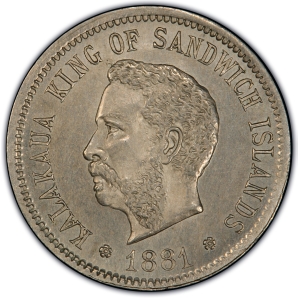
Obverse
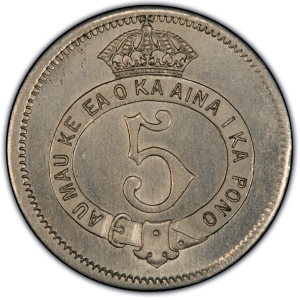
Reverse
In the 1840s, the Kingdom of Hawaii under King Kamehameha III was undergoing a period of intense modernization, grappling with the challenge of asserting its sovereignty amidst growing influence from American and European powers. The Hawaiian economy was chaotic, relying on a motley assortment of foreign coins—U.S. dollars, Spanish reales, British shillings, and French francs—which complicated commerce and fiscal policy. To establish monetary independence and simplify trade, Minister of Finance Gerrit P. Judd spearheaded an initiative to create a national coinage. In 1847, a contract was likely made with the American die-sinker Edward Hulseman to produce pattern coins for a one-cent denomination, called a 'Keneta' in Hawaiian. These trials, struck in various metals including copper, silver, and white metal, represented a tangible step toward a national currency. However, the project was never fully realized. The cost of minting and shipping large quantities of coins to the remote islands proved prohibitive, and the powerful influence of American merchants and their preference for U.S. currency ultimately scuttled the plan. The Hawaiian government would not successfully issue its own circulating coinage until 1883 under King Kalākaua. These 1847 patterns remain as physical evidence of Hawaii's first ambitious, though ultimately unsuccessful, attempt to forge a key symbol of national identity and economic autonomy.
Assayer/MinterEdward Hulseman (attributed)
Minter HistoryEdward Hulseman was a New York and later Connecticut-based die-sinker active in the mid-19th century. While documentation is not definitive, he is widely credited with the engraving and striking of the 1847 Hawaiian patterns. He produced various medals and tokens of the era, and the style of the Kamehameha III portrait is consistent with his known work. The patterns were struck at a private mint in the United States, most likely in Connecticut, rather than in Hawaii itself.
Reason for MintingTo create a standardized national currency for the Kingdom of Hawaii and reduce its reliance on a chaotic mix of foreign coins.
Historical SignificanceThe 1847 patterns are of immense historical importance as the first proposed coinage for the Kingdom of Hawaii. They are a powerful numismatic symbol of the Kingdom's struggle for sovereignty and its efforts to build a modern nation-state. Their failure underscores the powerful economic and political headwinds Hawaii faced from foreign interests, a precursor to the challenges that would ultimately lead to the overthrow of the monarchy decades later.
Geographic OriginKingdom of Hawaii (proposed), minted in United States (likely Connecticut)
The obverse across all varieties features a left-facing bust of a bareheaded King Kamehameha III. The portrait is executed in a classical style, and the overall design is simple and direct.
Obverse InscriptionThe typical obverse inscription is 'KAMEHAMEHA III. KA MOI.', which translates to 'Kamehameha III, The King'.
Reverse DescriptionThere are two primary reverse designs. The most common features a simple wreath enclosing the denomination 'HAPA HANERI' (One Hundredth). A rarer variety displays the full Royal Coat of Arms of the Kingdom of Hawaii. Extremely rare trial pieces with a plain reverse also exist.
Reverse InscriptionThe reverse inscription is typically 'AUPUNI HAWAII' (Kingdom of Hawaii) encircling the central design elements. The denomination is expressed as 'HAPA HANERI' and sometimes with the word 'KENETA' below the wreath.
CompositionStruck in multiple metals as trial pieces: Copper, Silver, Brass, White Metal, and Bronzed Copper.
DenominationKeneta (Cent)
Stated FinenessNot applicable, as these were pattern coins struck in various base and precious metals to test the designs.
Actual FinenessVaries by the metallic composition of the specific pattern; silver examples are presumed to be of high purity.
Mintages were not recorded and were exceptionally small, consistent with their production as patterns or trial strikes. It is likely that only a few dozen of the most 'common' types were made, with the silver strikings limited to just a handful of specimens.
Survival EstimateSurvival rates are extremely low, but this is a direct result of the tiny initial mintage, not post-production attrition. As they never circulated, loss from wear and melting was not a factor. Virtually all pieces that exist today were originally saved by collectors or officials associated with the project.
Rarity ScaleAll varieties are rare to extremely rare. The silver strikings are legendary rarities, with fewer than five believed to exist. The copper and white metal varieties are also very rare, with population reports showing only a dozen or so known for the main types. Every specimen is considered a major numismatic prize.
The 1847 patterns are among the most coveted items in all of U.S.-related numismatics. Their appeal lies in their extreme rarity, their status as Hawaii's first proposed coin, and their direct link to King Kamehameha III and the history of the sovereign Kingdom of Hawaii.
Key VarietiesKey varieties are distinguished primarily by metal composition: Silver (highest rarity), Copper, and White Metal. Further distinction is made by the reverse design: the Coat of Arms reverse is much rarer than the Wreath reverse. Specialists also recognize minor die variations.
Reference #Not applicable; typically referenced by Medcalf & Russell (2TC) or Judd (J-XC) numbers.
Authentication TipsExpert authentication is essential. Genuine pieces exhibit sharp, high-pressure striking details, particularly in the hair of the portrait and the fine lines of the coat of arms. The lettering punches have a distinct style that can be compared to known genuine examples. Be wary of cast copies, which will have a soft, porous appearance, and electrotypes, which may have a seam on the edge or an incorrect 'ring' when tapped. Weight and specific gravity tests can also help detect forgeries made of incorrect metals.
Shopping ConsiderationsFor this series, 'value' is intrinsically tied to rarity and originality. A problem-free example with original surfaces, even in a lower grade, is far more desirable than a higher-grade coin that has been cleaned, repaired, or damaged. A coin's provenance is of paramount importance; specimens previously held in famous collections such as Garrett, Eliasberg, or Brand command significant premiums, as the pedigree provides an extra layer of security and historical significance.
A coin's grade is its condition, rated on a 1-70 scale. For rare coins, this is the most critical factor in determining value, as a tiny difference in preservation can mean a huge difference in price.
Relevant Grade TypesAll examples are classified as patterns or trial strikes. Major grading services often use the 'SP' (Specimen) or 'P' (Pattern) designator to highlight their special production status. No business strikes for circulation were ever produced, and no proofs in the modern sense were made.
Mint State CharacteristicsUncirculated specimens are exceedingly rare. A high-quality example will show a sharp strike and either matte-like or semi-prooflike luster depending on the planchet preparation and striking pressure. As trial pieces, they may exhibit minor planchet or striking flaws (such as small striations or fissures) that are considered part of their character and are generally accepted by specialists.
Circulated Wear PatternsWhile never intended for circulation, most known examples have experienced some degree of handling over the past 170+ years, resulting in light friction or 'cabinet rub'. Wear first appears on the highest points: Kamehameha's cheekbone, ear, and the hair above his ear. On the reverse, the high points of the wreath or the central shield of the coat of arms would show wear first. Any coin with more than a slight amount of friction is highly unusual.
Key Factors for ValueThe single most important factor for value is the metal composition, with Silver being the pinnacle. The specific variety (Coat of Arms vs. Wreath) is the next key determinant. After rarity, the coin's grade and surface quality are critical. Finally, a documented and distinguished provenance is a massive value multiplier, providing both a historical narrative and a strong assurance of authenticity.