Hawaii Medals Subseries
From the Hawaii Medals (1891-1893) Series
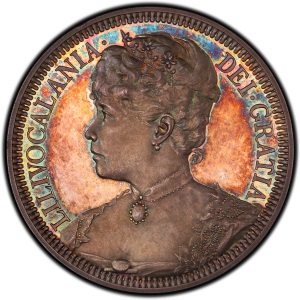
Obverse
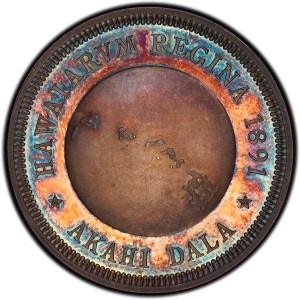
Reverse
The Hawaiian medals of 1891-1893 are not currency, but critical political artifacts from the tumultuous final years of the Hawaiian Kingdom under Queen Liliʻuokalani. This period was marked by intense struggle between the native monarchy, striving to restore power stripped by the 1887 'Bayonet Constitution,' and the powerful pro-American business and planter class who favored annexation by the United States. The K-1 medal, for the Hawaiian Agricultural Society (1891), appears innocuous but represented the established, largely foreign, business interests. The true political drama lies with the K-2 and K-3 'Liberal' medals of 1893. These were commissioned by the Hui Kalaiʻāina, a native Hawaiian political group, to honor the 37 legislators who supported the Queen's proposed new constitution. This constitution was a bold attempt to restore voting rights to native Hawaiians and strengthen the monarchy. However, the plan was the final catalyst for the pro-annexation 'Committee of Safety,' which, with the support of U.S. Marines, overthrew the monarchy in January 1893. This event occurred before the K-2 and K-3 medals could be formally presented, rendering them obsolete and politically dangerous souvenirs of a failed counter-revolution. They are thus tangible relics of the last moments of Hawaiian sovereignty.
Assayer/MinterKoehler (Berlin, Germany) and anonymous minters commissioned by political factions.
Minter HistoryThe Hawaiian Agricultural Society medal (K-1) was struck by the Koehler firm in Berlin, a common practice for organizations seeking high-quality medallic art. The K-2 (silver) and K-3 (bronze) 'Liberal' medals were commissioned by the Hui Kalaiʻāina (a native Hawaiian political league) on behalf of Queen Liliʻuokalani's supporters to be awarded to loyal legislators. The exact mint of origin is unconfirmed but was likely in the United States.
Reason for MintingTo serve as political awards and symbols of allegiance for competing factions during the final years of the Hawaiian monarchy.
Historical SignificanceThese medals represent the last numismatic-adjacent items commissioned under the authority of the Hawaiian monarchy. They are not merely collectibles but primary historical documents that embody the political propaganda, allegiances, and ultimate conflict that led to the end of Hawaiian independence and its eventual annexation by the United States.
Geographic OriginHonolulu, Kingdom of Hawaii (commissioned); Berlin, Germany & USA (struck)
The K-1 (Agricultural Society) medal features the Hawaiian coat of arms. The K-2 and K-3 ('Liberal') medals feature a left-facing portrait of Queen Liliʻuokalani, praised for its artistic quality.
Obverse InscriptionK-1: 'HAWAIIAN AGRICULTURAL SOCIETY / FOUNDED 1850'. K-2/K-3: 'LILIUOKALANI QUEEN OF HAWAII'.
Reverse DescriptionThe K-1 medal features a wreath with a blank central area for engraving the recipient's name and award details. The K-2 and K-3 medals feature a detailed, multi-line inscription surrounded by a wreath.
Reverse InscriptionK-1: Typically engraved. K-2/K-3: A lengthy inscription honoring the legislators of the 1892 session who were loyal to the monarchy, often including the Hawaiian motto 'UA MAU KE EA O KA AINA I KA PONO' (The life of the land is perpetuated in righteousness).
CompositionVaries: K-1 in Bronze or Gilt Bronze; K-2 in Silver; K-3 in Bronze.
DenominationMedallic Issue (No Denomination)
Stated FinenessNot applicable (medallic issue).
Actual FinenessNot applicable (medallic issue).
Mintages were not officially recorded but were exceptionally small. The K-1 is scarce. The K-2 and K-3 medals are extremely rare, with estimates of perhaps only 37 of the K-2 (silver) and an unknown but very small number of the K-3 (bronze) being struck.
Survival EstimateSurvival is exceedingly low, especially for K-2 and K-3. The 1893 overthrow made them politically dangerous and useless for their intended purpose of being awarded. Most were likely never distributed, with many probably destroyed or melted, contributing to their great rarity today. The K-1, being non-political, had a higher chance of survival.
Rarity ScaleThe series ranges from Scarce (K-1) to Extremely Rare (K-2), with the K-2 in silver being one of the paramount rarities in the entire field of Hawaiian numismatics. Only a handful of examples of K-2 and K-3 are confirmed to exist.
These medals are immensely appealing as direct, tangible links to the dramatic end of the Hawaiian Kingdom. They attract collectors of Hawaiiana, political and historical exonumia, and U.S. Territorial items.
Key VarietiesK-1: Hawaiian Agricultural Society Medal (in Bronze or Gilt Bronze). K-2: 'Liberal' Legislator's Medal (in Silver), intended for the 37 loyal legislators. K-3: 'Liberal' Supporter's Medal (in Bronze), likely for other key figures in the movement.
Kagin #K-1 to K-3
Authentication TipsAuthentic examples exhibit a high-quality, sharp strike consistent with late 19th-century minting technology. The portrait of Liliʻuokalani should show fine detail in the hair and regalia. Lettering is sharp and evenly spaced. Counterfeits, often cast, will show softness of detail, a porous or pimply surface texture under magnification, and may have a seam or tooling marks on the edge. Compare any prospective purchase to high-resolution images of certified examples.
Shopping ConsiderationsFor this series, historical significance and rarity trump a high numerical grade. An original, problem-free example with honest, even toning is far more desirable than a harshly cleaned but technically higher-grade piece. 'Good value' lies in acquiring a genuine specimen with solid surfaces and clear details. A documented provenance linking a medal to a specific legislator or an old-time Hawaiian collection adds a massive premium.
A coin's grade is its condition, rated on a 1-70 scale. For rare coins, this is the most critical factor in determining value, as a tiny difference in preservation can mean a huge difference in price.
Relevant Grade TypesAll are medallic issues. They were not struck for circulation, so any wear is from handling. No original proofs were made. Grading focuses on the degree of preservation of the original mint surfaces.
Mint State CharacteristicsAn uncirculated or 'Mint State' example should possess full original mint luster. The fields will be reflective or satiny. High points to check for rub are the Queen's cheek and hair details on the obverse, and the highest points of the wreath leaves on the reverse. Because they were not carefully packaged, even mint state examples can show light contact marks from handling or storage with other medals.
Circulated Wear PatternsTrue circulation wear does not exist for this series. Wear is instead from friction and handling. On the K-2/K-3, this would first appear as a slight flattening or dulling of the luster on Queen Liliʻuokalani's cheekbone and hair above her ear. On the reverse, the central bows and highest leaves of the wreath would show rubbing first.
Key Factors for ValueThe primary value driver is the specific type (K-2 is by far the most valuable). After that, authenticity and problem-free surfaces are paramount. A high numerical grade, sharp strike, positive eye appeal (pleasing toning and luster), and especially a strong, documented provenance are the key factors that create a premium value.