Dubosq & Company Subseries
From the Dubosq & Company (1849-1850) Series
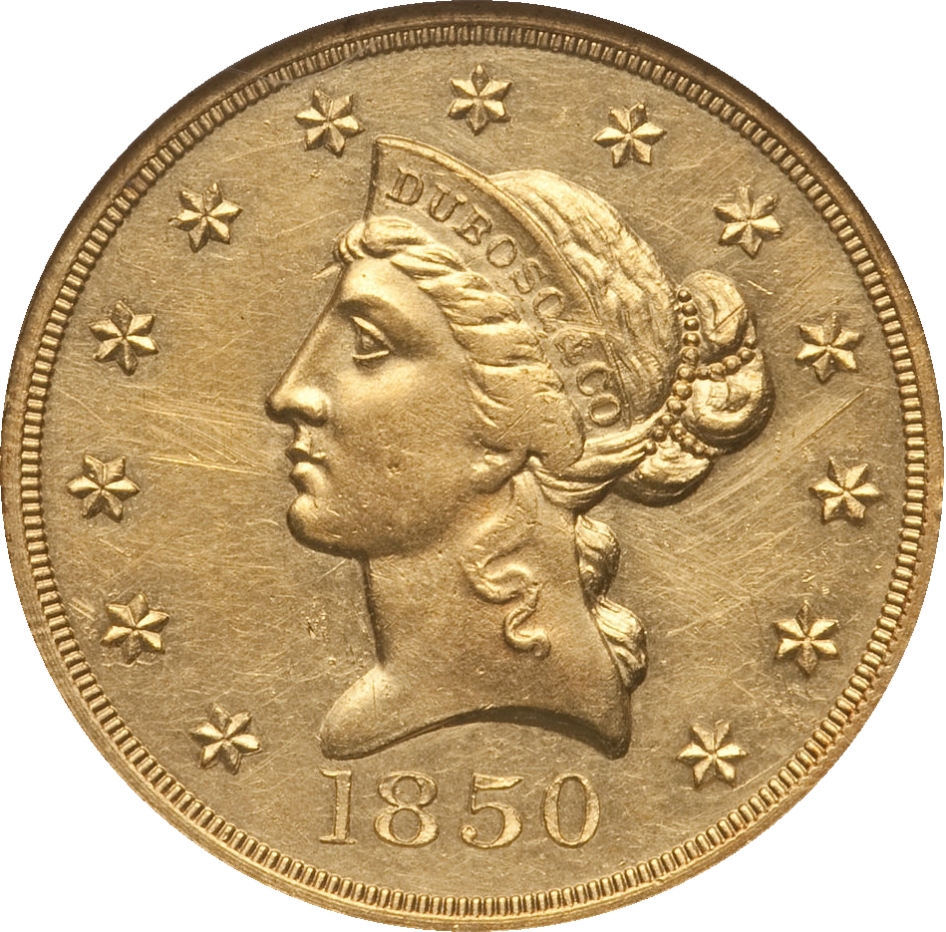
Obverse
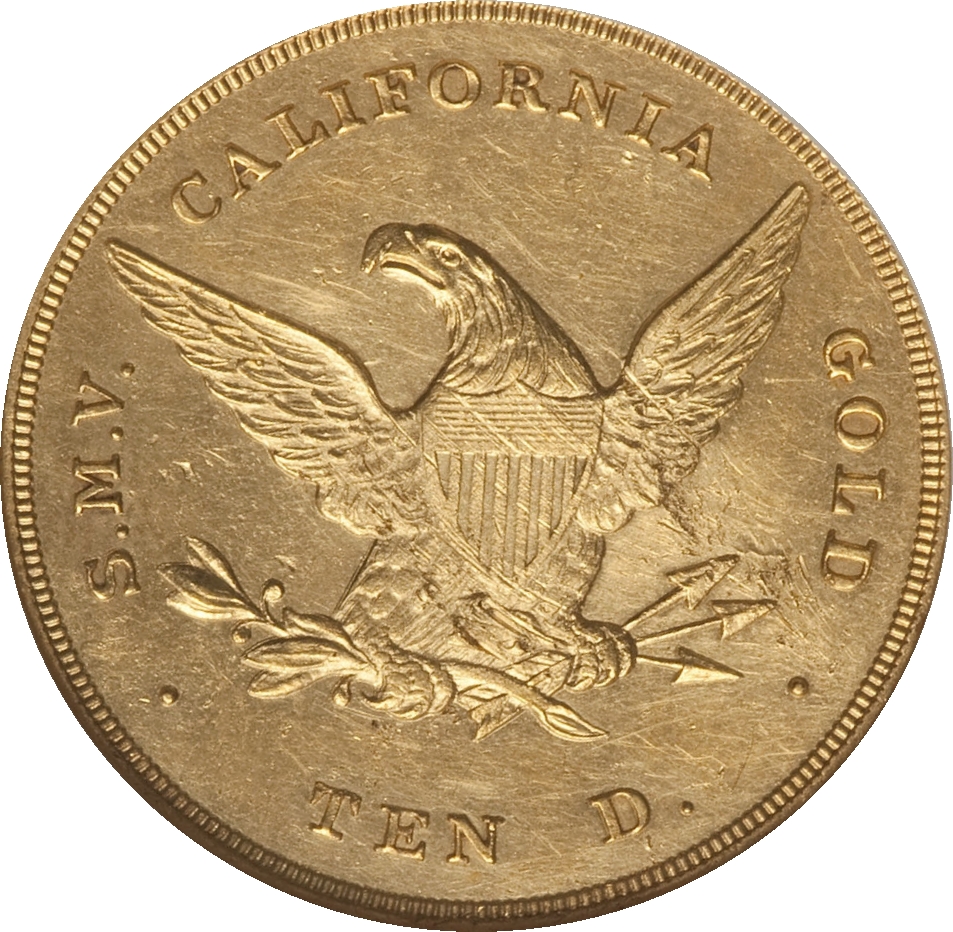
Reverse
The coinage of Dubosq & Company represents a fascinating intersection of artistry, opportunism, and the economic chaos of the early California Gold Rush. Theodore Dubosq Jr., the principal of the firm, was a skilled jeweler and silversmith from a prominent Philadelphia family. Arriving in San Francisco in 1849, he, like many others, saw the urgent need for a standardized medium of exchange to replace the inconvenient system of using raw gold dust for transactions. While dozens of private minters emerged, Dubosq's background resulted in coins of unusually high artistic merit. His defiant eagle design was a significant departure from the more simplistic or derivative motifs used by his competitors. However, the firm's tenure was brief and ultimately unsuccessful. The gold used was intentionally alloyed with a significant amount of silver, lowering its intrinsic value below its face value. This practice, while not unique, quickly led to public distrust. Merchants and bankers began to refuse Dubosq's coins, sealing their fate. The establishment of the U.S. Assay Office in 1850 provided a trustworthy alternative, rendering most private issues, especially debased ones like Dubosq's, obsolete. Consequently, the vast majority of their coinage was quickly melted, leading to its legendary rarity today.
Assayer/MinterDubosq & Company
Minter HistoryTheodore Dubosq Jr. was a well-established jeweler and silversmith in Philadelphia before venturing to California. His family firm, Dubosq & Son, was known for high-quality silver work. This background in metallurgy and engraving is evident in the superior design and execution of his California coinage compared to many contemporaries. Despite the artistic quality, the debasement of his coins led to their commercial failure. After his short-lived and unprofitable minting operation, Dubosq returned to Philadelphia and resumed his original trade.
Reason for MintingTo convert raw gold dust into a standardized, reliable medium of exchange for commerce in Gold Rush-era San Francisco.
Historical SignificanceThe Dubosq & Company coinage is historically significant as a prime example of high-quality private coinage that ultimately failed due to a lack of public trust. It highlights the critical importance of intrinsic value in the unregulated monetary environment of Gold Rush California. Numismatically, the coins are treasured for their unique and aesthetically pleasing design, standing as a testament to Theodore Dubosq's skill and representing the pinnacle of rarity within the broader series of California Territorial gold.
Geographic OriginSan Francisco, California
The obverse is celebrated for its unique and artistic design. It features a defiant eagle with outstretched wings perched on a rock, clutching a writhing snake in its beak and talons. This dynamic portrayal is distinct from the heraldic eagles on federal coinage. The eagle is surrounded by thirteen six-pointed stars.
Obverse InscriptionThe company name, 'DUBOSQ & CO', is inscribed in an arc above the eagle.
Reverse DescriptionThe reverse design centers on a Phrygian cap (Liberty Cap) on a pole, a classic symbol of freedom. This central device is encircled by fifteen six-pointed stars.
Reverse InscriptionThe inscription 'CALIFORNIA GOLD' encircles the upper periphery, while the denomination, either 'FIVE D.' or 'TEN D.', is at the bottom.
CompositionGold
Denomination$5, $10
Stated FinenessNo fineness is stated on the coins.
Actual FinenessThe coins are known to have been intentionally debased with a significant amount of silver. This gave them a distinct pale or 'greenish' gold color and meant their intrinsic bullion value was notably less than their stated face value, which was the primary reason for their commercial failure.
Mintages were never recorded and are presumed to be very small, likely only a few thousand pieces at most for both denominations combined.
Survival EstimateThe survival rate is minuscule, with perhaps fewer than a dozen examples known for each denomination. Their quick rejection by the public due to low intrinsic value and the subsequent establishment of the U.S. Assay Office ensured that the vast majority were melted down almost immediately after being struck.
Rarity ScaleBoth the $5 (K-2) and $10 (K-1) issues are considered among the greatest rarities in the entire U.S. numismatic series. They are typically classified as R-7 (4-12 known) to R-8 (2-3 known), with every appearance at auction being a major event.
Dubosq & Company coins are sought by the most advanced collectors for their extreme rarity, historical importance as a failed but artistically significant private issue, and their beautiful and unique 'eagle and snake' design.
Key VarietiesThe series consists of only two issues: the $10 (K-1) and the $5 (K-2). No significant die varieties are known or collected, as the surviving population is too small to conduct a meaningful study.
Kagin #K-1 to K-2
Authentication TipsAuthentication is paramount. Key diagnostics include the specific letter punch shapes, the details of the eagle's feathers and the snake, and the style of the stars. The strike is characteristically weak in the centers, particularly on the eagle's head and the Liberty Cap. The reeding should be compared to known genuine examples. Due to their high value, these coins are targets for forgery; any potential purchase must be certified by a top-tier grading service.
Shopping ConsiderationsAcquiring any Dubosq coin is a once-in-a-generation opportunity. 'Good value' is relative; focus on authenticity and provenance above all. A 'premium quality' example would be one that is free of significant damage, repairs, or harsh cleaning, and retains as much of the original, albeit weakly struck, detail as possible. Given the rarity, even impaired specimens are highly desirable.
A coin's grade is its condition, rated on a 1-70 scale. For rare coins, this is the most critical factor in determining value, as a tiny difference in preservation can mean a huge difference in price.
Relevant Grade TypesAll Dubosq coins were intended for circulation as business strikes. No proofs or restrikes were ever made. The vast majority of known survivors grade from Very Good to Extremely Fine. An AU or Mint State example is virtually unheard of and would be a landmark piece.
Mint State CharacteristicsA theoretical Mint State specimen would show some subdued luster in the protected areas, but would almost certainly exhibit the characteristic central striking weakness. The quality would be judged on the freshness of the surfaces and the absence of marks and friction, rather than the sharpness of the strike.
Circulated Wear PatternsWear is first and most apparent on the highest points of the design. On the obverse, this includes the eagle's head, breast, and the upper portions of its wings. On the reverse, the Phrygian cap and the top of the pole show the first signs of friction. The inscriptions and stars, being more protected, generally remain bold even on coins with considerable wear.
Key Factors for ValueThe primary driver of value is the series' extreme rarity. For any individual coin, the key factors are its grade (level of preservation), surface quality (avoiding damage, corrosion, or repairs), and strike definition. For a treasure of this magnitude, a documented provenance tracing back to famous collections like Garrett, Norweb, or Eliasberg is of paramount importance, adding immense desirability and value.