Clark, Gruber & Co. Subseries
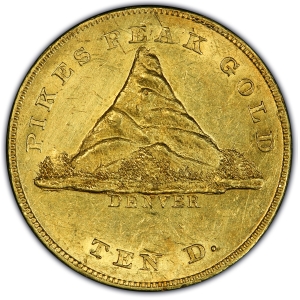
Obverse
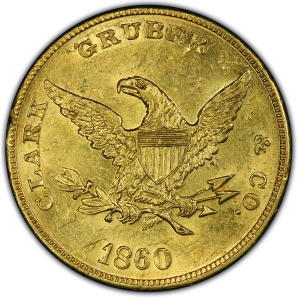
Reverse
The coinage of Clark, Gruber & Co. is a direct and celebrated product of the Pikes Peak Gold Rush, which began in 1858. As prospectors flooded into the newly established settlement of Denver in the Kansas Territory (later Colorado Territory), they faced a critical economic problem: an abundance of raw gold dust but a severe shortage of reliable, circulating currency. Gold dust was cumbersome, difficult to measure accurately, and prone to theft and fraud. Seeing a business opportunity and a civic need, the banking firm of Clark, Gruber & Co., previously established in Leavenworth, Kansas, transported a complete set of coining presses and equipment to Denver in 1860. They began producing coins that were meticulously assayed and, famously, contained slightly more gold than their stated face value. This intrinsic honesty made their coinage instantly trusted and preferred over worn federal coins or dubious private currency. Their 1860 issues feature a distinctive depiction of Pikes Peak, while the 1861 issues closely mimic contemporary U.S. federal designs, a testament to their technical skill. The operation was so successful and respected that in 1863, the U.S. government purchased their mint facility for $25,000, which became the foundation of the official U.S. Denver Mint. This transition marks Clark, Gruber & Co. as one of the most significant and historically important private minters in American history.
Assayer/MinterClark, Gruber & Co.
Minter HistoryFounded by Austin M. Clark, Milton E. Clark, and Emanuel H. Gruber, the firm was initially a banking house in Leavenworth, Kansas. Recognizing the monetary chaos of the Pikes Peak goldfields, they astutely decided to expand their operations to include not just assaying but coining. They shipped over $20,000 worth of machinery via steamboat and ox-drawn wagon to Denver. Their operation was highly professional, employing skilled die sinkers and press operators. Their reputation for integrity and producing high-quality coins of honest weight was impeccable, making them the de facto mint for the entire region until the federal government formally took over their facility.
Reason for MintingTo convert raw gold dust into a standardized, trustworthy, and convenient medium of exchange for the burgeoning economy of the Colorado Territory.
Historical SignificanceClark, Gruber & Co.'s coinage was instrumental in stabilizing the economy of the Colorado Territory during a volatile period of growth and on the eve of the Civil War. Their coins provided the liquidity necessary for commerce to thrive. The firm's ultimate legacy is its direct role in the establishment of the Denver Mint; they are the only private mint in U.S. history to have its facility purchased by the federal government to become an official U.S. Mint, a unique and enduring distinction in American numismatics.
Geographic OriginDenver, Colorado Territory
The series features two distinct obverse designs. The 1860 issues depict a stylized, conical representation of Pikes Peak surrounded by a forest, with 'PIKES PEAK GOLD' and 'DENVER' inscribed. The 1861 issues are a close copy of the contemporary Coronet Liberty Head design by Christian Gobrecht used on federal gold coinage, intended to increase public acceptance and familiarity.
Obverse InscriptionCommon inscriptions on 1860 issues include 'PIKES PEAK GOLD' and 'DENVER'. The 1861 issues replace the Liberty Head's stars with the inscription 'CLARK GRUBER & CO.' and feature the date below the bust.
Reverse DescriptionThe reverses also differ by year. The 1860 issues feature a simple eagle perched on a branch, looking left. The 1861 issues feature a more stately heraldic eagle with a shield on its breast, closely mimicking the design of U.S. federal gold coins of the period.
Reverse InscriptionInscriptions typically include the firm's name, 'CLARK, GRUBER & CO.', on the 1860 issues, and the denomination spelled out, such as 'TWO AND HALF D.', 'FIVE D.', 'TEN D.', or 'TWENTY D.' on all issues.
CompositionGold
Denomination$2.50, $5, $10, $20
Stated FinenessNo fineness is explicitly stated on the coins, but they were minted from largely unrefined placer gold.
Actual FinenessThe coins are renowned for being slightly overweight and of higher purity than required, containing approximately 1% more gold than their federal counterparts. This inherent honesty ensured their widespread acceptance and is a key part of their legacy.
Mintages were not officially recorded and are based on historical estimates. The total output is believed to be around $600,000 in face value. The lower denominations ($2.50, $5, $10) are the most frequently encountered, while the $20 issues of both years are considerably rarer.
Survival EstimateSurvival rates are low across all denominations. The coins saw extensive and hard circulation in the commerce of the Rocky Mountain West. Their slightly higher intrinsic gold value also made them prime candidates for melting, especially after the establishment of the official U.S. Mint in Denver. It is estimated that only a few hundred of each denomination survive, with the 1861 $20 being an extreme rarity.
Rarity ScaleThe series spans a wide range of rarities. The 1860 $10 (K-3) is one of the more common Territorial coins available to collectors, typically found in circulated grades. Conversely, the 1861 $20 (K-14) is a legendary rarity, with fewer than 20 examples believed to exist. All issues are rare to extremely rare in Mint State condition.
Clark, Gruber & Co. gold is highly sought after for its tangible connection to the Pikes Peak Gold Rush, the 'Old West,' and the founding of the Denver Mint. The coins' high quality, attractive designs, and unimpeachable history make them a cornerstone of any serious Territorial gold collection.
Key VarietiesThe primary division is between the 1860 'Pikes Peak' design and the 1861 'Coronet Head' design. Within this, the key issues are the four denominations for each year: $2.50, $5, $10, and $20. The 1861 $20 is the series' key rarity. Minor die varieties exist, but the major differentiators are date and denomination.
Kagin #K-1 to K-14
Authentication TipsAuthentic pieces exhibit sharp, well-defined details, even when worn. The lettering punches are distinctive and should be carefully compared to known genuine examples. The fields often show fine die polishing lines. Counterfeits frequently appear soft and 'soapy,' with incorrect letter shapes, weak details (especially in the eagle's feathers and Liberty's hair), and may have incorrect weights or specific gravities. Seams on the edge are a red flag for cast copies.
Shopping ConsiderationsFor this series, 'good value' is often found in attractive, problem-free circulated examples (VF or XF) with original surfaces and coloration. Avoid coins that have been harshly cleaned, polished, or show significant rim damage. A premium quality coin will have a strong strike for the issue, minimal distracting marks, and pleasing luster for its grade. A CAC sticker confirming quality for the assigned grade provides significant confidence and value.
A coin's grade is its condition, rated on a 1-70 scale. For rare coins, this is the most critical factor in determining value, as a tiny difference in preservation can mean a huge difference in price.
Relevant Grade TypesAll Clark, Gruber & Co. coins were produced as business strikes intended for general circulation. No proofs were originally struck. Their high manufacturing quality allows them to be graded using the same standards as contemporary federal coinage.
Mint State CharacteristicsUncirculated examples should exhibit vibrant, frosty cartwheel luster. Strike quality can vary. The 1860 'Pikes Peak' coins are often softly struck on the central high points of the mountain design. The 1861 'Coronet' types may show weakness on Liberty's hair curls and the reverse eagle's feathers. Clean, mark-free surfaces are rare and command significant premiums.
Circulated Wear PatternsOn the 1860 'Pikes Peak' issues, wear first appears on the highest points of the mountain range and the eagle's head and breast. For the 1861 'Coronet' issues, wear patterns are consistent with federal Liberty Head gold: the highest points of Liberty's hair (especially over the ear), the coronet, and the cheek, and on the reverse, the eagle's head, neck, and the upper edges of the wings.
Key Factors for ValueThe primary value driver is the specific date and denomination, which determines the baseline rarity. This is followed by the numerical grade. After that, surface quality is paramount; coins with original skin, minimal marks, and no evidence of cleaning or damage are prized. Strike sharpness and overall eye appeal play a huge role. For the rarest and finest known examples, a prestigious, documented provenance (e.g., Eliasberg, Garrett, Norweb collections) can add a substantial premium to the coin's value.