Cincinnati Mining & Trading Company Subseries
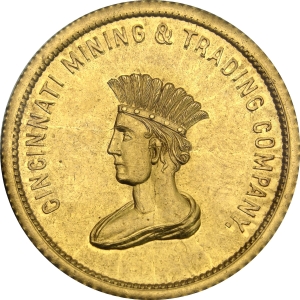
Obverse
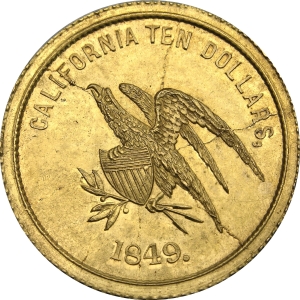
Reverse
The Cincinnati Mining & Trading Company represents a classic tale of the California Gold Rush: a group of enterprising individuals organizing to seek their fortune, and in the process, creating one of America's greatest numismatic rarities. Formed in Cincinnati, Ohio, the company of around 40 men traveled to California in 1849. Among them was Dr. John Locke, a respected scientist and inventor, who is credited with designing the dies and assaying the gold. Upon arriving in the gold fields, they faced the same fundamental economic problem as every other prospector: a severe shortage of official currency. Gold dust was cumbersome, difficult to value consistently, and prone to theft and fraud. To solve this, the company established a small, private minting operation in San Francisco. Their goal was twofold: to convert their mined gold into a convenient, tradable format and to create a store of value to pay for their eventual passage home. The resulting coins, a $5 and $10 piece, were struck in minuscule quantities before the company disbanded and its members returned east. Their operation was a microcosm of the chaotic, unregulated monetary environment of 'Period One' California gold, where dozens of private minters stepped in to fill the monetary vacuum left by the distant U.S. Mint, years before the establishment of the San Francisco branch mint.
Assayer/MinterCincinnati Mining & Trading Company
Minter HistoryThe Cincinnati Mining & Trading Company was not a long-term commercial enterprise but a joint-stock company formed specifically for a gold-seeking expedition. Its members were primarily from Ohio. The key figure numismatically was Dr. John Locke, whose scientific background lent a degree of credibility and technical skill to the minting operation that was unusual for the time. He designed the unique dies featuring a coining press. After a brief period of minting in San Francisco during 1849, the company achieved its objective, and the members returned home, dissolving the enterprise. Their coinage operation was ephemeral, existing only for a few months at most, which accounts for the extreme rarity of their issues today.
Reason for MintingTo convert raw gold dust into standardized coins for commerce and to facilitate the members' return voyage from California.
Historical SignificanceThe Cincinnati Mining & Trading Company coinage is of immense historical significance as it represents one of the earliest and rarest private issues of the California Gold Rush. The unique obverse design, depicting a coining press, is a powerful symbol of the industrial effort and ingenuity required to transform raw gold into money on the frontier. As one of the classic '49er' issues, these coins are tangible relics from the very beginning of the rush, embodying the desperation, ambition, and ad-hoc capitalism that defined the era. Their legendary rarity makes them cornerstones of any world-class collection of U.S. Territorial gold.
Geographic OriginSan Francisco, California
The obverse design is unique among all U.S. coinage, featuring a depiction of a steam-powered stamping mill or coining press. This industrial motif is rendered in a somewhat primitive but clear style, surrounded by the company name.
Obverse InscriptionCINCINNATI MINING & TRADING COMPANY encircles the central device.
Reverse DescriptionThe reverse features a heraldic eagle with outstretched wings, clutching an olive branch and arrows, a design clearly inspired by contemporary U.S. federal gold coinage but executed in a distinct, cruder style. The word CALIFORNIA is above the eagle, with the denomination below.
Reverse InscriptionCALIFORNIA / TEN DOLLARS or CALIFORNIA / FIVE DOLLARS.
CompositionGold
Denomination$5, $10
Stated FinenessNo fineness is stated on the coins.
Actual FinenessAssay reports indicate the gold was of high quality for the period, approximately .899 fine. While slightly below the .900 standard of federal coinage, this was significantly better than many other debased private issues, giving them good intrinsic value at the time.
Mintage figures were not recorded, but based on the minuscule number of survivors, production was exceptionally small, likely only a few hundred of each denomination at most.
Survival EstimateExtremely low, among the lowest of all U.S. Territorial issues. It is estimated that fewer than 10 examples of the $10 coin (K-2) and fewer than 20 of the $5 coin (K-1) survive in all grades. The vast majority of the original mintage was undoubtedly melted down once the San Francisco Mint began operations or as they were deposited in banks on the East Coast and found to be slightly underweight compared to federal issues.
Rarity ScaleThe series consists of two of the greatest rarities in American numismatics. The $5 is rated R-7 (4-12 known), while the $10 is rated R-8 (2-3 known), placing it on par with icons like the 1804 Dollar or 1913 Liberty Nickel in terms of rarity.
This series is sought by the most advanced numismatists for its legendary rarity, its direct link to the '49ers, its unique and historically important design, and its status as a cornerstone of any comprehensive U.S. Territorial gold collection.
Key VarietiesThe series consists of only two issues: the $5 (K-1) and the $10 (K-2). The $10 is significantly rarer and more famous, often considered the ultimate prize in the field of pioneer gold.
Kagin #K-1 to K-2
Authentication TipsAuthentication is a task for top-tier experts. Key diagnostics include the precise shape and placement of the letters punched into the dies, the specific details of the coining press, and faint die polish lines visible on high-grade specimens. The strike is characteristically weak in the centers. Any example that appears must be compared to known, pedigreed specimens. Given their value, dangerous modern forgeries exist.
Shopping ConsiderationsThese coins appear for sale only once every several years, typically in a major, named-collection auction. 'Good value' is almost irrelevant; acquisition at any price is a major event. A 'premium quality' example is one with minimal surface impairments, a relatively bold strike for the issue, and attractive original color. A documented provenance tracing back through famous collections like Eliasberg, Garrett, or Lilly adds enormous desirability and market stability.
A coin's grade is its condition, rated on a 1-70 scale. For rare coins, this is the most critical factor in determining value, as a tiny difference in preservation can mean a huge difference in price.
Relevant Grade TypesAll known examples are business strikes. No proofs or presentation pieces were made. The overwhelming majority of surviving examples are in circulated grades, typically ranging from Very Good to About Uncirculated. A Mint State specimen is a major numismatic event.
Mint State CharacteristicsA theoretical Mint State example would exhibit some original mint luster, though it would likely be subdued due to the quality of the planchets. The strike would still be expected to be weak in the centers, particularly on the press and the eagle's breast, as this is a universal characteristic of the issue. Small planchet flaws or adjustment marks would not be considered unusual or overly detrimental.
Circulated Wear PatternsOn the obverse, wear first appears on the highest points of the coining press. On the reverse, the eagle's head, neck, and the upper edges of the wings are the first areas to show friction. The soft gold fields are highly susceptible to contact marks and scratches.
Key Factors for ValueRarity is the dominant factor; simply owning an example is a major achievement. After that, grade and surface quality are paramount. Strike is also critical; a coin with a sharper-than-usual impression of the press or eagle commands a significant premium. Finally, for a coin of this magnitude, a well-documented provenance is not just a bonus but an essential component of its value and historical identity.