California Gold Ingots Subseries
From the California Gold Ingots Series
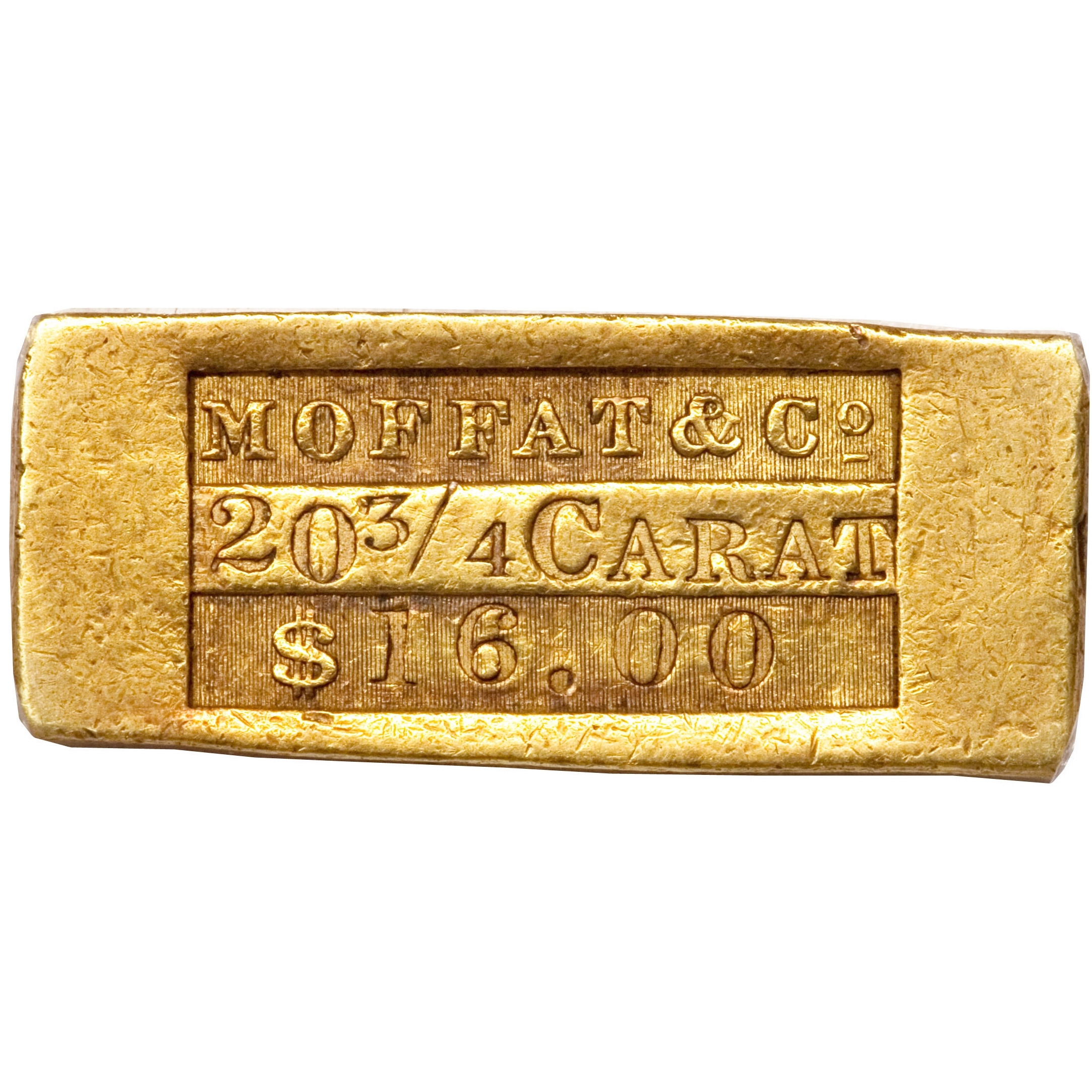
Obverse
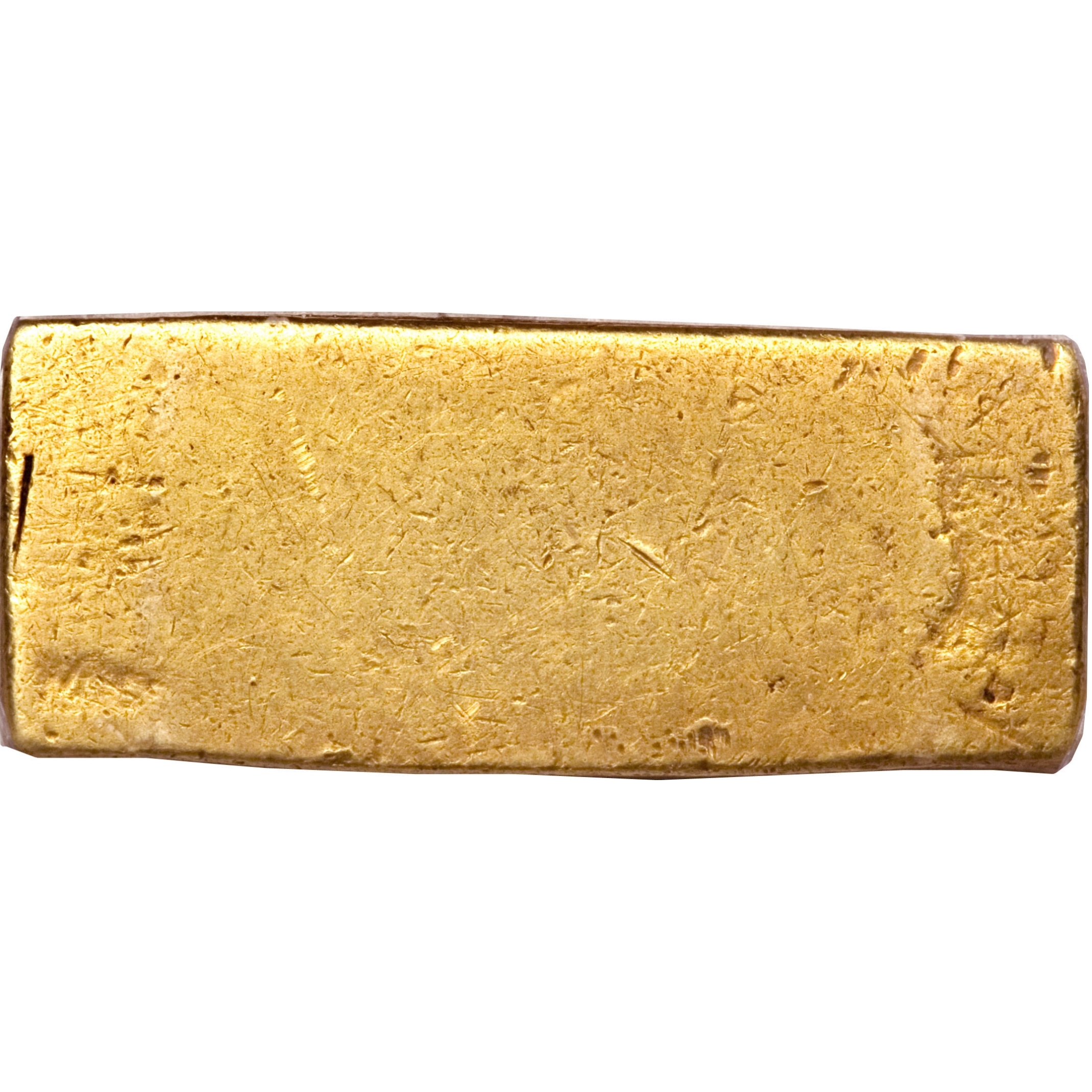
Reverse
The discovery of gold at Sutter's Mill in 1848 triggered a massive, chaotic influx of people and gold dust into California. With no federal mint yet established on the West Coast, the region faced a severe monetary crisis. Gold dust, the primary medium of exchange, was inconvenient, prone to theft, and difficult to value consistently. To bring order to this economic frontier, numerous private assayers and refiners emerged, primarily in San Francisco and Sacramento. These firms, founded by men with metallurgical expertise, played a pivotal role by melting raw gold dust and casting it into rectangular ingots. Each ingot was stamped with the assayer's name, its exact weight, its fineness (purity), a unique serial number, and its corresponding value in U.S. dollars. These ingots were not coins intended for general circulation but rather high-value units for large-scale commercial transactions, bank deposits, and shipment to the East Coast. They functioned as a trusted monetary instrument, stabilizing commerce and allowing the immense wealth of the goldfields to be systematically integrated into the U.S. economy. The operations of these assayers, particularly trusted firms like Moffat & Co. (which would be contracted as the U.S. Assay Office), directly paved the way for the establishment of the San Francisco Mint in 1854, which ultimately rendered private ingots and coinage obsolete.
Assayer/MinterVarious, including Moffat & Co., F.D. Kohler (State Assayer), Justh & Hunter, and Kellogg & Humbert.
Minter HistoryThe assayers were a diverse group of metallurgists and entrepreneurs. John Moffat was a respected figure whose firm, Moffat & Co., gained such a high degree of public trust that it was later designated the official U.S. Assay Office of Gold. Frederick D. Kohler became California's first official State Assayer, lending government authority to his stamped bars. Hungarian immigrants Samson Justh and Solomon Hunter formed Justh & Hunter, becoming one of the most prolific producers of ingots, while Kellogg & Humbert succeeded the U.S. Assay Office and handled immense quantities of gold. Each firm's reputation was staked on the accuracy of its assays, making their stamps a critical mark of integrity.
Reason for MintingTo convert raw, non-uniform gold dust into standardized, transportable bars of verified weight and fineness for use in large-scale commercial transactions.
Historical SignificanceCalifornia Gold Ingots are foundational artifacts of American economic history. They represent the first successful attempt to regulate and standardize the raw wealth of the Gold Rush, providing a stable medium of exchange that fueled the development of California. They were the essential financial instruments that allowed for the secure storage and transport of gold, effectively linking the frontier economy to the financial centers of the East Coast and the world. Their existence highlights the federal government's slow response to the needs of the West and the crucial role of private enterprise in creating financial order from chaos.
Geographic OriginSan Francisco and Sacramento, California
The obverse (top face) of a typical ingot is not a pictorial design but a series of hand-punched markings. These include the assayer's name or company cartouche, a serial number, the fineness (purity) expressed in thousandths, the weight in troy ounces and hundredths, and the precise value in dollars and cents. The surface often shows cooling lines or a crystalline texture from the original pour.
Obverse InscriptionCommon inscriptions are composed of multiple punches, such as 'MOFFAT & CO.', 'F.D. KOHLER / STATE ASSAYER', 'JUSTH & HUNTER', 'KELLOGG & HUMBERT', followed by punches for 'No.', fineness like '.890 THOU', weight like '21.50 OZ', and value like '$398.14'.
Reverse DescriptionThe reverse is typically blank and unmarked, showing the texture of the bottom of the mold. It can be smooth or somewhat rough, and may have incidental contact marks from handling and storage.
Reverse InscriptionNone, unless a counterstamp from a bank or subsequent owner was applied.
CompositionGold
DenominationVariable; valued by weight and fineness, ranging from under $10 to many thousands of dollars.
Stated FinenessThe fineness was precisely stated on each ingot, typically ranging from the low .800s to the high .900s, reflecting the natural alloys present in the gold dust from which it was made.
Actual FinenessThe reputations of the assayers depended on their accuracy. Surviving examples and historical records show that the actual fineness was almost always true to the stated fineness, making these ingots a highly reliable store of value.
Production quantities were never recorded. Ingots were produced on-demand as miners and merchants brought in gold dust. The output of firms like Justh & Hunter was immense, but this does not translate to high survival.
Survival EstimateThe survival rate is infinitesimally small. These were utilitarian objects created to be melted. Upon arrival at the Philadelphia Mint or after the opening of the San Francisco Mint, virtually all were converted into official U.S. coinage. The vast majority of known survivors today were recovered from shipwrecks, most notably the S.S. *Central America*, which sank in 1857 carrying a massive cargo of California gold.
Rarity ScaleAll California gold ingots are considered rare, with most examples being unique by virtue of their specific weight, serial number, and markings. In numismatic terms, they range from R-7 (4-12 known) to R-8 (Unique or 2-3 known). While shipwreck discoveries have increased the known population for certain assayers, they remain trophy-level artifacts.
California Gold Ingots possess a raw, tangible connection to the legendary Gold Rush. They are unique historical documents, not just monetary units. Collectors are drawn to their heft, their individuality, and the story they tell of frontier capitalism and the creation of immense wealth.
Key VarietiesThe primary way to collect is by assayer. Major names include Moffat & Co., F.D. Kohler, Justh & Hunter, and Kellogg & Humbert. Within each assayer, collectors seek different sizes, from small 'pocket' ingots to large, impressive 'brick' ingots. Bars with special historical context, such as those from the State Assayer, are particularly prized.
Kagin #K-1 to K-16 covers the primary assayer ingots, though many others are cataloged by specialists.
Authentication TipsAuthentication is highly specialized. Key diagnostics lie in the punches. Each assayer used a specific set of letter and number punches with unique fonts, spacing, and wear characteristics. These should be compared against known genuine examples, particularly those with shipwreck provenance. The surface texture, natural crystallization, and specific gravity are also critical. Be wary of modern fakes, which are often cast and have soft, poorly defined punches.
Shopping ConsiderationsValue is determined by a combination of factors. The historical importance of the assayer is paramount. Provenance is a massive value-driver; an ingot recovered from the S.S. *Central America* commands a huge premium. Beyond that, look for ingots with clear, fully impressed, and well-centered markings. Aesthetic appeal—a pleasing shape and original color—also contributes significantly. A smaller, complete, and attractive bar is often more desirable than a larger, damaged, or poorly marked one.
A coin's grade is its condition, rated on a 1-70 scale. For rare coins, this is the most critical factor in determining value, as a tiny difference in preservation can mean a huge difference in price.
Relevant Grade TypesStandard numerical grading (1-70) is not applied to ingots. They are unique, utilitarian objects. Third-party grading services like PCGS and NGC will authenticate and encapsulate them, but they do not assign a numerical grade. Instead, they note the assayer, weight, fineness, value, and any significant surface characteristics or provenance.
Mint State CharacteristicsThe concept of 'Mint State' is not applicable. A premium quality ingot is one that remains in a state of preservation close to when it was first created. This is characterized by bold, sharp, and complete punches, minimal contact marks or scratches, and original, unadulterated surfaces that may exhibit attractive natural toning or cooling features.
Circulated Wear PatternsIngots did not circulate like coins. Wear comes from handling and storage, resulting in scratches, abrasions, and dents. Some ingots may have assay clips (small pieces removed for testing) or assay drill holes, which are part of their history but can affect value depending on their severity. Damage incurred in a shipwreck and subsequent conservation can also impact the surfaces.
Key Factors for ValueThe primary drivers of value are: 1. Assayer: The historical renown of the maker. 2. Provenance: A documented history, especially to a famous shipwreck like the S.S. *Central America* or S.S. *Yankee Blade*, is the single greatest value enhancer. 3. Aesthetics: The visual appeal, including the quality and placement of the stamps. 4. Size/Value: While larger bars are often more valuable, the completeness and rarity of smaller bars also create high demand. 5. Condition: The degree of post-production damage.