Baldwin & Company Subseries
From the Baldwin & Company (1850-1851) Series
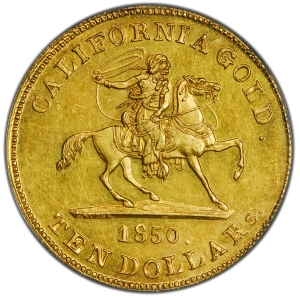
Obverse
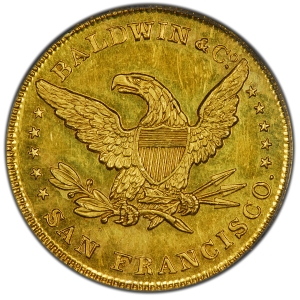
Reverse
Baldwin & Company emerged as a dominant force in the chaotic economic landscape of Gold Rush San Francisco. Founded by jeweler George C. Baldwin, the firm began striking coins in 1850 to meet the desperate need for a circulating medium beyond raw gold dust. In a city devoid of a federal mint, private minters filled a crucial vacuum, converting miners' gold into spendable currency. Baldwin's initial 1850 issues, particularly the iconic $10 'Horseman' piece, were well-regarded and widely circulated, making the firm one of the most prolific and trusted minters of its time. However, their fortunes turned dramatically in early 1851. A newly established U.S. Assay Office, under the direction of Augustus Humbert, declared that many private gold coins, including Baldwin's 1851 issues, were underweight and below their stated value. This announcement shattered public confidence, creating a financial panic. A run on Baldwin & Co. ensued, and the firm, unable to redeem its coins for U.S. currency or bullion, collapsed almost overnight. This event underscored the instability of the private coining system and hastened the federal government's efforts to establish an official branch mint in San Francisco, which finally opened in 1854.
Assayer/MinterBaldwin & Company
Minter HistoryGeorge C. Baldwin and his partner, Thomas S. Holman, were jewelers and watchmakers who astutely recognized the immense business opportunity in private coining. They rose rapidly from a small operation to become one of the largest producers of gold coins in San Francisco in 1850. Their success was built on the popularity of their distinctive designs and the sheer volume of their output. The firm's dramatic downfall in the Assay Office crisis of 1851, where their coins were discounted by up to 2%, serves as a cautionary tale of the high-stakes, unregulated environment of the Gold Rush economy.
Reason for MintingTo convert raw gold dust into reliable, standardized coins for daily commerce in California before the establishment of a U.S. Branch Mint.
Historical SignificanceThe Baldwin & Co. series is historically significant for several reasons. It represents one of the largest and most important private coinages of the Gold Rush era, providing a vital monetary function during a period of explosive growth. The $10 'Horseman' piece is considered one of the most original and artistically significant designs in all of U.S. numismatics, a rare departure from the Greco-Roman motifs that dominated federal coinage. Finally, the firm's spectacular collapse was a pivotal event that highlighted the inherent flaws of private coinage and directly influenced federal policy towards establishing a permanent mint in California.
Geographic OriginSan Francisco, California
The series features two distinct obverse motifs. The $5 and $20 denominations use a classic bust of Liberty, facing left, with a coronet inscribed 'BALDWIN & CO' and surrounded by stars. The iconic $10 piece features a dynamic depiction of a vaquero (a Mexican cowboy) on a horse, holding a lariat in the act of roping a bear (implied, not shown), a powerful symbol of Californian life.
Obverse InscriptionInscriptions vary by denomination but typically include 'BALDWIN & CO' or 'BALDWIN & COMPY', and the date. The Liberty heads are surrounded by 13 stars.
Reverse DescriptionThe reverse designs are more conventional, featuring a heraldic eagle with a shield on its breast, clutching an olive branch and arrows. The style is similar to contemporary U.S. federal gold coinage but with a distinct, somewhat cruder engraving style.
Reverse InscriptionReverse inscriptions typically include 'CALIFORNIA GOLD', the denomination spelled out (e.g., 'TEN DOL.'), and often the letters 'S.M.V.' for 'Standard Mint Value'.
CompositionGold
Denomination$5, $10, $20
Stated FinenessThe coins were intended to trade at face value, implying a fineness near the U.S. standard of .900. No fineness is explicitly stated on the coins themselves.
Actual FinenessThe actual fineness varies. The 1850 issues were generally found to be of acceptable fineness and weight. However, the 1851 issues were discovered by the U.S. Assay Office to be slightly below standard, containing less than their face value in gold, which directly led to the firm's failure.
No official mintage records were kept. Production of the 1850 $10 Horseman was substantial for a territorial issue, likely in the tens of thousands. All other issues were produced in much smaller quantities. All are considered rare today.
Survival EstimateThe survival rate for all Baldwin coinage is extremely low. The 1851 Assay Office crisis caused a massive wave of melting, as the discounted coins were sold as bullion. This event, combined with the extreme wear and tear of frontier circulation, means that only a tiny fraction of the original mintage survives for collectors today.
Rarity ScaleThe series spans a wide range of rarity. The 1850 $10 Horseman is the most available type, though still rare (R-4 to R-5). The 1850 $5 is Very Rare (R-6). The 1851 $10 is Extremely Rare (R-7), and the 1851 $20 is a legendary rarity, with only a few examples known to exist (R-8).
The Baldwin series is highly prized for its direct connection to the California Gold Rush and for featuring the iconic 'Horseman' design, a celebrated masterpiece of numismatic art. Owning a Baldwin coin is owning a tangible piece of the Wild West and American economic history.
Key VarietiesThe major types sought by collectors are: 1. The $5 of 1850 (K-3). 2. The famous $10 'Horseman' of 1850 (K-4). 3. The extremely rare reworked $10 of 1851 (K-5). 4. The exceedingly rare $20 of 1851 (K-6). Minor die varieties exist but are the focus of advanced specialists.
Kagin #K-3 to K-8
Authentication TipsAuthentication requires careful study. Examine the style of the lettering and numbers, as Baldwin's punches are distinctive. On the 'Horseman' ten, check for known die markers and the specific style of reeding. Counterfeits are common, especially cast copies which will show soft details, pitting, and often a seam on the edge. Genuine pieces have a sharp, if somewhat crude, strike from dies. Any piece should be carefully weighed and its specific gravity checked.
Shopping ConsiderationsFor this series, 'good value' often means a problem-free coin with original surfaces, even in a lower grade. Premium quality is defined by a strong strike—especially on the central devices like the vaquero on the $10 or Liberty's portrait on the $5 and $20—and minimal distracting marks or damage. Avoid coins that have been harshly cleaned, polished, or repaired, as these will always trade at a steep discount. An example with honest, even wear is far more desirable than a damaged higher-grade piece.
A coin's grade is its condition, rated on a 1-70 scale. For rare coins, this is the most critical factor in determining value, as a tiny difference in preservation can mean a huge difference in price.
Relevant Grade TypesAll known original Baldwin & Co. coins are business strikes intended for circulation. No proofs were made. Buyers should be exceptionally cautious of any pieces described as proofs or special strikes, as they are likely fantasies or later concoctions.
Mint State CharacteristicsMint State examples are exceedingly rare. Quality is judged by the sharpness of the strike, the quality of the luster, and the absence of marks. A superior strike will show full detail on the horseman's lariat, the eagle's feathers, and the curls of Liberty's hair. Due to the primitive minting technology, minor planchet flaws or adjustment marks made before striking are common and generally acceptable.
Circulated Wear PatternsOn the $10 Horseman, wear first appears on the head and torso of the rider, the horse's hip, and the lariat. On the reverse, the eagle's head and neck, and the top of the wings are the high points. For the Liberty head issues, wear is most evident on Liberty's cheek, the hair above the ear, and the coronet's highest edges.
Key Factors for ValueValue is determined by a combination of the specific Kagin variety's absolute rarity, the coin's certified grade, and its overall eye appeal. For Baldwin coinage, surface quality is paramount; coins free of corrosion, harsh cleaning, or significant damage command huge premiums. A well-documented provenance to a famous collection (e.g., Norweb, Eliasberg, Garrett) can add significantly to a coin's value, especially for the great rarities like the $20.