Templeton Reid (Georgia) Series
1830-1849
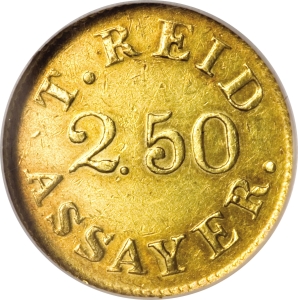
Obverse
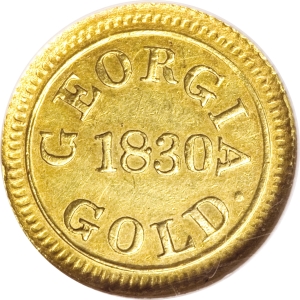
Reverse
Templeton Reid's coinage represents the very dawn of private gold minting in the United States, a critical chapter born from the nation's first significant gold rushes. Following the Carolina Gold Rush, a more substantial strike in Georgia in 1828 created an immediate and acute economic problem: a glut of raw gold dust but a severe shortage of reliable currency. Miners were forced to trade their gold by weight, often at a steep discount to unscrupulous merchants. Into this void stepped Templeton Reid, a skilled watchmaker and metallurgist from Milledgeville. In 1830, he established a private mint in Gainesville, Georgia, and began striking gold coins in denominations of $2.50, $5, and $10, predating the U.S. government's own branch mints in the region by eight years. Reid's enterprise was short-lived and fraught with controversy. His timing coincided with the Jacksonian era's deep-seated suspicion of centralized banking (the 'Bank War'), which created a climate somewhat tolerant of private currency solutions. However, his coins quickly drew the scrutiny of government officials. An assay conducted by the U.S. Mint in Philadelphia, published in newspapers, declared Reid's coins to be underweight and of lower fineness than their stated value. This public condemnation, whether entirely accurate or politically motivated to protect federal monetary authority, shattered public confidence. Within months, Reid's coins were widely refused, and his operation ceased. The vast majority of his output was melted down, contributing to their legendary rarity today. His venture, though a commercial failure, set a crucial precedent for the dozens of private minters who would later serve the gold fields of California and Colorado.
Assayer/MinterTempleton Reid
Minter HistoryTempleton Reid was a multi-talented artisan with established skills as a gunsmith, watchmaker, and metallurgist. His ingenuity allowed him to create a functional minting operation from scratch, including the machinery to coin gold. Despite the failure of his Georgia mint in 1830 due to public distrust over the coins' value, his ambition was not extinguished. Nearly two decades later, Reid surfaced during the California Gold Rush of 1849, where he again attempted to operate a private mint, though his California coinage is even rarer and more enigmatic than his Georgia issues.
Reason for MintingTo convert raw gold dust into a standardized, fungible currency for local commerce, solving the acute shortage of circulating coinage in the Georgia gold fields.
Historical SignificanceThe Templeton Reid coinage holds the distinction of being the first private gold series ever struck in the United States. Its existence directly led to federal action, hastening the establishment of the Dahlonega and Charlotte branch mints. As the progenitor of all subsequent territorial and private gold issues, its historical importance is unparalleled in American numismatics, representing a bold, albeit failed, private-sector solution to a critical frontier economic crisis.
Geographic OriginGainesville, Georgia
The obverse designs are characteristically simple and utilitarian. They typically feature the minter's name, 'TEMPLETON REID', in an arc at the top. The denomination, spelled out (e.g., 'TEN DOLLARS' or 'FIVE DOLLARS'), occupies the center, with the word 'ASSAYER' below it. The lettering is crude and often unevenly spaced.
Obverse InscriptionCommon inscriptions are 'TEMPLETON REID', 'ASSAYER', and the denomination ('TEN DOLLARS', 'FIVE DOLLARS', or '2.50').
Reverse DescriptionThe reverse design is equally stark, dominated by the location 'GEORGIA GOLD' arranged in an arc around the date, '1830', which is placed centrally. The planchets are often uneven and the strike can be weak in areas.
Reverse InscriptionThe standard reverse inscription is 'GEORGIA GOLD' and the date '1830'.
CompositionGold
Denomination$2.50, $5, $10
Stated FinenessNo fineness is explicitly stated on the coins. Reid intended them to be of standard purity, but public assays claimed they fell short.
Actual FinenessContemporaneous U.S. Mint assays reported the fineness to be around .900, but the total value was below face due to the coins being slightly underweight. This discrepancy between face value and intrinsic value was the primary cause of the series' failure.
Mintages were not recorded but are universally accepted as being extremely small. The entire operation lasted only a few months in 1830, and total output across all three denominations was likely only in the hundreds of pieces.
Survival EstimateThe survival rate is minuscule. Public outcry and accusations of debasement led to the vast majority of Reid's coinage being melted almost immediately. It is estimated that fewer than three dozen coins of all Georgia types combined exist today, making them among the rarest of all U.S. coins.
Rarity ScaleAll Templeton Reid Georgia issues are of the highest rarity. The $10 is the most 'common' and is rated R-7. The $5 is rated R-8. The $2.50 is a legendary rarity, with perhaps only two or three specimens known, also rated R-8.
As the first private gold coins struck in the nation, Templeton Reid issues are foundational items for any world-class collection of American coinage. Their extreme rarity, connection to the Georgia Gold Rush, and controversial history make them trophies of the highest order.
Key VarietiesThe series is collected by denomination and die variety: - $10 (K-1, K-2): The most available denomination, with a known die crack diagnostic on some obverses. - $5 (K-3, K-4): Extremely rare. - $2.50 (K-5, K-6): One of the most famous and unobtainable rarities in all of U.S. numismatics.
Kagin #K-1 to K-6
Authentication TipsAuthentication is critical and should only be performed by top experts. Key diagnostics include the specific shape and style of the crude letter punches, known die states and cracks (particularly on the $10), and characteristic planchet features. All known genuine examples are well-documented and plated in reference works; any newly discovered piece would require rigorous scientific and historical verification. Counterfeits and electrotypes from the 19th century exist.
Shopping ConsiderationsThese coins trade infrequently, typically only at major auctions featuring landmark collections. 'Good value' is relative; the primary goal is acquiring an authentic, problem-free example. Most survivors are in the VG-VF grade range. A premium quality coin is not judged by its grade alone, but by its originality of surfaces, lack of impairments (e.g., scratches, tooling, harsh cleaning), and strength of strike. A strong provenance is highly desirable and adds significantly to the coin's value and appeal.
A coin's grade is its condition, rated on a 1-70 scale. For rare coins, this is the most critical factor in determining value, as a tiny difference in preservation can mean a huge difference in price.
Relevant Grade TypesAll known examples are business strikes, produced for general circulation. No proofs, patterns, or presentation pieces are known to exist from his Georgia mint.
Mint State CharacteristicsNo confirmed Mint State example of a Templeton Reid Georgia coin is known to exist. A theoretical uncirculated specimen would be judged on the sharpness of the crudely engraved letters and date, as well as any surviving mint luster. Given the crude manufacturing process, even a perfect example would likely exhibit some weakness in strike and planchet imperfections.
Circulated Wear PatternsWear is first evident on the highest points of the letters of the denomination on the obverse and the date and 'GEORGIA GOLD' inscription on the reverse. Due to the simple designs, major identifying features remain visible even on coins with considerable wear.
Key Factors for ValueFor this series, value is determined in descending order of importance by: 1) Authenticity, 2) Denomination (with the $2.50 being the ultimate prize), 3) The absence of problems or damage, 4) Technical grade and eye appeal, and 5) Provenance. A documented history tracing a coin to a famous historical collection like Garrett or Eliasberg adds a substantial premium, as it provides both a record of authenticity and a story that enhances its desirability.