Oregon Gold Series
1849
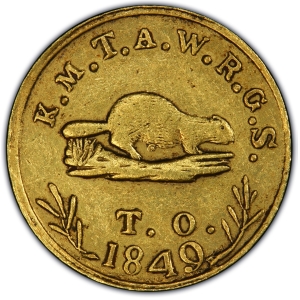
Obverse
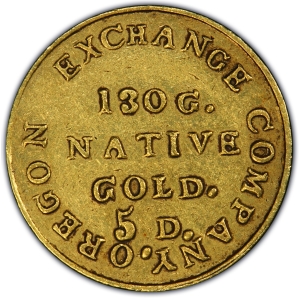
Reverse
The coinage of the Oregon Exchange Company, colloquially known as 'Beaver Money,' is a direct consequence of the California Gold Rush's impact on the isolated Oregon Territory. By 1848-1849, a flood of gold dust arrived in Oregon, brought by settlers returning from the California gold fields. This dust became the primary medium of exchange, but its use was fraught with problems: inconsistent values, fraudulent additions of sand or brass filings, and a general lack of uniformity that crippled commerce. The Territory's provisional government, operating without formal authority from a distracted U.S. Congress, took matters into its own hands. Governor George Abernethy and a group of prominent citizens formed the Oregon Exchange Company to establish a mint. This act was technically illegal, as only the federal government could coin money, but was born of pure necessity to stabilize the region's economy. Using rudimentary machinery, including a repurposed wagon-wheel-tire rolling mill, they began striking coins in Oregon City in early 1849. The mint's operation was short-lived; it ceased production upon the arrival of the new, federally appointed governor, Joseph Lane, in March 1849. He declared the provisional government's laws void, and by September, federal currency began to arrive, rendering the Beaver Money obsolete. The story is a quintessential example of American frontier ingenuity and the struggle to impose order and create economic stability in the vacuum of federal authority during the era of Manifest Destiny.
Assayer/MinterOregon Exchange Company
Minter HistoryThe Oregon Exchange Company was a joint-stock company formed by leading members of Oregon's provisional government, including Governor George Abernethy, William K. Kilborne, and William H. Willson. While these men provided the political and financial backing, the mechanical work of creating the dies and minting apparatus fell to Thomas Powell, a local blacksmith. The venture was a semi-official act of a government attempting to solve a dire economic crisis within its jurisdiction, acting as a de facto territorial mint before federal oversight was established.
Reason for MintingTo convert plentiful but inconvenient California gold dust into a standardized, reliable medium of exchange for the commerce-starved Oregon Territory.
Historical SignificanceThe Oregon Exchange Company's 'Beaver Money' holds the distinction of being the first coinage struck on the Pacific Coast of the United States. It represents a critical, albeit brief, chapter in American economic history, demonstrating the resourcefulness of pioneers in establishing functional economies on the frontier. The coins are tangible relics of the pre-statehood Oregon Territory and the immediate economic fallout of the California Gold Rush on neighboring regions.
Geographic OriginOregon City, Oregon Territory
The obverse design is primitive yet iconic, dominated by a central image of a beaver resting on a log. Above the beaver are the initials K.M.T.A.W.R.C.S., representing the eight partners in the company. Below the log is the date '1849' and 'T.O.' for Territory of Oregon.
Obverse InscriptionK.M.T.A.W.R.C.S. / T.O. / 1849
Reverse DescriptionThe reverse designs are simple and utilitarian, focused on conveying the coin's value and composition. The name of the issuer is arranged around the periphery with the denomination and gold content in the center.
Reverse InscriptionTypically 'OREGON EXCHANGE COMPANY' around the rim. The center of the $5 reads '130G. NATIVE GOLD. 5 D.' The $10 reads '10 D. 20 G. NATIVE GOLD.'
CompositionGold
Denomination$5, $10
Stated FinenessThe coins were inscribed with 'NATIVE GOLD', indicating they were struck from largely unrefined gold dust. Their value was based on a specific weight in grains (G.) and pennyweights (D.), not on a standardized fineness.
Actual FinenessModern analysis reveals the gold content was significantly purer and heavier than that of contemporary federal gold coins. The actual fineness is typically around .870 to .880, approximately 8-10% more valuable intrinsically than their stated face value. This high gold content is the primary reason for their low survival rate, as they were preferentially melted.
Official mintage records were not kept. Historical estimates place the production figures at approximately 6,000 for the $5 denomination and 2,850 for the $10 denomination.
Survival EstimateExtremely low. Because the coins contained more gold than their face value, they were systematically withdrawn from circulation and melted down for profit once federal coins became available. It is estimated that fewer than 100 examples of each denomination survive today, with many of those in lower circulated grades.
Rarity ScaleAll varieties are considered rare to extremely rare. The business strike $5 (K-3) and $10 (K-4) are the most 'common' types available to collectors, though both are major rarities. The initial pattern varieties are of the utmost rarity, with only one or two examples known of each, residing in institutional collections.
Beaver Money is among the most desirable and historically significant of all U.S. private and territorial issues. The unique beaver design, the story of frontier necessity, and their status as the first coins of the Pacific Coast create immense collector demand.
Key VarietiesThe series is simple, consisting of four main varieties: K-1 ($10 Pattern), K-2 ($5 Pattern), K-3 ($5 Business Strike), and K-4 ($10 Business Strike). The patterns are essentially uncollectible for private individuals. The primary collecting goal is to acquire one example of the $5 and one of the $10 business strikes.
Kagin #K-1 to K-4
Authentication TipsAuthentic examples exhibit a characteristically crude style. The letters are hand-punched and show slight irregularities in spacing and alignment. The beaver's fur has a distinct, somewhat soft texture. Weakness in the center of the strike is very common. The most dangerous counterfeits are high-quality transfers or modern-die-struck fakes, but many older cast copies exist, which can be identified by a lack of sharpness, porous surfaces, and a casting seam on the edge.
Shopping ConsiderationsFor this series, any genuine example is a prize. 'Good value' lies in finding a piece with pleasing, original surfaces, even with significant circulation wear. A premium quality coin would be one with an unusually bold strike (especially on the beaver and central legends), minimal distracting marks, and honest, even wear. Avoid coins that have been harshly cleaned, polished, or repaired, as these command significantly lower prices.
A coin's grade is its condition, rated on a 1-70 scale. For rare coins, this is the most critical factor in determining value, as a tiny difference in preservation can mean a huge difference in price.
Relevant Grade TypesAll original Oregon Gold pieces are business strikes, intended for circulation. No original proofs were ever produced. Any piece advertised as a 'proof' should be regarded with extreme skepticism and is likely a later fantasy creation.
Mint State CharacteristicsUncirculated examples are exceedingly rare. A true Mint State 'Beaver' would show some original, slightly subdued mint luster, consistent with the unrefined gold used. Strike is a critical factor, as most were weakly struck, particularly in the center. A coin with a bold strike on the beaver and central inscriptions commands a significant premium. Expect some light handling marks, even on uncirculated specimens.
Circulated Wear PatternsOn the obverse, wear first appears on the high points of the beaver's back, head, and tail. The initials above and date below are somewhat protected and wear more slowly. On the reverse, the central denomination ('5 D.' or '10 D.') and the words 'NATIVE GOLD' are the first design elements to show friction and lose detail.
Key Factors for ValueExtreme rarity is the foundational driver of value. Beyond that, the numerical grade is the most important factor. However, for coins of this caliber, eye appeal—encompassing strike quality, surface preservation, luster, and color—can cause two coins of the same grade to trade at vastly different prices. A documented provenance tracing back to famous historical collections (e.g., Garrett, Eliasberg) adds a substantial and often quantifiable premium.