Bechtler (N. Carolina/Georgia) Series
1831-1850
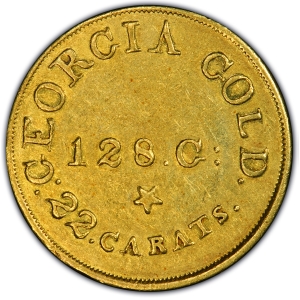
Obverse
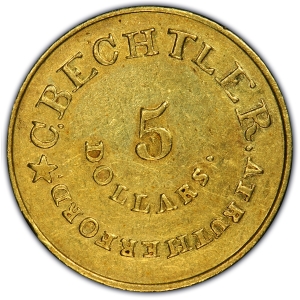
Reverse
The Bechtler coinage is the most significant and prolific of all U.S. private gold series, born from the first major gold rush in American history—the Carolina Gold Rush, which began in 1799. For decades, miners in the Appalachian region of North Carolina and Georgia had no practical way to convert their gold dust into a usable currency. The nearest federal mint was in Philadelphia, a long and perilous journey. This created a severe monetary crisis, particularly during the Jacksonian Era's 'hard money' policies and the Panic of 1837, which saw banks fail and paper money become worthless. Enter Christopher Bechtler, Sr., a German immigrant and master metallurgist who arrived in Rutherfordton, NC, in 1830. Recognizing the region's desperate need, he established a private mint in 1831. He offered a simple, honest service: for a small fee, he would assay miners' gold dust and strike it into coins of a stated weight and fineness. His reputation for absolute integrity meant his coins were immediately accepted in commerce, circulating widely throughout the Southeast. Bechtler's operation was so successful that by the mid-1830s, it had coined millions of dollars in gold, directly leading the U.S. government to establish branch mints in Charlotte, NC, and Dahlonega, GA, in 1838 to reclaim monetary authority. After Christopher Sr.'s death in 1842, his son August continued the mint until the early 1850s, when the Carolina gold fields began to decline.
Assayer/MinterChristopher Bechtler, Sr. and August Bechtler
Minter HistoryChristopher Bechtler, Sr. (1782-1842) was a watchmaker, gunsmith, and metallurgist from the Grand Duchy of Baden, Germany, who immigrated to the U.S. in 1829. His technical skill and unwavering honesty were the foundation of his mint's success. He became one of the most respected figures in the region. Upon his death, his son, August Bechtler (1810-c.1860s), took over the operation. While August continued the coinage and introduced a new eagle design, his tenure was less prolific, and the mint's operations ceased as the Carolina gold deposits waned and federal coinage became more accessible.
Reason for MintingTo convert raw gold dust from the Appalachian gold rush into a standardized, reliable circulating medium in a region starved for hard currency.
Historical SignificanceThe Bechtler mint was the first major private coiner in U.S. history and the most successful of the antebellum era. It provided a stable and trustworthy currency for an entire region, directly spurred the creation of the first U.S. branch mints, and proved the viability of private enterprise in solving monetary crises on the American frontier.
Geographic OriginRutherfordton, North Carolina
The series is characterized by simple, utilitarian designs. The obverse typically features the minter's name ('C.BECHTLER.' or 'A.BECHTLER.') and location ('RUTHERFORD.' or the rarer 'At Rutherf.'). Some varieties simply state the value, such as '28.G.' for 28 grains on a dollar coin.
Obverse InscriptionCommon inscriptions include the minter's name ('C.BECHTLER.ASSAYER.', 'A.BECHTLER.'), location ('RUTHERFORD.'), and value.
Reverse DescriptionThe reverse is dominated by the denomination spelled out (e.g., 'ONE DOLLAR', '2 1/2 DOLLARS', '5 DOLLARS') and a clear statement of the gold's fineness in carats and weight in grains. Later issues by August Bechtler feature a somewhat crude eagle design on the $5 piece.
Reverse InscriptionInscriptions denote the denomination, gold source ('CAROLINA GOLD' or 'GEORGIA GOLD'), fineness ('20 CARATS', '21 CARATS', '22 CARATS'), and weight (e.g., '28 G.', '64 G.', '141 G.').
CompositionGold
Denomination$1, $2.50, $5
Stated FinenessThe Bechtlers transparently stated the fineness of their gold, typically 20, 21, or 22 carats. This honesty was a key reason for their widespread acceptance.
Actual FinenessContemporary assays and modern analysis confirm that the Bechtlers' coins consistently met or slightly exceeded their stated fineness and weight, a stark contrast to many later territorial minters whose products were debased.
Mintages were not systematically recorded, but historical accounts suggest over $2.24 million worth of gold was struck by 1840 alone, equating to hundreds of thousands of coins. Output varied significantly between varieties.
Survival EstimateThe survival rate is extremely low compared to the vast original production. These coins saw heavy, continuous circulation for decades. Because their gold value was known to be honest, they were prime candidates for melting by both the public and the U.S. Treasury, especially after federal coinage became common.
Rarity ScaleThe series spans a wide rarity spectrum. The most common varieties, like the K-17 $5 'CAROLINA GOLD' 140 G., are considered scarce (R-4). Many other varieties are rare to very rare (R-5 to R-6), while a few, like the K-16 $2.50 'GEORGIA GOLD', are great rarities (R-7 or higher).
Bechtler coinage is fundamental to any collection of U.S. gold. It represents the very beginning of pioneer gold and the entrepreneurial spirit of a nation starved for hard currency. Their simple, honest design is a direct reflection of their creator.
Key VarietiesMajor collecting varieties are defined by: Minter (C. Bechtler vs. A. Bechtler); Denomination ($1, $2.50, $5); Inscription ('CAROLINA' vs. 'GEORGIA' gold); Fineness (20, 21, 22 Carats); and spelling variants (the 'RUTHERFORD' vs. the much rarer 'At Rutherf.' die). August Bechtler's eagle reverse $5 is a distinct and popular type.
Kagin #K-1 to K-29
Authentication TipsAuthentic Bechtler coins possess a distinctive character from their manual production. The letter and number punches are of a specific style and can be matched to known dies. Examine coins for evidence of die rust, cracks, and other markers cataloged by experts. The gold alloy often has a slightly greenish tint. Modern counterfeits often have incorrect weights, tool marks from modern engraving, or a 'mushy' appearance from being cast rather than struck.
Shopping ConsiderationsA 'premium quality' Bechtler is one with original, unadulterated surfaces and minimal distracting marks, even in VF or XF grades. Honest wear is far more desirable than a higher-grade coin that has been harshly cleaned, polished, or repaired. Strike quality varies; a coin with a bold, complete strike of the minter's name and the coin's specifications commands a significant premium over a weakly struck example.
A coin's grade is its condition, rated on a 1-70 scale. For rare coins, this is the most critical factor in determining value, as a tiny difference in preservation can mean a huge difference in price.
Relevant Grade TypesAll original Bechtler coins are business strikes intended for commerce. No original proof strikes are known to exist. Collectors must be wary of modern copies or fantasy pieces that are unrelated to the historical mint.
Mint State CharacteristicsMint State examples are exceedingly rare. Quality is judged by the satiny luster, which should be vibrant and unbroken. The strike is often somewhat weak in the centers, which is typical for the series. Planchets can be irregular, and minor adjustment marks (file marks to reduce weight) made at the mint are often seen and are generally accepted.
Circulated Wear PatternsOn most varieties, wear first appears on the highest points of the letters and numbers of the inscriptions. On the A. Bechtler eagle reverse, the high points are the eagle's head and the upper portions of the wings. The fields will accumulate contact marks from circulation, but significant rim bumps or deep gashes will severely detract from the value.
Key Factors for ValueValue is determined by a combination of the specific Kagin variety's absolute rarity, the coin's certified grade, and its eye appeal. Surface preservation is critical—original, problem-free surfaces command immense premiums. For exceptional specimens, particularly high-condition examples or great rarities, a documented provenance tracing back to important historical collections (e.g., Lilly, Garrett, Norweb) can substantially increase its value and desirability.