Lesher (Colorado) Dollars Series
1900-1901
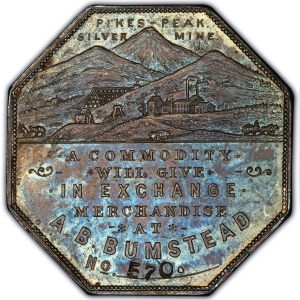
Obverse
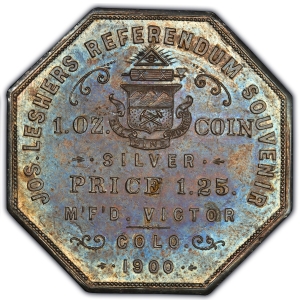
Reverse
The Lesher Referendum Dollars are a tangible link to the fiery political and economic debates of the turn of the 20th century, specifically the 'Free Silver' movement. Joseph Lesher, a Colorado silver mine owner, was a fervent proponent of bimetallism, the idea that the U.S. dollar should be backed by both gold and silver at a fixed ratio (16:1). This issue had dominated the 1896 presidential election, pitting William Jennings Bryan against William McKinley. After Bryan's defeat and the official adoption of the Gold Standard Act of 1900, silver prices plummeted, devastating mining economies in the West like that of Victor, Colorado. In response, Lesher devised a plan to privately monetize silver. He struck octagonal 'dollars' from silver mined in the region and offered them for redemption at a value above their bullion content ($1.25), hoping to demonstrate silver's utility and create a local medium of exchange. The term 'Referendum' was a political statement, implying that by accepting the pieces, citizens were voting in favor of silver. Merchants who agreed to accept them had their names stamped on the reverse. The experiment was short-lived; the U.S. Treasury Department deemed the pieces to be illegal private coinage and ordered Lesher to cease production in 1901, cementing their status as a fascinating and historically rich numismatic relic.
Assayer/MinterJoseph Lesher
Minter HistoryJoseph Lesher (1838-1918) was a silver miner, businessman, and passionate advocate for the Free Silver cause. Having experienced the boom-and-bust cycles of mining, he was deeply invested in the economic policies that affected the value of silver. His 'Referendum Dollar' was not just a commercial venture but a political act, a grassroots effort to challenge federal monetary policy from his small town in the heart of Colorado's Cripple Creek Mining District. Though his coinage was quickly suppressed by the government, his legacy is preserved through these unique pieces that bear his name.
Reason for MintingTo promote the monetization of silver and create a local currency in Colorado's mining districts following the Gold Standard Act of 1900.
Historical SignificanceLesher Dollars are one of the most famous and collectible series within the 'So-Called Dollar' category. They represent a unique intersection of private currency, political token, and Western Americana. Their creation was a direct, tangible protest against the Gold Standard and a final echo of the Populist movement's monetary planks. The series illustrates the economic desperation and political fervor that characterized Western mining towns at the dawn of the 20th century, making them far more than just silver tokens.
Geographic OriginVictor, Colorado
The obverse design is largely consistent across the series. The central motif is a shield containing a detailed scene of mountains (representing the Rockies) with a mining scene in the foreground, including a mill and tools like a pick and shovel. Inscriptions surround this central design.
Obverse InscriptionTypical obverse inscriptions include 'JOS. LESHERS REFERENDUM SOUVENIR', 'ONE OZ. OF COIN SILVER', and the stated value, 'PRICE $1.25' (sometimes with the misspelling 'PICE'). The date, 1900 or 1901, is also present.
Reverse DescriptionThe reverse is where the primary variations occur. Some early issues have a blank reverse. Most, however, were either die-struck or hand-punched with the name and location of a specific merchant who agreed to redeem the coins. This acted as a form of advertising and endorsement.
Reverse InscriptionVaries by merchant. The most common is the die-struck 'A.B. BUMSTEAD PUEBLO, COLO.' Others, which are much rarer, include hand-punched names like 'J.M. SLUSHER', 'SAM COHEN', 'GEO. D. HOBSON', and others from various Colorado towns.
CompositionSilver
Denomination$1.00 or $1.25 (face value/redemption value)
Stated FinenessThe pieces are inscribed 'COIN SILVER', which legally meant a fineness of .900 silver and .100 copper.
Actual FinenessAssays of genuine examples have consistently shown a fineness of approximately .950 silver, making them slightly purer than the U.S. silver dollars they sought to supplement. Lesher intentionally made them of higher quality to encourage their acceptance.
Mintages were not recorded. The total number struck across all types is estimated to be only around 3,500 pieces. Individual merchant varieties had extremely small mintages, often fewer than 100, and some are unique.
Survival EstimateThe total surviving population is estimated to be between 1,000 and 1,500 coins across all varieties. Their novelty ensured many were saved as souvenirs, but their non-legal tender status and the high silver content meant many others were likely melted over the decades. The A.B. Bumstead variety is the most common survivor, while other merchant types are exceptionally rare.
Rarity ScaleThe series spans a wide rarity range. The A.B. Bumstead type (K-798) is considered Scarce (R-4). The initial 1900 Zerbe type (K-795) is Very Rare (R-6). Most other merchant-stamped varieties are Very Rare (R-6) to Extremely Rare (R-7), with a few known by only one or two examples (R-8).
Lesher Dollars have immense crossover appeal, attracting specialists in territorial coinage, So-Called Dollars, political memorabilia, and Western history. Their unique octagonal shape, fascinating backstory, and direct link to the Free Silver movement make them a perennially popular series.
Key Varieties1. 1900 'Zerbe' No Merchant: The first type, often associated with Farran Zerbe. 2. 1900 'Bumstead': The most common, die-struck reverse for merchant A.B. Bumstead. 3. 1901 'Imprint' Merchants: A group of very rare varieties with names of various merchants hand-punched on the reverse (e.g., Slusher, Samelson, Boyd Park). 4. Blank Reverse types.
Kagin #K-793 to K-809
Authentication TipsAuthentic pieces have a sharp, high-relief strike from dies. Look for crisp details in the mining scene. The letter punches on the rare hand-stamped varieties should match known exemplars; counterfeit punches often have the wrong font or spacing. Cast copies will have a soft, porous appearance and often display a seam or tooling marks on the edge. Weight and specific gravity tests are also effective.
Shopping ConsiderationsValue is primarily driven by the rarity of the merchant stamped on the reverse. For any given type, a problem-free coin with minimal marks and strong eye appeal commands a significant premium. A sharp strike is critical; many were weakly struck, so a piece with full detail on the central shield and merchant stamp is highly desirable. Avoid examples that have been harshly cleaned or have significant rim damage.
A coin's grade is its condition, rated on a 1-70 scale. For rare coins, this is the most critical factor in determining value, as a tiny difference in preservation can mean a huge difference in price.
Relevant Grade TypesAll Lesher Dollars were business strikes intended for local commerce. No proof or presentation pieces are known to have been originally struck. They are graded using the same standards as federally issued coins.
Mint State CharacteristicsAn uncirculated (Mint State) Lesher Dollar should exhibit vibrant, unbroken mint luster. The quality of the strike is a key determinant of grade; weak strikes are common, so a fully struck piece is a condition rarity. Due to their handling as novelties, even MS examples can have scattered contact marks; the fewer and less distracting the marks, the higher the grade.
Circulated Wear PatternsWear typically first appears on the highest points of the design: the mountain peaks and the crossed pick and shovel in the central shield on the obverse. On the reverse, friction will first flatten the letters of the merchant's name and town. On heavily worn examples, the finer details of the mining mill will be completely effaced.
Key Factors for ValueThe single most important factor is the specific merchant variety, which dictates the base rarity. The numerical grade is the second factor. Beyond that, eye appeal is crucial; coins with attractive original toning and clean surfaces can sell for multiples of those that are darkly toned or have distracting marks. A clear, well-executed merchant stamp is also highly desirable. For exceptional examples, a documented provenance to a major historical collection (e.g., Zerbe, Clifford, Hibler, Kappen) can add a significant premium.