Confederate States of America Series
1861-1863
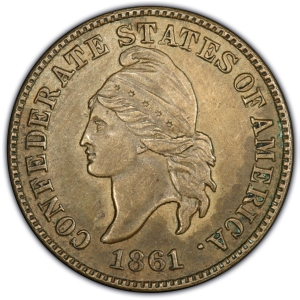
Obverse
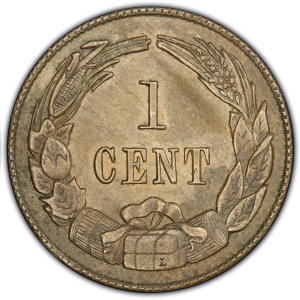
Reverse
The coinage of the Confederate States of America represents a brief but numismatically profound chapter born from the crucible of the Civil War. Upon its secession, the Confederacy sought to establish its own economic and political sovereignty, a key element of which was a national coinage. In early 1861, the CSA seized the three federal branch mints within its territory: Dahlonega, Charlotte, and New Orleans. While the former two simply continued striking U.S. gold coins for a short period, only New Orleans undertook a distinctly Confederate coinage. Under the direction of CSA Treasury Secretary Christopher Memminger, a new reverse die was created for the half dollar. Engraved by A.H.M. Patterson, it featured a shield with seven stars (for the seven initial seceding states) surmounted by a Liberty Cap, all within a wreath of cotton and sugar cane. In April 1861, Chief Coiner B.F. Taylor used this die, paired with a contemporary Union Seated Liberty obverse die, to strike just four specimens. Before mass production could begin, the immense logistical and financial pressures of the war, coupled with a severe silver bullion shortage, halted the project indefinitely. Taylor, fearing the die's capture when Union forces retook New Orleans in 1862, hid it within the city. The die remained lost for years until its rediscovery in 1879, leading to a famous series of restrikes. Concurrently, the CSA sought to produce a cent. A contract was made with Philadelphia die-sinker Robert Lovett Jr., who produced a Greco-Roman styled obverse of Minerva/Liberty and a reverse with an agricultural wreath. Fearing arrest for 'aiding the enemy' by producing coinage for the Confederacy in the heart of the Union, Lovett allegedly struck only a dozen or so samples before hiding the dies and coins in his cellar. The existence of these patterns remained a secret until they were rediscovered decades later, leading, like the half dollar, to a series of subsequent restrikes from the original dies.
Assayer/MinterConfederate States of America (New Orleans Mint); Robert Lovett Jr. (cent patterns)
Minter HistoryThe Confederate coinage effort was driven by political figures rather than established minters. Secretary Christopher Memminger authorized the project. The half dollar die was engraved by A.H.M. Patterson and the four originals were struck by Dr. B.F. Taylor, Chief Coiner of the New Orleans Mint. The cent patterns were a private endeavor contracted to Robert Lovett Jr. of Philadelphia, a well-regarded medalist and die-sinker who operated in a precarious political position, ultimately prioritizing his safety over the completion of the Confederate contract.
Reason for MintingTo establish national sovereignty and facilitate commerce for the newly formed Confederate States of America.
Historical SignificanceThough the planned coinage never reached circulation, the story of the Confederate half dollar and cent is one of the most compelling in U.S. numismatics. The pieces are tangible relics of the Confederacy's national ambitions. The minuscule original mintages, the secret hiding of the dies during wartime, their rediscovery years later, and the subsequent restrikes have created a legacy that far outweighs their contemporary economic impact, making them objects of immense historical fascination and collector desire.
Geographic OriginNew Orleans, Louisiana; Philadelphia, Pennsylvania
The half dollar utilizes a regular issue United States 1861-O Seated Liberty obverse die. The cent patterns feature a classical bust of Liberty (Minerva) facing left, wearing a Phrygian or Liberty cap inscribed LIBERTY, surrounded by stars.
Obverse InscriptionHalf Dollar: Standard U.S. design with 13 stars and the date '1861'. Cent Patterns: 'CONFEDERATE STATES OF AMERICA' and the date '1861'.
Reverse DescriptionThe half dollar reverse features a shield with 7 stars, topped by a Liberty Cap on a pole, flanked by a wreath of cotton and sugar cane. The cent reverse features an agricultural wreath of cotton, wheat, corn, and tobacco enclosing the denomination.
Reverse InscriptionHalf Dollar: 'CONFEDERATE STATES OF AMERICA' and 'HALF DOL.'. Cent Patterns: '1 CENT'.
CompositionSilver (Half Dollar), Copper-Nickel (Original Cent Patterns)
DenominationHalf Dollar, Cent
Stated FinenessHalf Dollar: .900 Silver, per U.S. Mint standards. Cent Patterns: Not applicable, as they were pattern coins.
Actual FinenessConsistent with the U.S. Mint's .900 silver standard for the half dollar. The cent patterns are a copper-nickel alloy.
Half Dollar: Four original specimens struck. Cent: Approximately 12 original copper-nickel patterns struck.
Survival EstimateThe survival rate for the original pieces is effectively 100%, as all four half dollars and the small population of original cents are known and accounted for in major collections. The rarity comes from the microscopic original mintage, not from attrition. Later restrikes were sold to collectors and thus have very high survival rates, though they are still scarce.
Rarity ScaleThe original strikes of both the half dollar and the cent are of the highest rarity, R-8. The 1879 Scott Company restrikes of the half dollar are R-4. The various restrikes of the cent from the 20th century range from R-4 to R-7, depending on the specific metal and striking period.
Confederate issues are a pinnacle of American collecting, combining extreme rarity with a direct, tangible link to the Civil War. The dramatic story of their creation, loss, and rediscovery adds an unparalleled layer of historical romance.
Key VarietiesOriginal 1861 CSA Half Dollar (4 known, R-8) Scott Restrike Half Dollar (1879, 500 struck, R-4) Original 1861 Lovett Cent Pattern in Copper-Nickel (R-8) Lovett/Haseltine/Bashlow Cent Restrikes (various metals and dates, R-4 to R-7)
Kagin #K-1 to K-4 (for original half dollar and cents)
Authentication TipsOriginal half dollars are confirmed by a prominent reverse die crack from the rim, through the 7th star, to the top of the shield. Scott restrikes show a flattened and weakly detailed obverse due to the host coin being planed down. For cents, original copper-nickel strikes must be distinguished from later restrikes in bronze, silver, and gold by composition, weight, and specific die states (e.g., presence of die rust on later strikes). Forgeries exist and professional authentication is non-negotiable for any purported original.
Shopping ConsiderationsFor nearly all collectors, the goal is a restrike. A high-quality Scott restrike half dollar is defined by a sharp, well-centered reverse strike and a host coin (obverse) with minimal evidence of the planing process and strong underlying details. For cents, early restrikes are more desirable than later ones that show significant die degradation. 'Good value' involves balancing the quality of the strike with the originality and preservation of the surfaces.
A coin's grade is its condition, rated on a 1-70 scale. For rare coins, this is the most critical factor in determining value, as a tiny difference in preservation can mean a huge difference in price.
Relevant Grade TypesOriginals were presentation pieces or patterns, not business strikes for circulation, so they are graded as such (e.g., SP for Specimen or PF for Proof). No original proofs were made in the modern sense. The later restrikes were specifically made for collectors and are also graded as Proofs or Specimens.
Mint State CharacteristicsFor uncirculated examples, quality is judged by the sharpness of the strike. The CSA half dollar reverse often shows some central weakness. Luster may be subdued on originals due to handling over time. The key is to find an example with clean surfaces, free from distracting marks or hairlines. On restrikes, look for full striking details and minimal die rust or other imperfections inherited from the aged dies.
Circulated Wear PatternsNot applicable to originals, as none circulated. If a restrike were to show wear, the high points would be Liberty's knee and breast on the half dollar obverse, and the cotton bolls and Liberty Cap on the reverse. For the cent, wear would first appear on Minerva's cheek and the high points of the wreath.
Key Factors for ValueAuthenticity is the absolute first factor. For originals, provenance is paramount; a documented chain of ownership back to the 19th century adds immense value. For all pieces, the technical grade, the quality of the strike (especially on the CSA-specific designs), surface preservation, and overall eye appeal are critical. The type of restrike is also a major value driver, with earlier restrikes struck closer to the time of die rediscovery being far more valuable than later iterations.