California Fractional Gold Series
1852-1882
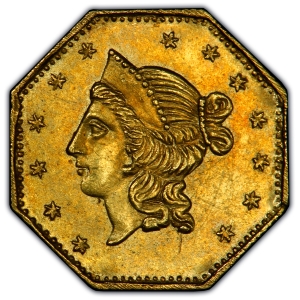
Obverse
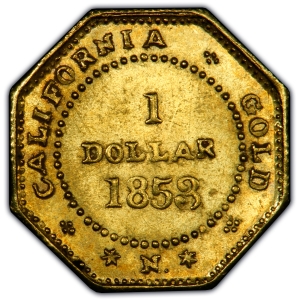
Reverse
California Fractional Gold coinage is a direct, tangible product of the socio-economic chaos of the California Gold Rush. Following the discovery of gold in 1848, a massive influx of prospectors and merchants created a booming economy, but one critically devoid of circulating coinage, especially for small, everyday transactions. Gold dust and nuggets were impractical for buying a drink or a loaf of bread. The U.S. government was slow to react, with federal coins from the East Coast taking months to arrive and being wholly insufficient in quantity. The San Francisco Mint would not open until 1854, and even then, it initially focused on larger denominations. Into this monetary vacuum stepped numerous jewelers, engravers, and private assayers. Between 1852 and 1857 (Period One), these artisans produced immense quantities of tiny quarter-dollar, half-dollar, and dollar coins to facilitate local commerce. These pieces were intended to circulate and did so vigorously. However, the Private Coinage Act of 1864 effectively outlawed private currency. This did not end the production of fractional gold but transformed it. From 1859 to 1882 (Period Two), production shifted to creating souvenir and novelty items for tourists and collectors. These later pieces were often underweight and made of lower-purity gold, intended as keepsakes rather than currency. This entire series thus chronicles the evolution of the California economy from a makeshift frontier system to a more integrated part of the United States.
Assayer/MinterVarious private minters (e.g., Antoine Louis Nouizillet, Robert B. Gray, Herman J. Brand, Gaime & Co., etc.)
Minter HistoryCalifornia Fractional Gold was not the product of a single entity but was struck by dozens of different jewelers, assayers, and private minters, primarily in San Francisco and Sacramento. These individuals were often skilled French, German, or American artisans who saw a commercial opportunity to meet the desperate need for small change. Prominent names include Antoine Louis Nouizillet, Robert B. Gray, Herman J. Brand, Pierre Frontier & Eugene Deviercy (Frontier, Deviercy & Co.), and Gaime, Guillemot & Co. They operated small, independent shops, and the distinct artistic styles and technical qualities of their products are a major focus for specialists.
Reason for MintingTo alleviate a severe shortage of small-denomination circulating coinage for daily commerce in Gold Rush-era California.
Historical SignificanceThese coins represent a classic example of a grassroots response to economic necessity on the American frontier. They are tangible relics of the chaotic, entrepreneurial spirit of the Gold Rush and illustrate the practical difficulties of commerce before the establishment of a robust federal mint presence in the West. Their evolution from practical currency (Period One) to souvenir items (Period Two) also charts the maturation and stabilization of California's economy and its integration into the broader U.S. monetary system.
Geographic OriginSan Francisco and Sacramento, California
The most common obverse motif is a diademed Liberty Head, facing left or right, surrounded by 13 stars. These are often referred to as 'Indian Heads' in contemporary literature, though this is a misnomer. A less common but highly popular design features a portrait of George Washington. The artistic quality and specific details of the portrait vary significantly from one minter to another.
Obverse InscriptionTypically, 'LIBERTY' is inscribed on the coronet of the Liberty Head portrait. The date, if present, is usually located below the bust. Some issues are undated. The maker's name or initials can sometimes be found on the obverse.
Reverse DescriptionThe vast majority of issues feature a simple wreath, open at the top, enclosing the denomination. A few rare varieties feature an eagle, a beaver, or other more complex designs, but the wreath is the standard.
Reverse InscriptionThe denomination is inscribed within the wreath, such as '1/2 DOLLAR' or '25 CENTS'. The words 'CALIFORNIA GOLD' often appear around the perimeter. Variations like 'DOL' or 'D.' for 'DOLLAR' are common.
CompositionGold
Denomination$1/4, $1/2, $1 (in both Round and Octagonal formats)
Stated FinenessFineness was almost never stated on the coins themselves. They were intended to be accepted based on their gold value, though this was often taken on faith.
Actual FinenessHighly variable. Period One circulating issues were generally of a higher, more honest fineness, often ranging from .800 to .900 fine, as they needed to be accepted in trade. Period Two souvenir pieces frequently have a much lower gold content, sometimes below .500 fine (less than 12-karat gold), and were typically underweight.
Mintages were not recorded by the private issuers and are completely unknown. Relative rarity is therefore determined exclusively by painstaking census data and survival estimates for each Breen-Gillio variety.
Survival EstimateSurvival rates for Period One (1852-1857) issues are extremely low. Their minuscule size made them easy to lose, and their heavy use in commerce led to wear and eventual melting. Period Two (1858-1882) souvenir pieces have a much higher survival rate, as they were often bought as keepsakes and put away. Even so, for any specific variety, the number of known survivors is often very small, with many being unique or known by fewer than five examples.
Rarity ScaleThe series spans the entire numismatic rarity spectrum. The most common Period Two souvenir issues might be considered R-1 or R-2 in the context of the series. However, most Period One issues are R-5 to R-7 (4-30 known), and a significant number of varieties are R-8 (unique or 2-3 known). Rarity, as defined by the BG number, is a primary driver of value.
The series is immensely popular for its direct, romantic connection to the California Gold Rush. Its appeal lies in the vast number of varieties, the challenge of collecting, their miniature size, and the fact that they represent a relatively affordable entry point into the world of U.S. territorial gold, while still containing legendary rarities.
Key VarietiesThe most fundamental division is Period One (circulating issues) vs. Period Two (souvenir issues). Other key categories include: denomination (25c, 50c, $1), shape (Round vs. Octagonal), design type (Liberty vs. Washington), and coins attributed to specific, desirable minters. The 'Peacock' and 'Beaver' reverse varieties are famous rarities.
Reference #Primarily cataloged by Breen-Gillio (BG) numbers, from BG-101 to BG-1234.
Authentication TipsAuthentication is paramount, as the field is rife with contemporary and modern counterfeits. Genuine pieces are die-struck and will show characteristic metal flow, not the porous or granular surfaces of cast copies. Examine the style of the letter punches; fakes often use modern, uniform punches, whereas originals show the unique, hand-cut character of 19th-century punches. Compare potential purchases to high-quality images of known genuine examples, paying close attention to die markers (cracks, chips, repunching) cataloged in the Breen-Gillio reference. Third-party certification by PCGS, NGC, or ANACS is strongly recommended.
Shopping ConsiderationsFor this series, 'good value' means finding a problem-free coin with strong eye appeal for the grade. A well-struck, clean VG is often a better acquisition than a weakly struck, heavily marked AU. For Period One coins, evidence of honest circulation is expected and adds to the coin's character. For Period Two pieces, seek examples with original luster and minimal distracting marks. The specific Breen-Gillio (BG) catalog number is the most important factor, as it defines the coin's rarity and historical context.
A coin's grade is its condition, rated on a 1-70 scale. For rare coins, this is the most critical factor in determining value, as a tiny difference in preservation can mean a huge difference in price.
Relevant Grade TypesAll original California Fractional Gold pieces are considered business strikes. No true proofs were ever issued. Some later souvenir issues from the 1870s were struck with polished dies on polished planchets, resulting in a prooflike surface, but these are not official proofs. Collectors must be aware of numerous modern restrikes and replicas that are not from the designated 1852-1882 period.
Mint State CharacteristicsUncirculated examples are exceptionally rare for Period One and more available for Period Two. Strike quality is a key determinant of quality. Many were struck weakly, particularly in the center of the design. A premium Mint State example will exhibit a sharp strike on Liberty's hair strands and the details of the reverse wreath. Luster is typically satiny. Due to the softness of the gold and their method of storage in pouches, even uncirculated pieces can be found with significant contact marks.
Circulated Wear PatternsWear first appears on the highest points of the design: Liberty's cheek, the hair above her eye, and the edges of the wreath leaves. Inscriptions and the date, being small, are often the first elements to become indistinct. Due to their small size and heavy use, it is common to find circulated examples with minor rim bumps, planchet flaws, or scratches; these are graded accordingly but are not always disqualifying for collectors seeking rare varieties.
Key Factors for ValueThe ultimate value of a California Fractional Gold coin is a combination of factors, ranked in importance: 1) The Breen-Gillio (BG) number, which establishes its absolute rarity and period of issue. 2) The coin's condition (grade), with major premiums for problem-free, high-grade examples. 3) Eye appeal, which includes strike quality, surface preservation, and toning. 4) For truly exceptional rarities, a documented provenance tracing back to major historical collections (e.g., F.C.C. Boyd, Ed Risse, Jay Roe) can add a significant premium.