1830 $2.50 Templeton Reid (Regular Strike)
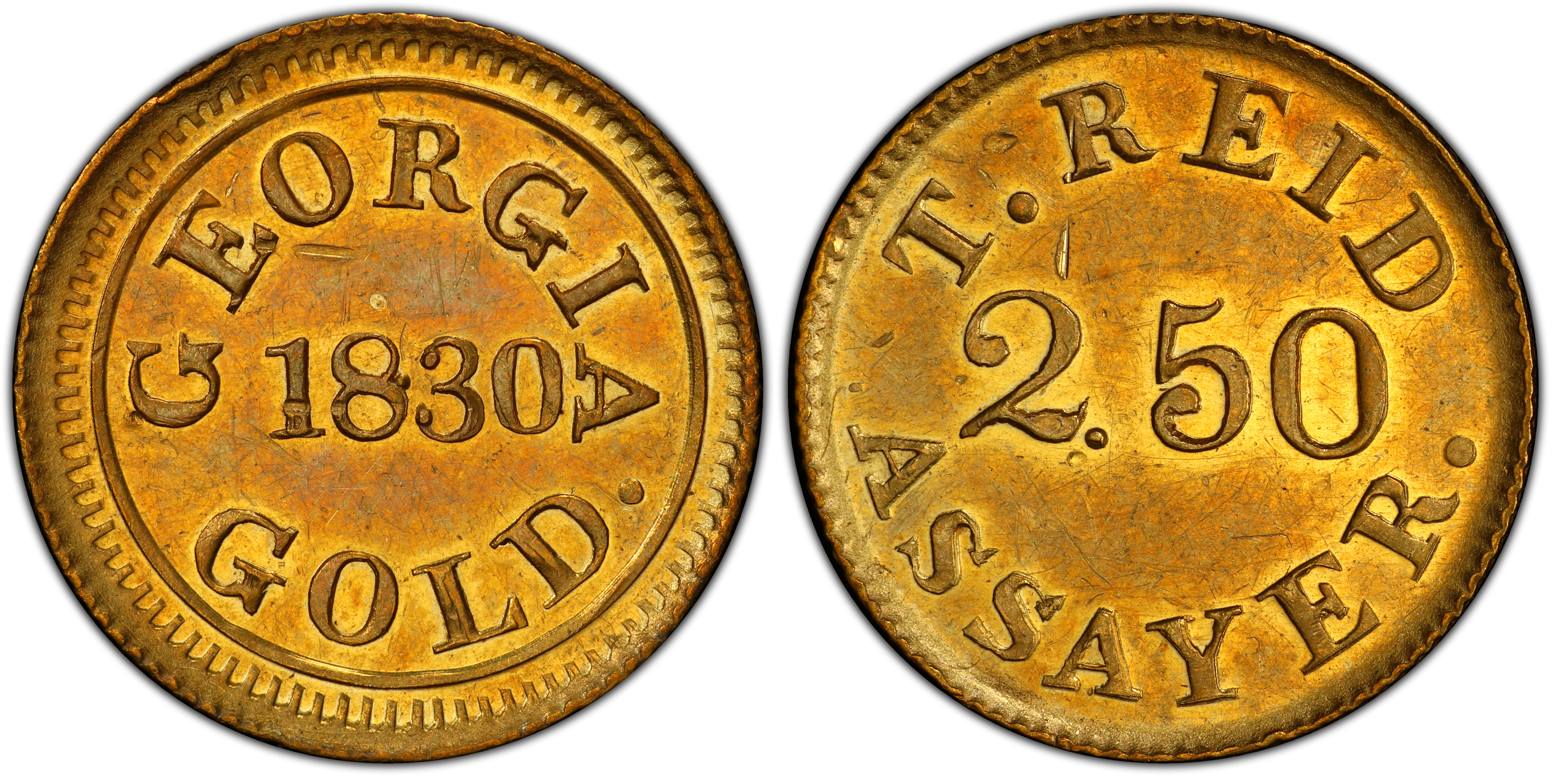
Obverse & Reverse
The 1830 Templeton Reid $2.50 Quarter Eagle stands as the inaugural issue of the first private gold mint in American history, a direct and immediate response to the nation's first major gold rush in Georgia. Gold was discovered in the foothills of the Appalachian Mountains in the late 1820s, drawing thousands of prospectors to the region. This influx of population and raw gold created a severe economic bottleneck. The nearest United States Mint was a long and perilous 600-mile journey away in Philadelphia, making the conversion of gold dust and nuggets into usable specie impractical and dangerous. Miners and merchants were forced to rely on barter or trade gold dust by weight, a system rife with inefficiency and fraud due to inconsistent scales and impurities. Templeton Reid, a skilled watchmaker, gunsmith, and machinist from Milledgeville, Georgia, recognized this critical need for a standardized medium of exchange. In the summer of 1830, he relocated to Gainesville, closer to the gold fields, and established a private mint. Using machinery and dies of his own creation, he began striking gold coins in denominations of $2.50, $5, and $10, advertising his service in the local 'Southern Recorder' on July 24, 1830. Public reception was initially positive; Reid's coins provided a much-needed service and facilitated local commerce. However, his enterprise was short-lived, lasting only about three months. In August 1830, a series of anonymous, critical letters were published in the 'Georgia Courier' under the pseudonym 'No Assayer.' The author claimed to have had a Reid $10 piece assayed by the U.S. Mint, which found it to contain only $9.38 worth of gold. This assertion, which gave Reid a profit of over 6%, was devastating. Reid's critical error was not dishonesty, but a lack of sophisticated metallurgical equipment. He struck his coins from native gold without properly refining it to remove the naturally occurring silver and other alloys. He mistakenly believed the raw gold was nearly pure. The public controversy, combined with accusations that his enterprise violated the U.S. Constitution (a legally gray area at the time), shattered public confidence. Demand for his coins evaporated, and his minting operation ceased by October 1830. The vast majority of his coinage, including most of the estimated 1,000 quarter eagles, was subsequently refused in trade and ultimately melted down at the Philadelphia Mint. This brief, dramatic chapter in monetary history cemented the Templeton Reid issues as legendary rarities, representing a pioneering, if flawed, solution to a frontier economic crisis.
Associated EventGeorgia Gold Rush
Reason For MintingTo convert raw gold dust from the Georgia Gold Rush into a standardized, convenient medium of exchange for local commerce due to the great distance to the U.S. Mint in Philadelphia.
Minter HistoryTempleton Reid (c. 1787-1851) was a versatile and skilled artisan active in Milledgeville and Gainesville, Georgia. Renowned as a watchmaker, gunsmith, silversmith, and machinist, he was an inventive entrepreneur. His decision to open the first private mint in the U.S. in 1830 was a bold attempt to solve a major economic problem on the Georgia frontier. Despite the ultimate failure of his coinage due to a public controversy over its gold content, the venture showcased his mechanical ingenuity. After closing his mint, Reid returned to his other trades, including manufacturing cotton gins. He later produced pattern coins from California gold in 1849, though these never entered production. He died in 1851, leaving a legacy as a pivotal, if controversial, figure in American numismatic history.
Historical SignificanceThe 1830 Templeton Reid coinage marks the very beginning of the extensive history of U.S. private and territorial gold. It was the first attempt by a private individual under the Constitution to supplement the federal money supply during a regional gold rush, setting a precedent that would be followed decades later in California, Oregon, and Colorado. The public controversy and ultimate failure of his mint highlighted the critical importance of accurate assaying and public trust, directly influencing the federal government's decision to establish branch mints in Dahlonega, Georgia, and Charlotte, North Carolina, in 1838.
K-1
Denomination$2.50
Minting Period1830
Assayer/MinterTempleton Reid
Geographic OriginGainesville, Georgia
Obverse DescriptionThe design is simple and utilitarian. In the center, the date '1830' is prominently displayed. Encircling the date around the periphery is the inscription 'GEORGIA GOLD'. A simple raised or denticled ring forms the border.
Obverse InscriptionGEORGIA GOLD / 1830
Reverse DescriptionThe reverse design is equally straightforward. The denomination '2.50' is located in the center. The name of the minter and his title, 'T. REID ASSAYER', encircle the denomination around the periphery. A simple raised border mirrors the obverse.
Reverse InscriptionT. REID ASSAYER / 2.50
CompositionGold
Stated FinenessNot explicitly stated, but intended to be of high purity from unrefined native gold.
Actual FinenessApproximately .900 fine, though variable. U.S. Mint assays of his $10 coin showed it was 22.5 carats, which is about .9375 fine, but analyses suggest the $2.50 had an intrinsic value of only about $2.27, implying a fineness below the U.S. standard of the era.
EdgeReeded
Approximately 1,000
Survival EstimateFewer than 25 known
Rarity ScaleR-6 (Very Rare: 13-30 known)
This coin possesses immense historical significance as the first private gold coin struck in the United States. Its connection to the nation's first gold rush and its extreme rarity make it a cornerstone piece for advanced collectors of Territorial gold, early American coinage, and Georgia-related numismatics. It is the most obtainable of Reid's three denominations, but 'obtainable' is a highly relative term for such a rare issue.
Key VarietiesThere are no major design varieties of the Kagin-1 1830 $2.50 issue struck for circulation. Unlike some later Territorial series, Templeton Reid did not produce any patterns, trial pieces, or special presentation strikes of his Georgia coinage that are known to exist today. His later involvement with California gold in 1849 resulted in pattern $10 and $25 coins, but these are entirely separate issues and not related to the 1830 Georgia minting period. The only known variety is a subtle one involving the style of the '3' in the date, but this is a minor die variation not typically collected as a distinct variety.
Authentication TipsAuthentication should be left to top-tier grading services (PCGS, NGC). Genuine examples exhibit a distinctive crude style. The lettering is somewhat uneven in placement and strength, a hallmark of hand-cut dies. The surfaces often show planchet imperfections and adjustment marks consistent with primitive minting technology. Counterfeits may appear too perfect, with sharp, uniform lettering and fields that are artificially smooth or granular. Weight and specific gravity tests are crucial, as fakes may not match the density of the known gold alloy. The reeded edge on genuine specimens is often weak and irregular.
Shopping ConsiderationsFor a coin of this rarity, any example is a major acquisition. A 'premium quality' specimen is one that is free from significant impairments such as repairs, harsh cleaning, or excessive marks. Look for a bold strike, particularly on the date and denomination, which can be weak. The ideal coin will retain some measure of its original mint luster, often seen as a soft, satiny glow in the protected areas around the devices. Eye appeal is paramount; coins with a pleasing, original reddish-gold or orange-peel toning are highly coveted and command significant premiums over those that have been dipped or cleaned. Given the high value and potential for issues, purchasing a coin certified by PCGS or NGC, and ideally approved by CAC, is strongly advised.
A coin's grade is its condition, rated on a 1-70 scale. For rare coins, this is the most critical factor in determining value, as a tiny difference in preservation can mean a huge difference in price.
Relevant Grade TypesAll original 1830 Templeton Reid coins were business strikes intended for circulation and are found in Circulated grades (AG-3 to AU-58) and, very rarely, in Mint State (MS-60 to 70). No Proof (PR/PF) examples were struck by Templeton Reid during the original minting period, and no later-date restrikes were ever produced. Any coin purporting to be a 'Proof' would be highly suspect and not a genuine product of Reid's 1830 mint.
Mint State CharacteristicsUncirculated examples are exceedingly rare. A true Mint State specimen exhibits original, satiny mint luster, though the quality can be subdued due to the crude production methods. The strike is often somewhat weak in areas, particularly on the dentils and parts of the peripheral legends. Planchet quality is typically poor, so small, mint-made imperfections or adjustment marks are common and should not be confused with post-strike damage. Contact marks are expected, but large, distracting marks on the central design elements will limit the grade.
Circulated Wear PatternsWear first appears on the highest points of the simple design. On the obverse, friction will first dull the luster on the numerals of the date '1830' and the surrounding fields. On the reverse, the numerals '2.50' and the letters of 'ASSAYER' will show the first signs of flattening. On mid-grade examples (VF-XF), the letters in 'GEORGIA GOLD' and 'T. REID' will show wear on their tops. In lower grades (F and below), the legends will become soft and may start to merge with the rim, and the central digits will be significantly flattened.
Key Factors For ValueOriginality of the surfaces is the single most important factor. An example with untouched, original 'skin' is far more valuable than a cleaned or processed coin of the same technical grade. Secondly, the strength of the strike is critical; a coin with a sharp date and denomination is highly desirable. Eye appeal, driven by attractive toning and minimal distracting marks, plays a huge role in pricing. Finally, for this issue, approval by CAC (Certified Acceptance Corporation) provides a significant validation of quality for the grade and typically results in a substantial price premium, as it confirms the coin's superior originality and eye appeal.
PCGS Price Guide
| Grade | Price | Population |
|---|---|---|
| 20 | $135,000.00 | 1 |
| 25 | $150,000.00 | N/A |
| 30 | $175,000.00 | N/A |
| 35 | $190,000.00 | 2 |
| 40 | $225,000.00 | 1 |
| 45 | $250,000.00 | 2 |
| 45+ | $265,000.00 | N/A |
| 50 | $330,000.00 | 3 |
| 50+ | $350,000.00 | N/A |
| 53 | $375,000.00 | N/A |
| 53+ | $400,000.00 | N/A |
| 55 | $425,000.00 | 2 |
| 55+ | $450,000.00 | N/A |
| 58 | $475,000.00 | 2 |
| 58+ | $525,000.00 | 1 |
| 60 | $575,000.00 | N/A |
| 61 | $650,000.00 | 1 |
Graysheet Price Guide
| Coin | Price Range |
|---|---|
| 1830 G$2 1/2 Templeton Reid, K-1 MS | $300,000 - $510,000 |
| 1830 G$5 Templeton Reid, K-2 MS | $510,000 - $870,000 |
| 1830 G$10 Templeton Reid, K-3 MS | $1,200,000 - $1,440,000 |