1849 $10 Oregon (Regular Strike)
From the Oregon Gold (1849) Series
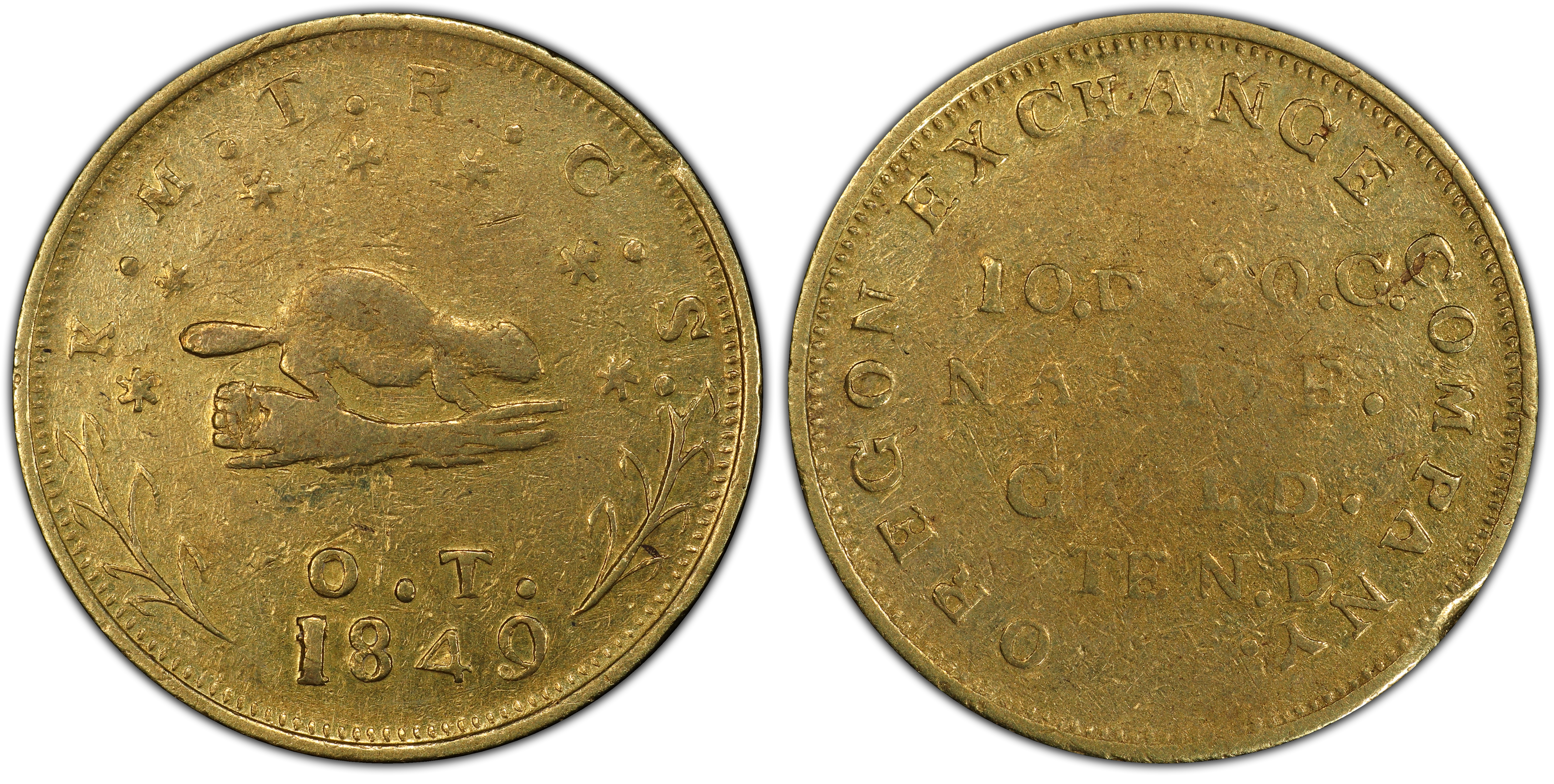
Obverse & Reverse
The 1849 Oregon Exchange Company ten-dollar gold piece, colloquially known as 'Beaver Money,' is a numismatic legacy of American frontier ingenuity and necessity. Following the discovery of gold in California in 1848, many Oregonians journeyed south, returning by early 1849 with significant quantities of gold dust. This influx created a severe economic problem in the Oregon Territory, which lacked a standardized medium of exchange. Commerce was crippled by the cumbersome and often fraudulent system of barter and weighing gold dust for every transaction. Recognizing the crisis, the provisional legislature passed a bill to establish a territorial mint on February 15, 1849. However, the newly arrived territorial Governor, Joseph Lane, declared the act unconstitutional, asserting that only the federal government had the right to coin money. In response to this governmental void, a consortium of eight prominent citizens—William K. Kilborne, Theophilus Magruder, James Taylor, George Abernethy, William H. Willson, William H. Rector, John Gill Campbell, and Noyes Smith—formed the Oregon Exchange Company to undertake a private coinage. Using rudimentary equipment, including machinery forged from old wagon tires by a Salem blacksmith, they began striking $5 pieces in March 1849, followed shortly by the $10 issue. These coins were struck from unrefined, unalloyed California gold. To ensure their acceptance and compensate for any potential variance in fineness, the minters deliberately made the coins overweight—the $10 piece contained approximately 8-10% more gold than its federal counterpart. This high intrinsic value made them instantly popular and trusted in commerce throughout the Pacific Northwest. However, this same quality sealed their fate. When the U.S. Assay Office and later the San Francisco Mint began operations in the early 1850s, the overweight 'Beaver Money' was actively sought out, exchanged at a premium, and melted down en masse. The minting operation itself was short-lived, ceasing in September 1849 when their crucibles broke. This brief production window, combined with the systematic destruction for profit, has rendered the Oregon Exchange Company issues, particularly the $10 denomination, exceptionally rare and historically significant as the first 'dollars' of the Oregon Territory.
Associated EventCalifornia Gold Rush
Reason For MintingTo create a standardized, reliable medium of exchange for the Oregon Territory, which was flooded with California gold dust but lacked official coinage.
Minter HistoryThe Oregon Exchange Company was a private enterprise founded in 1849 in Oregon City by eight influential residents to address a critical currency shortage. Key figures included William H. Rector, who helped create the machinery, and Victor M. Wallace, who engraved the dies for the $10 coin. The company operated for less than a year, from roughly March to September 1849, before disbanding. Their coinage, though technically illegal from a federal perspective, was essential to the region's economy and stands as a classic example of pioneer resourcefulness.
Historical SignificanceThe Oregon Exchange Company coinage was the first currency struck in the Pacific Northwest and played a vital role in stabilizing the regional economy during a period of rapid growth and monetary chaos. Its creation represented a direct challenge to the federal government's monopoly on coinage, born out of frontier necessity. The 'Beaver Money' is a tangible artifact of the socio-economic impact of the California Gold Rush far beyond California's borders and symbolizes the independent spirit of the Oregon Territory before its full integration into the United States.
K-2
Denomination$10
Minting Period1849
Assayer/MinterOregon Exchange Company
Geographic OriginOregon City, Oregon Territory
Obverse DescriptionThe central device is a representation of a beaver, facing right, standing on a log. Above the beaver, in an arc, are the initials of five partners of the Oregon Exchange Company: K. M. T. R. C. S. (Kilborn, Magruder, Taylor, Rector, Campbell, Smith). Below the log is the abbreviation for Oregon Territory, O.T., above the date, 1849, which is flanked by laurel branches.
Obverse InscriptionK. M. T. R. C. S. / O. T. / 1849
Reverse DescriptionThe reverse is purely informational and contains no images. At the periphery is the name of the issuing authority. The central inscription is arranged in four lines, indicating the weight and composition.
Reverse InscriptionOREGON EXCHANGE COMPANY / 10. D. 20. G. / NATIVE. / GOLD. / TEN D.
CompositionGold (unalloyed native gold with natural silver content)
Stated FinenessNATIVE. GOLD.
Actual FinenessVariable, approximately .870 to .900 fine, as it was unrefined gold from California.
Weight16.85 grams
Diameter27.00 mm
EdgePlain
2,850
Survival EstimateFewer than 20
Rarity ScaleHigh R-6
The 1849 $10 'Beaver' is one of the most iconic and desirable issues in the entire Territorial gold series. Its appeal stems from its extreme rarity, its direct connection to the westward expansion and the California Gold Rush, its charmingly primitive and unique beaver design, and its romantic, frontier history. It is a foundational coin for any advanced collection of U.S. private gold.
Key VarietiesThere are no major varieties of the 1849 $10 regular issue. The dies for the $10 coin corrected errors found on the earlier $5 piece (K-1), such as changing 'T.O.' to the correct 'O.T.' and Campbell's initial from 'G' to 'C'. The initials of Abernethy and Willson, present on the $5, were removed for the $10. No known patterns, restrikes, or special collector issues were produced by the original minters.
Authentication TipsAuthentic examples are struck on crude, unalloyed gold planchets and often exhibit a distinct lime-green or reddish-gold hue due to natural silver and copper content. The strike is almost universally weak in the centers, particularly on the beaver's body and the central reverse inscriptions. The lettering is crude and irregular. Counterfeits are often cast, showing pitting and a soapy feel, or are struck with incorrect details and lettering style. Any example with a sharp, full strike on the beaver should be viewed with extreme suspicion.
Shopping ConsiderationsFinding any example is a challenge. A 'premium quality' specimen is one that is problem-free, without evidence of cleaning, tooling, repairs, or mounting. Look for original, unmolested surfaces, even if well-worn. Given the softness of the unalloyed gold, expect to see numerous contact marks and abrasions; the key is distinguishing honest circulation from later damage. An example with a stronger-than-average strike, particularly showing some detail on the beaver's fur or on the log, would command a significant premium. Eye appeal is paramount; coins with attractive, consistent original coloration are highly prized.
A coin's grade is its condition, rated on a 1-70 scale. For rare coins, this is the most critical factor in determining value, as a tiny difference in preservation can mean a huge difference in price.
Relevant Grade TypesAll original 1849 $10 Oregon Exchange coins were struck as business strikes intended for commerce and are found in Circulated (1-58) and, very rarely, in low-end Mint State (MS, 60-70) grades. No original Proof (PR/PF) examples were ever struck. The finest known examples are graded in the About Uncirculated (AU) range, and a true Mint State coin is a major numismatic prize. No later-date Proof restrikes or special collector strikings are known to exist.
Mint State CharacteristicsAn uncirculated example of this coin would exhibit some degree of mint luster, though likely soft and satiny rather than deeply prooflike. The strike would still be characteristically weak in the center, so a lack of full detail on the beaver's fur is expected and not a detriment to the grade. The fields would be free of wear but, due to the softness of the pure gold, will likely show scattered contact marks and small abrasions from the primitive minting and handling process. The color of the gold is often a key indicator of originality.
Circulated Wear PatternsWear first appears on the highest points: the beaver's shoulder, hip, and the top of its head. The log on which the beaver stands will also show early friction. On the reverse, the letters of 'NATIVE' and 'GOLD' in the center will begin to flatten. In lower grades (VG and below), the beaver becomes a near-silhouette, the date becomes weak, and the peripheral lettering begins to merge with the rim.
Key Factors For ValueFor the $10 Beaver, value is determined first by rarity, then by grade and quality. The primary factor is the condition of the surfaces; an example with original, uncleaned 'skin' is immensely more valuable than a harshly cleaned or damaged piece of the same grade. Strike sharpness is a major consideration; any specimen showing more central detail than is typical will command a premium. Eye appeal, driven by attractive toning and minimal distracting marks, is crucial. A CAC sticker is highly significant for this issue, as it provides a third-party endorsement of quality and originality for the assigned grade.
PCGS Price Guide
| Grade | Price | Population |
|---|---|---|
| 8 | $105,000.00 | N/A |
| 10 | $130,000.00 | N/A |
| 12 | $175,000.00 | N/A |
| 15 | $250,000.00 | N/A |
| 20 | $400,000.00 | 3 |
| 25 | $425,000.00 | N/A |
| 30 | $450,000.00 | N/A |
| 35 | $475,000.00 | N/A |
| 40 | $500,000.00 | 1 |
| 45 | $550,000.00 | 2 |
| 45+ | $575,000.00 | N/A |
| 50 | $600,000.00 | N/A |
| 50+ | $650,000.00 | N/A |
| 53 | $700,000.00 | N/A |
| 53+ | $750,000.00 | N/A |
| 55 | $800,000.00 | 1 |
| 55+ | $850,000.00 | N/A |
| 58 | $925,000.00 | N/A |
| 58+ | $1,000,000.00 | 1 |