1849 $5 Oregon Exchange Co. (Regular Strike)
From the Oregon Gold (1849) Series
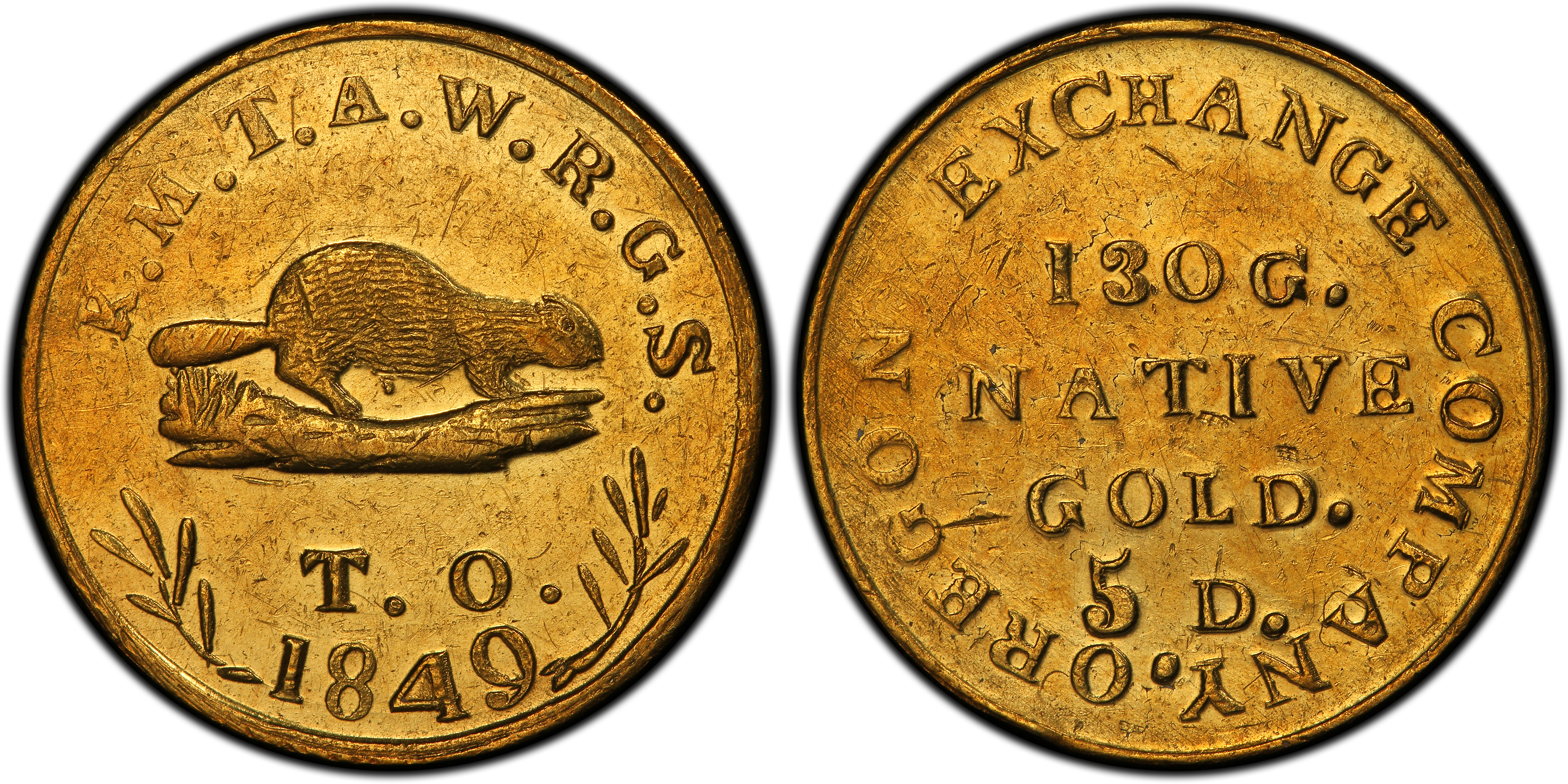
Obverse & Reverse
The 1849 $5 'Beaver' coin is a direct and tangible artifact of the economic turmoil and ingenuity that characterized the American West following the California Gold Rush. In 1848, many Oregon Territory settlers traveled south to the California gold fields and returned with significant quantities of gold dust. This sudden influx of wealth created a severe economic problem: the territory lacked a standardized medium of exchange. Gold dust, while valuable, was impractical for daily transactions, prone to spillage, and subject to fraudulent measurement by unscrupulous merchants, causing miners to lose a significant percentage of its true value. The local economy, which had previously relied on a clumsy system of barter involving wheat, furs, and scrip, was thrown into chaos. Recognizing the urgent need for a stable currency, the territorial legislature passed an act on February 15, 1849, to establish a public mint. However, the newly appointed territorial governor, Joseph Lane, declared the act unconstitutional on March 3, arguing that coinage was an exclusive power of the federal government. Faced with a governor's veto and with Washington D.C. months away by post, a group of eight prominent Oregon City citizens took matters into their own hands. They formed a private joint-stock venture, the Oregon Exchange Company, to mint their own coins. The machinery was ingeniously fabricated by blacksmith Thomas Powell, largely from scrap iron salvaged from wagon wheel rims of abandoned prairie schooners. From roughly March to September 1849, this makeshift mint produced approximately 6,000 $5 pieces and a smaller number of $10 coins. To ensure public acceptance, the coins were intentionally struck from native, unalloyed gold and made overweight, containing about 8-10% more gold than their stated face value (U.S. Mint assays valued them at about $5.50). This strategy worked, and the 'Beaver Money' was readily accepted in commerce, stabilizing the regional economy. However, this over-valuation also sealed their fate; the coins were ironically too valuable to survive. They were quickly bought up and shipped to San Francisco or the Philadelphia Mint to be melted for a tidy profit, leading to their extreme rarity today.
Associated EventCalifornia Gold Rush and westward expansion
Reason For MintingTo create a standardized medium of exchange for the Oregon Territory due to a lack of official currency and the impracticality of using raw gold dust.
Minter HistoryThe Oregon Exchange Company was a private enterprise founded in early 1849 by eight prominent citizens of Oregon City: William K. Kilborn, Theophilus Magruder, James Taylor, George Abernethy (the former provisional governor), William H. Willson, William H. Rector, John G. Campbell, and Noyes Smith. This consortium of merchants and leaders organized to fill the monetary void left by the legislature's failed attempt to create a territorial mint. Hamilton Campbell, a Methodist missionary, is credited with cutting the dies for the $5 piece, while William H. Rector, one of the partners, performed the lathe work. The company operated for only about six months before ceasing operations in September 1849, partly because their two crucibles broke and also because key members decided to return to the California gold fields.
Historical SignificanceThe Oregon Exchange Company's coinage was the first to be privately struck on the Pacific Coast of the United States. These coins successfully stabilized a regional economy on the brink of chaos, broke the local trading monopoly of the Hudson's Bay Company, and represent a classic example of American frontier pragmatism and self-reliance in the face of governmental inaction. They are among the most storied and sought-after issues in the entire U.S. Territorial gold series.
K-1
Denomination$5
Minting Period1849
Assayer/MinterOregon Exchange Company
Geographic OriginOregon City, Oregon Territory
Obverse DescriptionThe central device is a rustic depiction of a beaver, a symbol of the Oregon region's early fur trade economy, facing right and resting on a log. Above the beaver are the initials of the eight company partners. Below the beaver and log are the initials for 'Territory of Oregon' and the date '1849', flanked by small branches.
Obverse InscriptionK.M.T.A.W.R.G.S. / T.O. / 1849
Reverse DescriptionThe reverse is purely textual. The issuer's name encircles the top periphery. The center contains the weight '130 G.' (for Grains), the composition 'NATIVE GOLD.', and the denomination '5 D.' (for 5 Dollars), arranged in three lines.
Reverse InscriptionOREGON EXCHANGE COMPANY / 130 G. / NATIVE GOLD. / 5 D.
CompositionGold (unalloyed native gold)
Stated FinenessStated as 'Native Gold', implying no specific fineness, but understood to be unrefined.
Actual FinenessVaries by planchet as the gold was unrefined, but generally high-purity gold with natural trace silver. U.S. Mint assays confirmed the intrinsic value was significantly higher than face value.
Weight8.42 grams
Diameter23.00 mm
EdgePlain
Approximately 6,000
Survival Estimate50-75 coins in all grades
Rarity ScaleR-6
This coin is highly coveted for its historical importance as the first private gold coin from the Pacific Coast, its iconic 'Beaver' design, its famous engraving errors, and its extreme rarity. It tells a vivid story of the American frontier and is a centerpiece for any advanced collection of U.S. Territorial gold.
Key VarietiesThere are no major varieties from the original 1849 minting period. The entire issue is known for two famous die-cutting errors: 1) The initials 'T.O.' on the obverse are reversed and should be 'O.T.' for Oregon Territory (this was corrected on the later $10 issue). 2) The initial 'G' was used instead of 'C' for partner John G. Campbell (this was also corrected on the $10 coin). There are no known patterns, trial pieces, or later-date restrikes of this coin.
Authentication TipsOriginals have a crude, rustic appearance due to the primitive minting process. The strike is often weak, particularly on the reverse lettering. The surfaces of genuine examples often have a slightly soft, irregular luster characteristic of unalloyed gold. Counterfeits may appear too sharp or have a cast appearance with pitting or a soapy texture. Plated copies are common and will have an incorrect weight and metallic ring. Known diagnostics, such as minor die cracks or specific letter placements, should be compared against high-quality images of certified examples.
Shopping ConsiderationsA 'premium quality' example for this issue is one that exhibits a bold strike for the issue, especially on the beaver's fur and the reverse inscriptions, which are often faint. Original, uncleaned surfaces are paramount; many surviving examples have been harshly cleaned or damaged. Look for coins with minimal distracting marks and a pleasing, original reddish or greenish-gold color. Avoid examples with evidence of tooling, harsh cleaning, or removal from jewelry. Evenly circulated, problem-free coins in grades like VF and XF are highly desirable and represent the typical condition for this rare issue. Any Mint State example is a major numismatic prize.
A coin's grade is its condition, rated on a 1-70 scale. For rare coins, this is the most critical factor in determining value, as a tiny difference in preservation can mean a huge difference in price.
Relevant Grade TypesAll original 1849 Oregon $5 coins are business strikes, created for general circulation. They are found in Circulated grades (AG-3 to AU-58) and, very rarely, in Mint State (MS, 60-70). No Proof examples were struck during the original minting period, and there are no known later-date Proof restrikes. Any coin described as a 'Proof' is either a modern replica or a misrepresentation.
Mint State CharacteristicsUncirculated examples are exceptionally rare. A typical Mint State specimen will still exhibit some production weakness, especially on the reverse lettering and the lower right obverse border. Luster is typically soft and satiny rather than flashy, a characteristic of the high-purity, unalloyed gold. Because the gold is soft, even a coin that never circulated will likely have some small contact marks or 'chatter' from mint handling and bag storage. The finest known examples are graded only MS-62.
Circulated Wear PatternsWear first appears on the highest points of the design. On the obverse, check for flatness on the beaver's back, head, and tail. The initials above the beaver are also high points that will show early friction. On the reverse, the central inscriptions ('130 G.', 'NATIVE GOLD.') and the words 'EXCHANGE COMPANY' will show wear first. In lower grades (VG and below), the beaver becomes a partial outline, and the finer inscriptions may become illegible.
Key Factors For ValueFor the Oregon $5, value is driven by several key factors. First is surface preservation; an example with original 'skin' and no harsh cleaning, tooling, or damage commands a significant premium. Second is the sharpness of the strike, as well-struck examples showing detail in the beaver's fur are rare and prized. Third is overall eye appeal; coins with a pleasing, even color and minimal distracting marks are most sought-after. Finally, certification by a top-tier service (PCGS or NGC) is essential, and a sticker from CAC (Certified Acceptance Corporation) indicating premium quality for the grade will add a substantial premium.
PCGS Price Guide
| Grade | Price | Population |
|---|---|---|
| 2 | $26,000.00 | 1 |
| 3 | $27,500.00 | N/A |
| 4 | $29,000.00 | N/A |
| 6 | $30,000.00 | N/A |
| 8 | $32,500.00 | N/A |
| 10 | $36,000.00 | N/A |
| 12 | $40,000.00 | N/A |
| 15 | $45,000.00 | 2 |
| 20 | $52,500.00 | 1 |
| 25 | $57,500.00 | 2 |
| 30 | $72,500.00 | 3 |
| 35 | $80,000.00 | 2 |
| 40 | $95,000.00 | 9 |
| 45 | $98,500.00 | 5 |
| 45+ | $110,000.00 | N/A |
| 50 | $125,000.00 | 4 |
| 50+ | $135,000.00 | N/A |
| 53 | $160,000.00 | 1 |
| 53+ | $175,000.00 | N/A |
| 55 | $200,000.00 | 1 |
| 55+ | $225,000.00 | N/A |
| 58 | $250,000.00 | 2 |
| 58+ | $300,000.00 | N/A |
| 60 | $350,000.00 | N/A |
| 61 | $400,000.00 | N/A |
| 62 | $475,000.00 | 1 |