(1842-52) $5 C. Bechtler, 134 Grains, 21 Carats (Regular Strike)
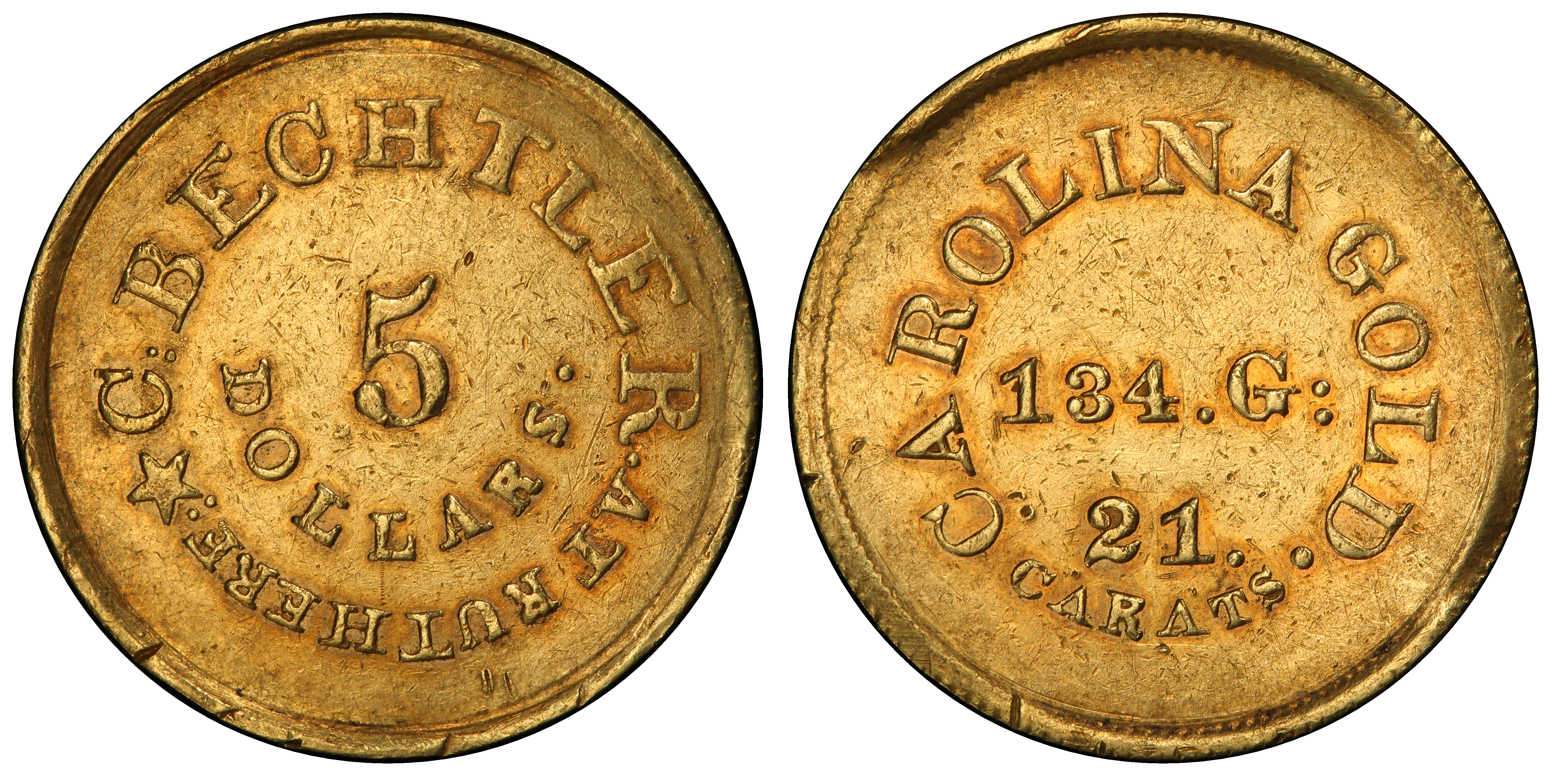
Obverse & Reverse
The Bechtler coinage is a direct product of America's first gold rush, which occurred not in California, but in the rolling hills of the Southern Appalachian Mountains of North Carolina and Georgia. Prior to 1848, this region was the sole domestic source of gold for the United States. Miners, however, faced a significant dilemma: the only U.S. Mint was in Philadelphia, a treacherous and lengthy journey away. Transporting raw gold dust was perilous, and the returns from the Mint were slow to arrive, stifling local commerce. Into this vacuum stepped Christopher Bechtler, Sr., a skilled German metallurgist and watchmaker who immigrated to Rutherfordton, North Carolina, in 1830. In July 1831, he established a private mint that quickly earned a reputation for scrupulous honesty and accuracy. His coins, valued by their stated weight and fineness, became the lifeblood of the regional economy, trusted more than the scarce paper money of the era. Christopher Sr. operated the mint with his son, Augustus, until his death in 1842. Augustus, a trained gunsmith and jeweler himself, seamlessly took over the family business. The coin specified, K-27, is a product of Augustus's tenure. While the user's query mentions 'C. Bechtler', coinage from the 1842-52 period with these specifications was struck by Augustus. He continued his father's legacy of high-quality coinage, producing $1 and $5 gold pieces that were indispensable to the local economy. The Bechtler mint's output was so significant that it is estimated they coined over $2.24 million in gold between 1831 and 1840 alone, rivaling the output of the U.S. Mint during that period. Even after the establishment of federal branch mints in Charlotte (1838) and Dahlonega (1838), the Bechtler's operation continued to thrive due to its convenience and trusted reputation. The K-27, with its clear declaration of weight and purity, is a tangible link to this fascinating chapter of American economic history, a time when a private family of German immigrants provided a crucial monetary service that fueled the prosperity of an entire region.
Associated EventAppalachian Gold Rush (Carolina/Georgia Gold Rush)
Reason For MintingTo convert raw gold dust from the Appalachian Gold Rush into a reliable, standardized medium of exchange for local commerce due to the distance and danger of shipping gold to the Philadelphia Mint.
Minter HistoryAugustus Bechtler (ca. 1813-1846) was the son of Christopher Bechtler, Sr., the founder of the Bechtler Mint. Trained by his father in metallurgy and the family trades of watchmaking and gunsmithing, he was well-prepared to take over the coining operations upon his father's death in 1842. Augustus continued the mint's reputation for integrity, producing coins of honest weight and fineness. He modified some of his father's designs, notably removing the 'GEORGIA GOLD' designation for the 22-carat pieces and standardizing on 'CAROLINA GOLD'. The business continued to prosper under his direction, though it faced increased competition from the nearby Charlotte branch mint. Augustus ran the mint until he was succeeded by his cousin (Christopher Bechtler, Jr.) around 1846; the mint ceased operations entirely by the early 1850s.
Historical SignificanceThe Bechtler coinage was the most successful and prolific private currency in United States history before the Civil War. It provided a stable and trusted monetary system for the gold-producing regions of the Southeast, facilitating economic growth. The K-27 is a prime example of the coinage under Augustus Bechtler, representing the continuation of a vital economic institution and a direct link to the nation's first gold rush.
K-27
Denomination$5
Minting Periodca. 1842-1852
Assayer/MinterAugustus Bechtler
Geographic OriginRutherfordton, North Carolina
Obverse DescriptionThe central device consists of the weight and purity, '134.G:' on one line above '21. CARATS' on a second line, all enclosed within a circular inscription 'CAROLINA GOLD'. There are no stars or other ornaments on the obverse.
Obverse Inscription134.G: 21. CARATS CAROLINA GOLD
Reverse DescriptionThe denomination '5 DOLLARS.' is centered. This is surrounded by the circular inscription '* A. BECHTLER.' at the top and 'RUTHERFORD.' at the bottom, with the periods included as part of the legend.
Reverse Inscription5 DOLLARS. * A. BECHTLER. RUTHERFORD.
CompositionGold
Stated Fineness21 Carats (0.875 fine)
Actual FinenessGenerally considered to be accurate to the stated fineness.
Weight8.68 grams
Diameter24.50 mm
EdgeReeded
Unknown
Survival EstimateApproximately 40-50 known
Rarity ScaleR-5+
This coin is highly sought after as a key issue from the most prolific private mint in U.S. history and a direct artifact of America's first gold rush. Its simple, utilitarian design and clear markings of weight and value speak to its essential role in commerce. As the most common of the Augustus Bechtler $5 varieties, it is often the choice for collectors seeking a representative example from this historic period.
Key VarietiesAugustus Bechtler struck three main varieties of $5 coins, distinguished by weight and purity: K-27 (134 Grains, 21 Carats), K-28 (128 Grains, 22 Carats), and K-29 (141 Grains, 20 Carats). A unique transitional piece, K-26, exists with a C. Bechtler obverse die and A. Bechtler reverse die. The most directly related Christopher Bechtler piece is the K-20 (134 Grains, 21 Carats), struck ca. 1834-1837 with a plain edge. Of special note to advanced collectors are the Henry Chapman restrikes, produced around 1908-1920 using original or copy dies. These Proof restrikes are numismatically distinct, much rarer than the original business strikes, and command very high prices.
Authentication TipsAuthentic examples have a somewhat crude but sharp strike from a hand-operated screw press. The lettering is distinctive and should be compared to high-resolution images of certified examples; pay close attention to the shape of the letters and numerals. The reeding is typically coarse and somewhat irregular. Counterfeits often have a soft or cast appearance, incorrect weight, or a soapy, non-metallic luster. The surfaces of genuine pieces often show planchet striations or adjustment marks consistent with the Bechtlers' minting process. Any piece that is attracted to a magnet is a forgery.
Shopping ConsiderationsA premium quality example for the grade will exhibit a bold strike, especially on the central weight and purity legends and the minter's name. Look for coins with original, undisturbed surfaces and a pleasing, often reddish or greenish-gold, original skin. Many survivors are found in Extremely Fine or About Uncirculated condition; Mint State examples are exceedingly rare. Avoid specimens that have been harshly cleaned, which imparts a bright, unnatural shine and often leaves hairline scratches. Evidence of tooling, polishing in the fields, or repairs at the edge should be cause for rejection. Given the coin's rarity and value, purchase only examples certified by a top-tier grading service (PCGS or NGC).
A coin's grade is its condition, rated on a 1-70 scale. For rare coins, this is the most critical factor in determining value, as a tiny difference in preservation can mean a huge difference in price.
Relevant Grade TypesOriginal period issues were business strikes intended for robust circulation, and are found in Circulated (1-58) and, very rarely, Mint State (MS, 60-70) grades. No Proofs were struck during the original minting period. The rare Proof restrikes made by Henry Chapman in the early 20th century are a separate numismatic category and are graded with the PR/PF designation; they should not be confused with the original business strikes.
Mint State CharacteristicsAn uncirculated K-27 is a major rarity. A true Mint State example would exhibit full, frosty or satiny mint luster, often with a slightly prooflike or reflective quality in the fields. The strike is characteristically uneven, with some areas of weakness not uncommon, but a premium specimen will be as sharp as possible. Due to the soft gold and rudimentary planchet preparation, small, mint-made planchet flaws or adjustment marks are common and should not be confused with post-strike damage. The color can range from a bright yellow-gold to a deep, rich reddish-orange hue.
Circulated Wear PatternsWear first appears on the highest points of the lettering. On the obverse, the tops of the numerals '134' and the letters in 'CAROLINA GOLD' will show smoothing. On the reverse, the highest points of the letters in 'BECHTLER' and 'DOLLARS' will be the first to exhibit friction and loss of detail. On lower-grade examples, the peripheral legends begin to merge with the fields, and the central inscriptions become faint.
Key Factors For ValueBeyond the numerical grade, value is driven by surface quality and eye appeal. A coin with minimal contact marks, no distracting scratches, and original, unstripped surfaces commands a significant premium. The sharpness of the strike is critical; well-defined lettering is highly desirable. Coins displaying an attractive, natural 'old gold' patina with reddish or greenish hues are prized by collectors over those that have been cleaned or dipped. A CAC sticker, indicating premium quality for the grade, adds a substantial premium for this historically significant issue.
PCGS Price Guide
| Grade | Price | Population |
|---|---|---|
| 20 | $37,500.00 | 1 |
| 25 | $40,000.00 | N/A |
| 30 | $42,500.00 | N/A |
| 35 | $47,500.00 | N/A |
| 40 | $55,000.00 | N/A |
| 45 | $62,500.00 | N/A |
| 45+ | $67,500.00 | N/A |
| 50 | $80,000.00 | N/A |
| 50+ | $87,500.00 | N/A |
| 53 | $100,000.00 | 1 |
| 53+ | $107,500.00 | N/A |
| 55 | $115,000.00 | N/A |
| 55+ | $120,000.00 | N/A |
| 58 | $135,000.00 | N/A |