(1837-42) $5 C. Bechtler, 134 Grains, Star (Regular Strike)
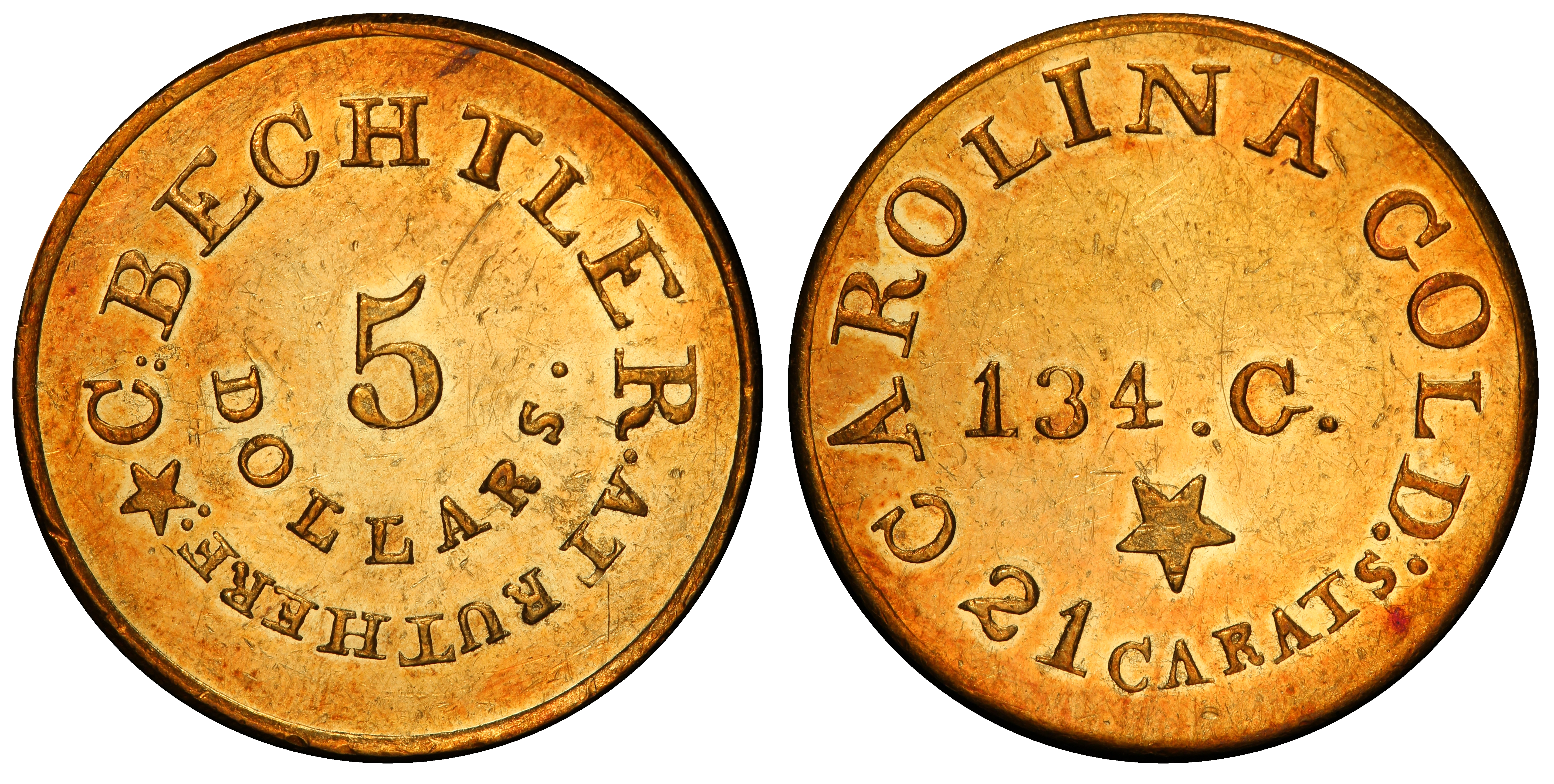
Obverse & Reverse
The Christopher Bechtler five-dollar gold piece of the '134 Grains, 21 CARATS' standard stands as a pivotal artifact from America's first gold rush in the Appalachian Mountains. Long before the California strikes of 1848, the rolling hills of North Carolina and Georgia were the epicenter of the nation's gold production. Miners, however, faced a significant logistical crisis: the only United States Mint was in distant, and dangerously remote, Philadelphia. Transporting raw gold dust was perilous, and the federal government was slow to respond to petitions for a local branch mint. Into this void stepped Christopher Bechtler, a German immigrant metallurgist, watchmaker, and gunsmith of exceptional skill and unimpeachable integrity. Arriving in Rutherfordton, North Carolina, in 1830, he quickly recognized the region's desperate need for a reliable medium of exchange. By 1831, 'at the suggestion of several gentlemen of highest standing,' he established a private mint on his property, offering to convert miners' dust into coin for a modest fee, significantly undercutting the U.S. Mint's seigniorage. The K-20 variety, struck between 1837 and 1842, represents a mature phase of his operation. By this time, the Bechtler mint was a cornerstone of the regional economy, having already produced the nation's first gold dollar in 1832. His coins were trusted implicitly, often circulating more freely than federal issues. The weight and fineness were explicitly stated on the coin, a testament to his transparency and a direct guarantee to the holder. The inscription 'CAROLINA GOLD' denoted a specific purity standard (21 carats), distinguishing it from the 'GEORGIA GOLD' (22 carats) and 'N. CAROLINA GOLD' (20 carats) used on other issues, which reflected the varying quality of bullion brought to him. This issue was produced concurrently with the newly established U.S. branch mints in Charlotte (1838) and Dahlonega (1838), yet Bechtler's operation continued to thrive, a powerful statement of the public's confidence in his product. The coins were utilitarian, crudely struck by modern standards, but they were of honest weight and intrinsic value. Christopher Bechtler, Sr. died in 1842, passing the business to his son Augustus, who continued coinage but with a reputation for less consistent quality. Today, the K-20 is a tangible link to a period of entrepreneurial ingenuity and the foundational, yet often overlooked, chapter of America's affair with gold.
Associated EventAppalachian Gold Rush
Reason For MintingTo convert raw gold dust into a reliable, standardized medium of exchange for a region geographically isolated from the only U.S. Mint in Philadelphia.
Minter HistoryChristopher Bechtler, Sr. (1782-1842) was a German metallurgist from the Grand Duchy of Baden who immigrated to the U.S. in 1829. After a brief period in Philadelphia, he settled in Rutherford County, North Carolina, in 1830, drawn by the burgeoning gold rush. A skilled watchmaker, gunsmith, and jeweler, he applied his expertise to assaying and coining, establishing his private mint in 1831. He manufactured his own dies and presses. Bechtler earned a sterling reputation for honesty and accuracy, and his private coinage, including the first gold dollar in U.S. history (1832), became the lifeblood of the regional economy. His operation was so successful and trusted that it continued to flourish even after the U.S. government opened competing branch mints in Charlotte and Dahlonega in 1838. He ran the mint until his death in 1842.
Historical SignificanceBechtler's coinage was the most successful and prolific private currency of the pre-Civil War era, providing a vital and trusted medium of exchange that fueled the economy of the American Southeast during its first gold rush. The K-20 variety demonstrates the public's enduring trust in a private minter over federal institutions, even after they became locally available. It represents a crucial solution to a currency shortage and stands as a monument to American ingenuity and free enterprise.
K-20
Denomination$5
Minting Periodc. 1837-1842
Assayer/MinterChristopher Bechtler, Sr.
Geographic OriginRutherfordton, North Carolina
Obverse DescriptionThe central device is a five-pointed star. The periphery is inscribed with the weight and fineness, '134 . G .' above the star and '21 CARATS .' below. The legend 'CAROLINA GOLD .' is at the top rim.
Obverse InscriptionCAROLINA GOLD . / 134 . G . / ★ / 21 CARATS .
Reverse DescriptionThe coin's denomination, '5 DOLLARS', is stated in the center. The name of the minter and the location, 'C:BECHTLER. AT RUTHERF:', encircles the denomination along the rim.
Reverse InscriptionC:BECHTLER. AT RUTHERF: / 5 DOLLARS
CompositionGold
Stated Fineness21 Carats (.875 fine)
Actual FinenessBechtler's coins were known to be of honest weight and fineness, generally meeting or slightly exceeding their stated purity.
Weight8.68 grams
Diameter24.70 mm
EdgePlain
Unknown
Survival Estimate76-200 (per R-4 rating); considered one of the more common Bechtler $5 varieties.
Rarity ScaleR-4
This coin is highly sought after as a key representative of America's first gold rush and the most successful private coinage in U.S. history. Its crude but honest appearance, clear inscriptions of weight and fineness, and direct connection to Christopher Bechtler make it a cornerstone for collectors of territorial gold and early American coinage.
Key VarietiesThe K-20 is a distinct variety. There are no known major variations from its original minting period. It is important for collectors to distinguish this issue from later Proof restrikes made by famed coin dealer Henry Chapman around 1908. These restrikes (K-30 and K-31) were made from different, rusted dies (141 Grains, 20 Carats) and are considered separate numismatic collectibles, not original business strikes.
Authentication TipsAuthentic examples often exhibit characteristics of primitive minting technology. Look for irregular or flawed planchets, a generally soft or incomplete strike (especially on the reverse legends), and rotated dies. The surfaces should have a natural, often slightly prooflike or satiny luster, not the sharp, uniform fields of modern or die-struck counterfeits. Many fakes are cast and will show pitting or a soapy texture under magnification. Pay close attention to the style of the lettering and the star; comparison with high-resolution images of certified specimens is essential.
Shopping ConsiderationsA premium quality example for its grade will possess superior luster and minimal distracting marks. While softly struck areas are common, seek out specimens with a bolder strike on the central star and the denomination. Original, uncleaned surfaces are paramount; many examples have been harshly cleaned over the years, which drastically reduces value. Attractive, original toning, often seen as greenish-gold or with subtle rose and blue accents around the periphery, adds significant eye appeal and commands a premium. Avoid examples with evidence of plugging, tooling, or significant rim damage, as these are common on circulated territorial issues.
A coin's grade is its condition, rated on a 1-70 scale. For rare coins, this is the most critical factor in determining value, as a tiny difference in preservation can mean a huge difference in price.
Relevant Grade TypesOriginal period issues were business strikes intended for circulation. They are found in Circulated grades (AG-3 to AU-58) and, very rarely, in Mint State (MS, 60-70). No original Proofs were struck during the 1837-1842 period. Later-date Proof restrikes by Henry Chapman exist for different Bechtler $5 varieties (K-30, K-31), but these are distinct numismatic items and should not be confused with original K-20 issues.
Mint State CharacteristicsUncirculated examples of the K-20 are scarce. They typically exhibit a soft, satiny luster, sometimes with prooflike or reflective fields. The strike is often weak in areas, particularly on the reverse legend 'C:BECHTLER. AT RUTHERF:'. Planchet quality can be crude, with minor flaws being mint-made and acceptable. Due to the softness of the high-purity gold, even Mint State examples will often show scattered light contact marks from handling and storage.
Circulated Wear PatternsWear first appears on the highest points of the design. On the obverse, friction will dull the luster and show first on the center and points of the star. On the reverse, the highest points are the numbers in '5 DOLLARS' and the letters in 'BECHTLER'. In lower grades (VG and below), the finer inscriptions of weight and fineness on the obverse will become faint and eventually illegible.
Key Factors For ValueSurface preservation is the most critical factor. An example with original, uncleaned 'skin' and luster is far more valuable than a cleaned coin of the same technical grade. Strike sharpness is also key; a coin with a bold strike, especially on the reverse, is highly desirable. Eye appeal, driven by attractive, original toning and minimal distracting marks, can add a substantial premium. Certification by a major grading service (PCGS or NGC) is standard, and a CAC sticker for this issue indicates premium quality for the grade and will result in a significant price increase.
PCGS Price Guide
| Grade | Price | Population |
|---|---|---|
| 8 | $2,500.00 | N/A |
| 10 | $2,850.00 | N/A |
| 12 | $3,750.00 | N/A |
| 15 | $4,350.00 | N/A |
| 20 | $5,500.00 | N/A |
| 25 | $6,000.00 | N/A |
| 30 | $6,500.00 | 2 |
| 35 | $7,200.00 | N/A |
| 40 | $8,500.00 | 8 |
| 45 | $8,800.00 | 8 |
| 45+ | $9,000.00 | N/A |
| 50 | $9,400.00 | 13 |
| 50+ | $10,000.00 | N/A |
| 53 | $11,000.00 | 13 |
| 53+ | $12,500.00 | N/A |
| 55 | $18,000.00 | 16 |
| 55+ | $19,000.00 | N/A |
| 58 | $20,000.00 | 5 |
| 58+ | $22,500.00 | N/A |
| 60 | $25,000.00 | 1 |
| 61 | $30,000.00 | 2 |
| 62 | $37,500.00 | N/A |
| 62+ | $42,500.00 | N/A |
| 63 | $55,000.00 | N/A |
Graysheet Price Guide
| Coin | Price Range |
|---|---|
| (1837-42) G$5 C. Bechtler, RUTHERF., 140 GR, 20C, Distant 20, K-19 MS | $10,000 - $86,500 |
| (1837-42) G$5 C. Bechtler, RUTHERF., 134 GR, 21C, with Star, Plain Edge, K-20 MS | $8,250 - $72,000 |
| (1837-42) G$5 C. Bechtler, RUTHERF., 134 GR, 21C, with Star, Part, Reeded Edge, K-20a MS | $48,000 - $360,000 |
| (1922) G$5 Bechtler, 134 GR, 21C, Reverse of C.Bechtler, Gilt Restrike MS | $6,250 - $6,250 |