(1842-50) G$1 A. Bechtler, 27.G., 21.C. Reeded Edge (Regular Strike)
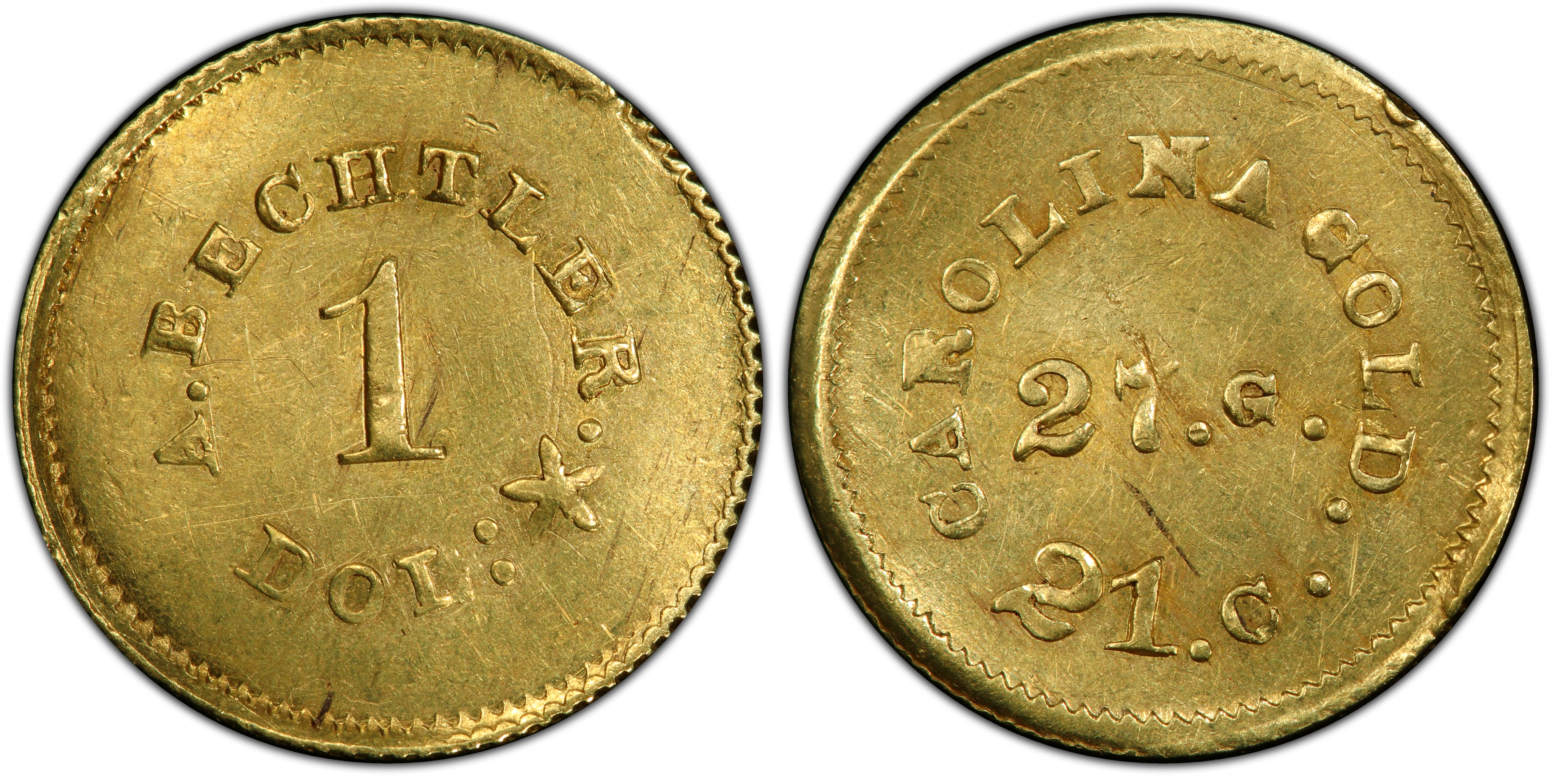
Obverse & Reverse
The August Bechtler G$1 K-25 represents a fascinating and exceedingly rare experimental phase in the history of the most successful private minting operation in pre-Civil War America. Struck amidst the waning years of the Carolina Gold Rush, this coin emerged from the mint established by August's father, Christopher Bechtler, a skilled German metallurgist who arrived in North Carolina in 1830. The elder Bechtler recognized a critical economic need: miners and merchants in the goldfields had no efficient way to convert their raw gold dust and nuggets into a reliable medium of exchange. The only federal mint was a perilous and time-consuming journey away in Philadelphia. Seizing this opportunity, Christopher established a private mint in 1831, producing honest-weight gold dollars (the first in America, predating the U.S. Mint's by 17 years), quarter eagles, and half eagles that quickly gained the public's trust. Upon Christopher's death in 1842, his son August inherited the well-regarded business. August continued the family tradition of producing coinage that served as the lifeblood of the regional economy. The standard design for his gold dollar was simple and utilitarian, merely stating its weight (27 Grains) and purity (21 Carats). The vast majority of these were produced with a plain edge (K-24). The K-25, with its distinctive coarsely reeded edge, stands as a testament to a brief experiment. Numismatic historians posit that August, perhaps seeking to emulate the style of federal coinage and deter clipping, attempted to produce coins using a reeded collar. However, the technical challenges appear to have been insurmountable for his machinery. It is widely believed that the reeded collar caused issues with the planchets seating properly or with ejecting the struck coins, leading to damage and production delays. This experiment was, therefore, quickly abandoned. This technical failure is the very source of the K-25's modern rarity and allure, transforming a simple piece of regional currency into a legendary numismatic prize.
Associated EventCarolina Gold Rush
Reason For MintingTo provide a circulating medium of exchange for commerce in the gold-producing regions of North Carolina and Georgia, converting raw gold dust into standardized coins.
Minter HistoryAugust Bechtler was the son of Christopher Bechtler, Sr., the founder of the most prolific and respected private mint in U.S. history. After immigrating from Germany with his father, August was intimately involved in the family's assaying and coining business in Rutherfordton, NC. He took full control of the operation following his father's death in 1842. While continuing to produce the trusted coinage his father had pioneered, August's tenure is marked by his own issues, identified by the 'A. BECHTLER' inscription. He moved the minting operation from the family homestead to a house in downtown Rutherfordton. While his plain-edge dollars were produced in large quantities and are the most common of all Bechtler issues, August also experimented with designs and production methods, as evidenced by the extremely rare reeded-edge K-25 dollar.
Historical SignificanceThe K-25 is a numismatically significant artifact of a brief technological experiment by a major private coiner. Its extreme rarity highlights the technical challenges faced by private mints in emulating federal coinage standards like reeded edges. It serves as a tangible link to the ingenuity and the limitations of the Bechtler mint under the direction of August Bechtler, shortly after he inherited the operation.
K-25
Denomination$1
Minting Period1842-1850
Assayer/MinterAugust Bechtler
Geographic OriginRutherfordton, North Carolina
Obverse DescriptionA simple, utilitarian design with all inscriptions and no central device. The legend 'CAROLINA GOLD' is arranged in an arc along the upper periphery. The weight and fineness, '27. G.' and '21. C.', are located in the center, separated by a dot.
Obverse InscriptionCAROLINA GOLD / 27. G. / 21. C.
Reverse DescriptionSimilar to the obverse in its purely informational design. The denomination '1 DOL:' is centered, followed by a star. The minter's name, 'A. BECHTLER', is in an arc along the lower periphery.
Reverse Inscription1 DOL: ★ / A. BECHTLER
CompositionGold
Stated Fineness21 Carats (.875 fine)
Actual FinenessGenerally close to stated fineness, though slight variations were common with private minters. The Bechtler family had a strong reputation for honest weight and purity.
Weight1.75 grams
EdgeReeded (coarsely)
Extremely low; likely a few dozen at most as a trial.
Survival EstimateFewer than 5 confirmed examples known.
Rarity ScaleR-7 (High)
The K-25 is a classic territorial gold rarity, sought by advanced specialists for its near-mythical status. Its appeal lies in being an experimental issue from the famed Bechtler mint, combining the historical importance of the Carolina Gold Rush with the extreme rarity of a failed production technique. It is the ultimate challenge for a Bechtler variety collector.
Key VarietiesThe primary variety is the K-25 itself, defined by its reeded edge. It was struck from the same dies as the common plain edge K-24, apparently in their earliest state before they became rusted or worn. There are no known major sub-varieties, patterns, or restrikes of the K-25. The plain edge counterpart, K-24, is the only related variety.
Authentication TipsAuthentication hinges almost entirely on the edge. The reeds should be coarse and somewhat irregular, consistent with the primitive and experimental nature of their application. The strike characteristics should match a very early die state of the K-24 dies. The weight and specific gravity should be consistent with 21-carat gold. Given its high value and rarity, any prospective purchase demands certification by a top-tier grading service (PCGS or NGC) and should be scrutinized by an expert in territorial gold.
Shopping ConsiderationsAcquiring a K-25 is a once-in-a-generation opportunity. A 'premium quality' example, given that fewer than five exist, is simply one that is genuine and has not been significantly damaged. The finest known graded example is MS60, which sets the benchmark. A collector should look for minimal marks and evidence of originality, such as reddish-gold toning common on undisturbed Bechtler gold. The sharpness of the strike on the simple lettering and the quality of the reeding would be key differentiators. Any example, regardless of grade, would be a centerpiece of a major collection. Avoid any specimen with signs of tooling on the edge or other alterations.
A coin's grade is its condition, rated on a 1-70 scale. For rare coins, this is the most critical factor in determining value, as a tiny difference in preservation can mean a huge difference in price.
Relevant Grade TypesAll original Bechtler issues were business strikes intended for circulation and are found in Circulated (1-58) and Mint State (MS, 60-70) grades. No Proofs (PR/PF) were struck by the Bechtlers during the original period of issue, and no later-date restrikes of the K-25 are known to exist.
Mint State CharacteristicsAn uncirculated K-25 would be judged on the quality of its strike and luster. The few known examples were struck from early state dies, so they should exhibit sharp, clear lettering without the rust pitting or die cracks seen on later-state plain edge examples. Luster is typically soft and satiny rather than deeply reflective. Being struck from a constrained collar, the rims should be relatively well-formed. The surfaces of the known high-grade examples show some minor planchet streaks, which are characteristic of the Bechtlers' minting process.
Circulated Wear PatternsWear would first appear as a slight flattening across the highest surfaces of the letters and the central star. The '27. G.' and '1 DOL:' being the most central elements, would likely show the first signs of friction. On lower grade examples, the individual letters in 'CAROLINA GOLD' and 'A. BECHTLER' would begin to lose their sharp edges and blend slightly into the fields. The reeding on the edge would also show flattening and loss of definition.
Key Factors For ValueFor a great rarity like the K-25, the primary factor for value is simply its existence and authenticity. Beyond that, grade is paramount. An example with minimal circulation wear, such as the known AU58 or MS60 specimens, will command a price many multiples of a lower-grade circulated piece. Surface quality is crucial; original, uncleaned surfaces with attractive reddish or greenish-gold toning are highly prized. The quality and boldness of the reeding itself would be a key point of connoisseurship and eye appeal for specialists.
PCGS Price Guide
| Grade | Price | Population |
|---|---|---|
| 30 | $5,000.00 | 1 |
| 35 | $5,500.00 | N/A |
| 40 | $6,750.00 | N/A |
| 45 | $7,500.00 | 1 |
| 45+ | $8,000.00 | N/A |
| 50 | $10,000.00 | N/A |
| 50+ | $10,750.00 | N/A |
| 53 | $12,000.00 | N/A |
| 53+ | $12,750.00 | N/A |
| 55 | $14,000.00 | 2 |
| 55+ | $14,500.00 | N/A |
| 58 | $16,500.00 | 2 |
| 60 | N/A | N/A |
| 62 | N/A | N/A |