(1831-34) $5 C. Bechtler, Assayer, with 150.G. (Regular Strike)
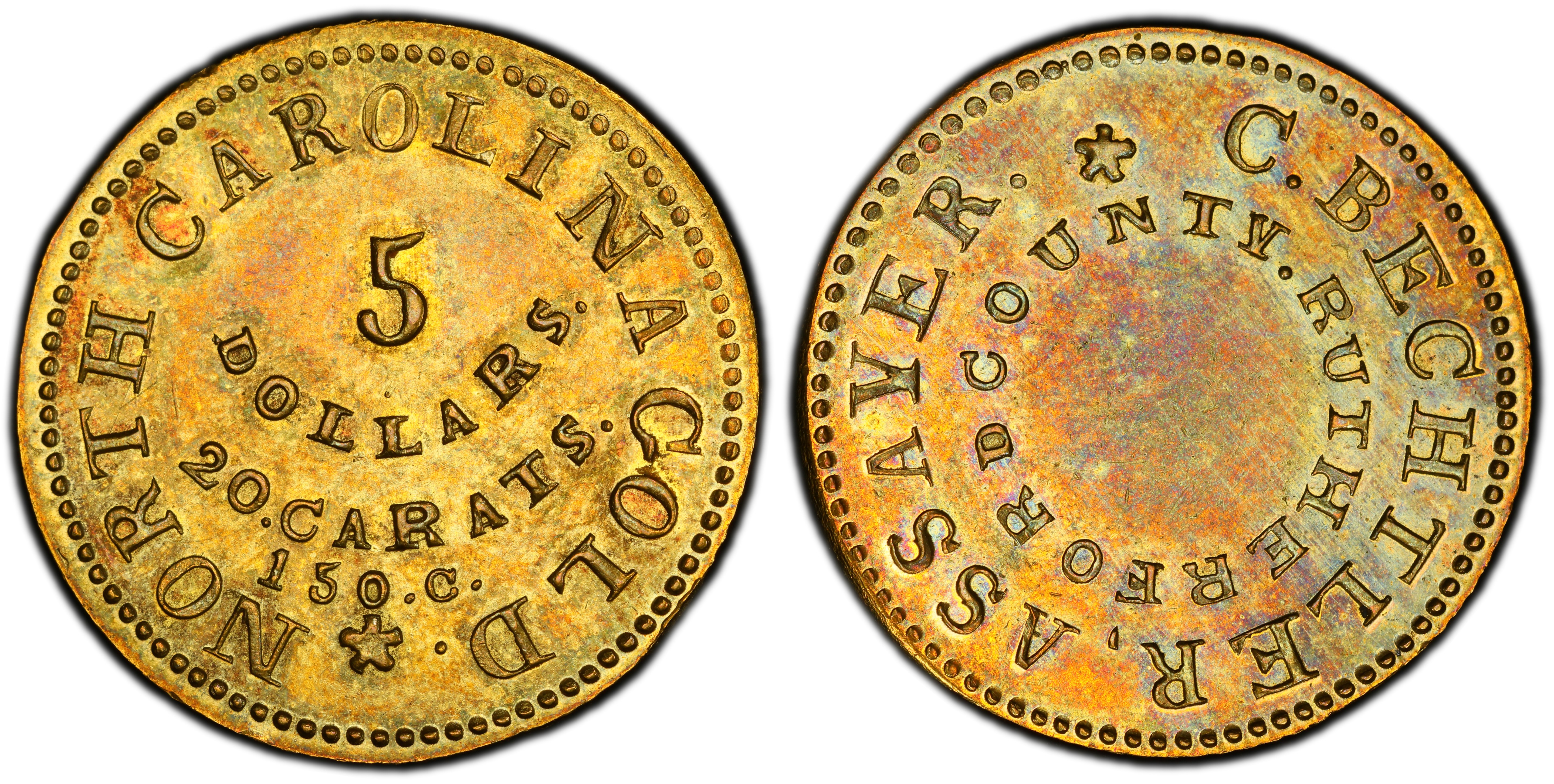
Obverse & Reverse
The Bechtler $5 gold piece, Kagin-15, represents a fascinating and pivotal chapter in American monetary history, born from necessity during the nation's first gold rush. In the late 1820s and early 1830s, significant gold deposits were discovered in the Appalachian Mountains of North Carolina and Georgia. This influx of raw gold created a severe economic problem for miners and merchants. The nearest United States Mint was in Philadelphia, a treacherous and expensive journey of over 500 miles. Transporting gold dust was fraught with peril from bandits, and the cost of shipping and insurance was prohibitive. Furthermore, the Philadelphia Mint's services were slow, and payment was often made in bank drafts, not the hard currency the frontier economy demanded. This monetary logjam stifled local commerce, as miners struggled to convert their newfound wealth into a usable medium of exchange. Enter Christopher Bechtler, a German immigrant metallurgist, gunsmith, and watchmaker who had settled in Rutherford County, North Carolina, in 1830. Recognizing the miners' plight, and at their urging, he established a private mint on his property in 1831. For a modest fee of around 2.5%, Bechtler would assay and convert raw gold dust into professionally struck coins of reliable weight and fineness. This K-15 variety, struck between 1831 and 1834, was one of his earliest half eagle issues. Unlike the failed private minting attempt by Templeton Reid in Georgia, Bechtler's operation was an immediate success, predicated entirely on his unimpeachable reputation for honesty and the consistent quality of his products. His coins were of such reliable purity and weight—often containing slightly more gold than their federal counterparts—that they were readily accepted throughout the southeastern United States. The U.S. Treasury itself tested Bechtler's coinage and found it to be of high quality, a stark contrast to the often-debased foreign gold coins then in circulation. Bechtler's coinage became the de facto currency of the region, so trusted that decades later, during the Civil War, contracts were sometimes specified to be payable in 'Bechtler gold'. The Coinage Act of June 28, 1834, which increased the value of gold by over 6%, led to the widespread melting of most pre-1834 gold coins, including the vast majority of these early Bechtler issues, cementing their rarity for future generations.
Associated EventCarolina Gold Rush
Reason For MintingTo provide a reliable and convenient medium of exchange for miners and merchants during the Carolina Gold Rush due to the great distance to the U.S. Mint in Philadelphia.
Minter HistoryChristopher Bechtler, Sr. (1782-1842) was a German metallurgist and craftsman who immigrated to the U.S. in 1829. He settled in Rutherford County, North Carolina, the heart of the gold-producing region. A man of diverse skills, he quickly established a reputation for integrity. At the request of local miners, he opened his private mint in 1831, offering to coin gold for a small percentage. His operation was highly successful and prolific, producing over $2.24 million in gold coins by 1840, including the first $1 gold coin in U.S. history. His coins were known for their accurate weight and fineness, making them a trusted currency. After his death, the mint was operated by his son Augustus and later his nephew, also named Christopher, though their reputations were not as pristine as the patriarch's.
Historical SignificanceThe Bechtler K-15 is historically significant as one of the first private gold coins to successfully circulate in the United States, providing a crucial solution to a major economic problem on the frontier. It demonstrated the viability of private coinage and highlighted the federal government's failure to serve the new gold regions, directly leading to the establishment of the Charlotte and Dahlonega branch mints in 1838. The widespread acceptance of Bechtler's coinage stands as a testament to the power of individual reputation and integrity in establishing a trusted currency.
K-15
Denomination$5
Minting Period1831-1834
Assayer/MinterChristopher Bechtler, Sr.
Geographic OriginRutherford County, North Carolina
Obverse DescriptionA simple, utilitarian design consisting entirely of text. In the center, the inscription is laid out in four lines: '5', 'DOLLARS.', '20.CARATS.', and '150.G.'. Around the periphery, enclosed by a beaded border, is the legend 'NORTH CAROLINA GOLD.'. A single star or asterisk separates the beginning and end of the peripheral legend.
Obverse InscriptionNORTH CAROLINA GOLD. / 5 / DOLLARS. / 20.CARATS. / 150.G.
Reverse DescriptionSimilar to the obverse, the design is text-based and functional. The legend 'C. BECHTLER, ASSAYER.' is arranged in a circle, which is itself enclosed within a second, outer circle of text reading 'RUTHERFORD COUNTY.'. A single star or asterisk separates the beginning and end of the outer legend. The entire design is enclosed by a beaded border.
Reverse InscriptionRUTHERFORD COUNTY. / C. BECHTLER, ASSAYER.
CompositionGold
Stated Fineness20 Carats (0.8333 fine)
Actual FinenessGenerally considered to be at or slightly above the stated fineness. Bechtler's reputation was built on providing honest value, and his coins often contained slightly more gold than federal issues of the same era.
Weight9.72 grams
EdgeBeaded Border
Unknown
Survival Estimate15 to 20 coins
Rarity ScaleR-7 (Very Rare)
The K-15 Bechtler $5 is a classic American rarity, prized as one of the earliest issues from the most successful private minter in U.S. history. Its connection to the nation's first gold rush, its crude but honest design, and its extreme rarity create immense demand among advanced collectors of territorial gold and early American coinage.
Key VarietiesThe K-15 is a key variety itself, distinguished by the addition of '150.G.' to the dies used for the K-14. Bechtler's coinage contains numerous varieties based on weight, carats, and wording (e.g., 'CAROLINA GOLD', 'GEORGIA GOLD'). No known patterns, trial pieces, or restrikes of the K-15 exist. All known examples are business strikes from the original 1831-1834 period.
Authentication TipsAuthentic examples have a distinctive, somewhat crude but sharp strike from hand-cut dies. The lettering style is unique to Bechtler. Surface texture should be slightly uneven, consistent with early minting technology, not smooth or porous like many cast counterfeits. The weight should be very close to the 9.72-gram standard. Many forgeries are underweight or exhibit a soapy, soft appearance to the details. A granular surface is a key red flag. Given its high value and rarity, third-party authentication by PCGS or NGC is essential.
Shopping ConsiderationsFinding any example is a major challenge. A 'premium quality' specimen for this issue is typically one in the AU (About Uncirculated) range with minimal marks and strong details for the grade. Most known survivors are circulated. Look for a bold strike, as this can vary; the central inscriptions and peripheral legends should be as clear as possible. Original, uncleaned surfaces are paramount and command a significant premium; they often exhibit a pleasing reddish or greenish-gold patina. Be wary of coins that have been harshly cleaned, polished, or show evidence of tooling or repairs in the fields. Given the experimental beaded border, look for examples where the beads are as complete and well-defined as possible, as they are often weak or struck off-center.
A coin's grade is its condition, rated on a 1-70 scale. For rare coins, this is the most critical factor in determining value, as a tiny difference in preservation can mean a huge difference in price.
Relevant Grade TypesAll original Bechtler K-15 coins are business strikes intended for circulation and are found in Circulated (1-58) and Mint State (MS, 60-70) grades. The vast majority of the small surviving population grades from Very Fine to About Uncirculated. Mint State examples are exceedingly rare, with only a handful certified by the major grading services. No Proofs were struck during the original period of issue, and no later-date Proof restrikes are known to exist.
Mint State CharacteristicsAn uncirculated K-15 is a monumental rarity. Quality is defined by the sharpness of the strike, particularly on the numbers and letters, which were individually punched into the dies. Luster is typically of a soft, satiny, or sometimes mildly reflective character, not the deep, booming luster of a later federal issue. Due to the primitive planchet quality and minting process, even Mint State examples may show minor planchet cracks at the border or light adjustment marks. Contact marks, even small ones, significantly impact the grade.
Circulated Wear PatternsWear first appears on the highest points of the simple design: the numerals '5' and '150.G.' on the obverse, and the letters of 'BECHTLER' and 'RUTHERFORD' on the reverse. As wear progresses, the legends will become softer and begin to merge with the fields. In lower grades (Fine and below), the beaded border will become significantly worn and indistinct, and the central inscriptions will be weak but should still be legible.
Key Factors For ValueFor the Bechtler K-15, rarity is the primary driver of value. Beyond that, surface preservation is paramount; an example with original, undisturbed skin and attractive color is far more desirable than a cleaned or processed coin of the same grade. The quality of the strike is also critical; coins with sharp, well-centered legends and a full beaded border are highly sought after. Finally, eye appeal—the overall visual impact of the coin—plays a significant role. Given the stakes, a CAC sticker verifying the quality for the grade adds a substantial premium.
PCGS Price Guide
| Grade | Price | Population |
|---|---|---|
| 8 | $11,000.00 | N/A |
| 10 | $12,500.00 | N/A |
| 12 | $15,000.00 | N/A |
| 15 | $18,500.00 | N/A |
| 20 | $25,000.00 | N/A |
| 25 | $27,500.00 | N/A |
| 30 | $30,000.00 | N/A |
| 35 | $34,000.00 | 1 |
| 40 | $40,000.00 | N/A |
| 45 | $42,500.00 | 2 |
| 45+ | $44,000.00 | N/A |
| 50 | $46,000.00 | 3 |
| 50+ | $47,500.00 | N/A |
| 53 | $50,000.00 | N/A |
| 53+ | $52,500.00 | N/A |
| 55 | $57,500.00 | 6 |
| 55+ | $65,000.00 | N/A |
| 58 | $72,500.00 | 1 |
| 58+ | $82,500.00 | N/A |
| 60 | $95,000.00 | 1 |
| 61 | $105,000.00 | 1 |
| 62 | $140,000.00 | 1 |
| 63 | N/A | 1 |