(1831-34) G$1 C. Bechtler, 30 G., Reeded Edge (Regular Strike)
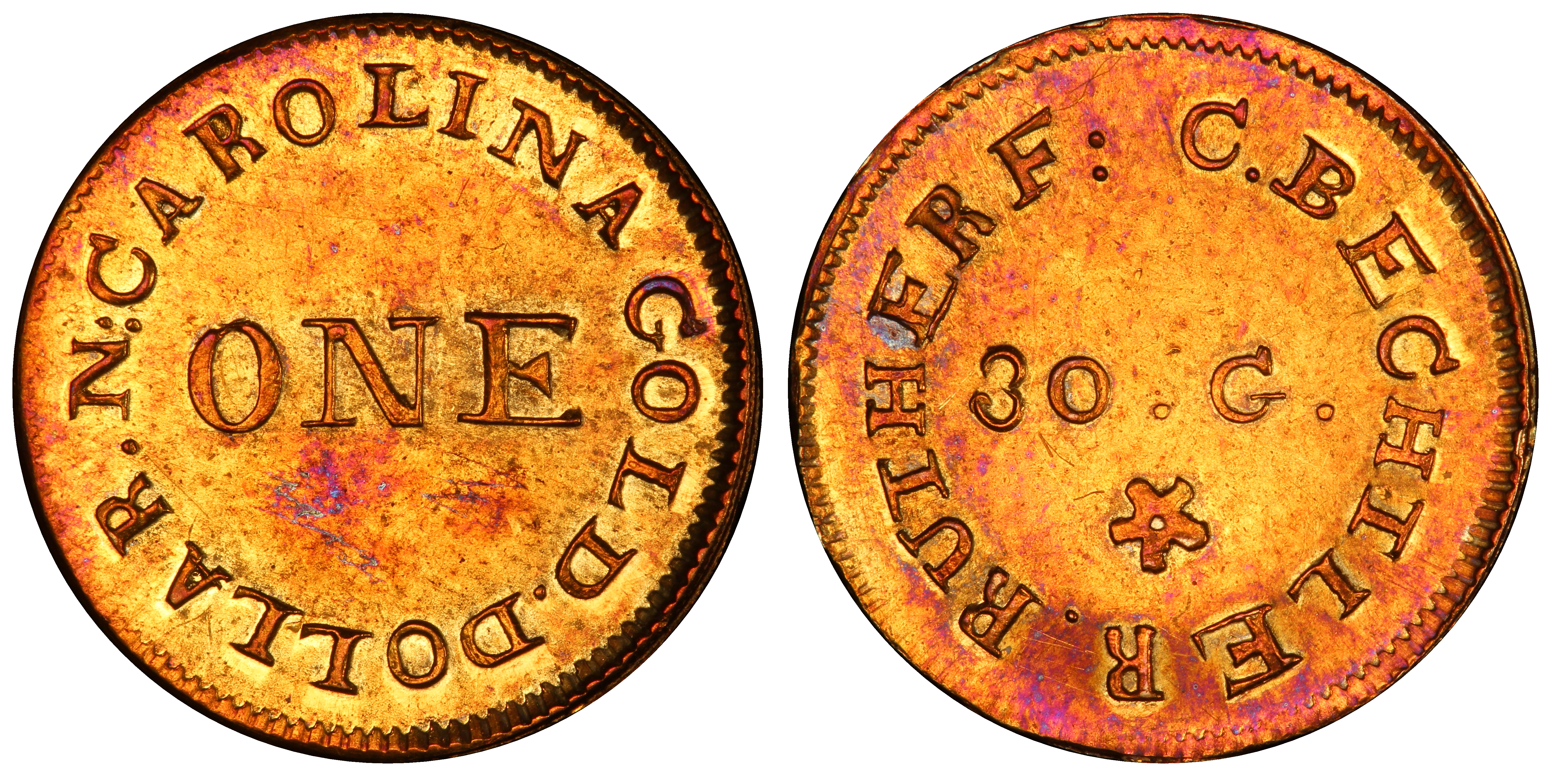
Obverse & Reverse
The Christopher Bechtler gold dollar holds a hallowed place in American numismatics as the very first gold dollar ever struck for circulation in the United States, predating the first federal issue by 17 years. Its creation was a direct response to the socio-economic conditions of the Carolina Gold Rush, which began in 1799. By the 1820s, substantial quantities of gold were being extracted in the hills of North Carolina and Georgia, yet the region suffered from a chronic shortage of circulating coinage. Miners and merchants were forced to transact business using raw gold dust and nuggets, an inefficient and often untrustworthy system. The nearest U.S. Mint was in Philadelphia, a long and perilous journey. Recognizing a critical need and a business opportunity, Christopher Bechtler, a talented German metallurgist, gunsmith, and watchmaker who had immigrated to Rutherfordton, North Carolina, in 1830, established a private mint. With the tacit approval of the government, Bechtler began assaying and coining the local gold in 1831. His operation was known for its unimpeachable integrity; the weights and fineness of his coins were scrupulously honest, and they quickly gained widespread acceptance and trust throughout the Southeast. This K-1 variety, marked '30.G.' for 30 grains, was struck to the old Federal standard for the gold dollar (a denomination not yet officially minted) at 20 carats fine. The coins were utilitarian, featuring simple inscriptions of the minter, location, weight, and denomination. Bechtler's coining press, which can be seen today at the American Numismatic Society, was a manually operated screw press, resulting in coins that were often weakly or unevenly struck. The Coinage Act of June 28, 1834, increased the value of gold by over 6%, which ironically led to the widespread melting of these early, heavier Bechtler issues. Their historical importance, extreme rarity, and direct connection to America's first gold rush make them one of the most significant and coveted issues in the territorial gold series.
Associated EventCarolina Gold Rush
Reason For MintingTo convert locally mined raw gold into a standardized, trustworthy circulating medium of exchange for a region starved of official coinage.
Minter HistoryChristopher Bechtler, Sr. (1782-1843) was a German immigrant with exceptional skills as a metallurgist, watchmaker, and mechanic. He established his private mint in Rutherfordton, NC, in 1831, assisted by his son Augustus and nephew Christopher Jr. His operation was renowned for its honesty and accuracy, processing over $2.2 million in gold by 1840. The Bechtler mint's reputation for integrity was so high that their coins circulated without question alongside federal issues and were a vital part of the Southern economy until the U.S. government established branch mints in Charlotte, NC, and Dahlonega, GA, in 1838.
Historical SignificanceThis coin is historically paramount as the first gold dollar struck in the United States, proving the viability and necessity of the denomination years before the U.S. Mint began its own production in 1849. It is a tangible artifact of America's first gold rush and a testament to the private enterprise that filled a critical void in the nation's monetary system.
K-1
Denomination$1
Minting Period1831-1834
Assayer/MinterChristopher Bechtler, Sr.
Geographic OriginRutherfordton, North Carolina
Obverse DescriptionA simple, utilitarian design featuring the weight and minter's name within a serrated border. The inscription is arranged peripherally with 'C.BECHTLER.' at the bottom, 'RUTHERF:' to the right, and '30.G' at the top, separated by a centered asterisk or star.
Obverse InscriptionC.BECHTLER. * RUTHERF: 30.G.
Reverse DescriptionThe reverse is similarly utilitarian, stating the denomination and metal type within a serrated border. The inscription 'N:CAROLINA GOLD' is at the periphery, with 'ONE' and 'DOLLAR' in the center, separated by the horizontal line of the letter 'N' in 'N:CAROLINA'.
Reverse InscriptionN:CAROLINA GOLD ONE DOLLAR
CompositionGold
Stated Fineness20 Carats
Actual FinenessApproximately 20 Carats (.833 fine)
Weight1.94 grams
EdgeReeded
Unknown
Survival EstimateApproximately 150 pieces
Rarity ScaleR-4
This coin is immensely popular as the first gold dollar struck in the U.S., a foundational piece of the territorial gold series, and a direct link to the Carolina Gold Rush. Its crude charm and historical gravitas make it a cornerstone of any advanced collection of American coinage.
Key VarietiesThe primary variety is the K-1 Reeded Edge. An exceedingly rare variety, K-1a, exists with a Plain Edge, of which only a single specimen is confirmed. There are no known patterns, trial pieces, or later-date collector restrikes associated with the K-1 issue.
Authentication TipsAuthentic examples often show a weak or uneven strike, particularly in the centers. The planchets are typically crude and may have minor flaws or laminations. The lettering style is distinctive and should be compared to high-quality images. Many contemporary counterfeits exist, but they are often of incorrect weight, have a soapy or cast-like appearance, and exhibit incorrect letter punches and spacing. Be wary of coins with unusually sharp, uniform strikes or pristine fields.
Shopping ConsiderationsA premium quality example for its grade will show minimal distracting marks and retain some original luster, often with a pleasing reddish-gold or greenish-gold patina. Strike is a major factor; coins with bold legends, a complete serrated border, and a strong denomination command significant premiums. Look for examples free of harsh cleaning, tooling, or repairs. Given the crude manufacturing process, minor planchet irregularities are common and acceptable, but large, deep gashes or edge damage will detract from the value. Rotated dies are common and do not typically add or detract significantly from the value unless extreme.
A coin's grade is its condition, rated on a 1-70 scale. For rare coins, this is the most critical factor in determining value, as a tiny difference in preservation can mean a huge difference in price.
Relevant Grade TypesAll original Bechtler issues were business strikes intended for circulation. They are found in Circulated grades (AG-3 to AU-58) and, very rarely, in Mint State grades (MS-60 and higher). No Proofs were struck during the original period of issue, and there are no known later-date Proof restrikes of this specific K-1 variety.
Mint State CharacteristicsAn uncirculated (MS) example is exceptionally rare. Quality is defined by the strength of the strike, the quality of the planchet, and the luster. Luster is typically soft and satiny rather than deeply frosty. The strike is almost never full; some weakness, especially on 'DOLLAR' or 'BECHTLER', is expected. Contact marks from handling are common due to the softness of the 20-carat gold.
Circulated Wear PatternsWear first appears on the highest points of the letters in the inscriptions. On the obverse, the letters in 'BECHTLER' and 'RUTHERF:' will show flatness. On the reverse, the letters in 'CAROLINA GOLD' and 'ONE DOLLAR' begin to merge with the fields. In lower grades (VG and below), the inscriptions become faint and the serrated borders wear away.
Key Factors For ValueThe primary drivers of value are grade and surface preservation. An example with original, uncleaned surfaces and some remaining luster is highly prized. Strike quality is paramount; a coin with an unusually bold strike for the issue will command a strong premium over a weakly struck example of the same grade. Eye appeal, encompassing attractive natural toning and a lack of distracting marks, is also a critical factor. For a major rarity like this, certification by PCGS or NGC is standard, and a CAC sticker indicating premium quality for the grade adds a significant premium.
PCGS Price Guide
| Grade | Price | Population |
|---|---|---|
| 30 | $5,000.00 | 2 |
| 35 | $5,750.00 | 4 |
| 40 | $6,500.00 | 9 |
| 45 | $7,000.00 | 11 |
| 45+ | $7,750.00 | N/A |
| 50 | $8,250.00 | 10 |
| 50+ | $8,750.00 | N/A |
| 53 | $9,250.00 | 8 |
| 53+ | $9,750.00 | N/A |
| 55 | $10,500.00 | 15 |
| 55+ | $11,500.00 | N/A |
| 58 | $13,500.00 | 15 |
| 58+ | $15,750.00 | 1 |
| 60 | $17,500.00 | 1 |
| 61 | $20,000.00 | 4 |
| 62 | $27,500.00 | 6 |
| 62+ | $32,500.00 | N/A |
| 63 | $55,000.00 | 2 |
Graysheet Price Guide
| Coin | Price Range |
|---|---|
| (1832-34) G$1 C. Bechtler, 30 GR, Reeded Edge, K-1 MS | $5,500 - $52,000 |
| (1832-34) G$1 C. Bechtler, 30 GR, Plain Edge, K-1a MS | $8,250 - $30,000 |
| (1835-37) G$1 C. Bechtler, 28 GR, Center, Plain Edge, K-3a MS | $3,750 - $40,500 |