(1834-37) $5 "C:"Bechtler, Carolina Gold Reeded Edge (Regular Strike)
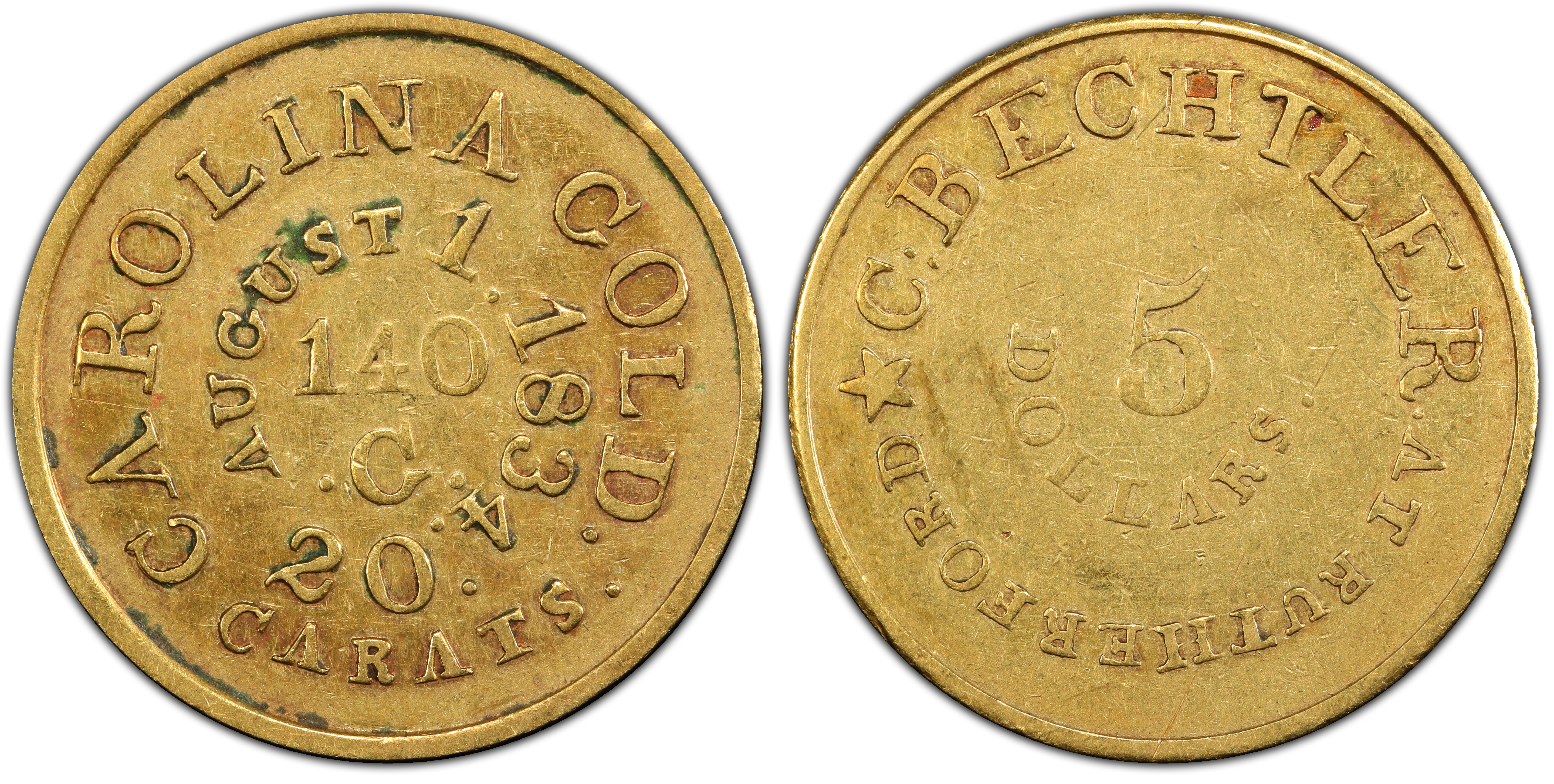
Obverse & Reverse
The Bechtler five-dollar gold piece, specifically the Kagin-16 variety, stands as a pivotal artifact from America's first gold rush. Prior to the California frenzy of 1849, the rolling hills of the North Carolina and Georgia piedmont were the epicenter of the nation's gold production. However, a significant economic bottleneck plagued the region: a severe lack of circulating coinage and the absence of a local federal mint. Miners were forced to transact with raw gold dust, an inefficient and insecure method, or undertake the perilous, lengthy journey to the U.S. Mint in Philadelphia to have their findings converted to coin. Christopher Bechtler, a skilled German metallurgist, watchmaker, and gunsmith who immigrated to Rutherfordton, North Carolina, in 1830, recognized this critical need. At the urging of local miners and merchants, he established a private mint in 1831, offering to convert raw gold into reliable coinage for a modest fee, typically 2.5%. His reputation for honesty and the consistent quality of his coins quickly made his mint the de facto regional monetary authority. The K-16 variety is a direct response to a major federal monetary policy shift, the Coinage Act of June 28, 1834. This act reduced the statutory weight of federal gold coins to counter the trend of U.S. coins being melted for their bullion value. To avoid any potential conflict with Treasury authorities and to signify that his coins conformed to the new, lighter federal standard, Bechtler astutely inscribed 'AUGUST 1, 1834'—the effective date of the new law—on the obverse of this $5 issue. This was a feature the U.S. Mint itself had considered but never implemented, making it a unique element of Bechtler's coinage. These coins circulated widely throughout the Southeast, becoming a trusted and essential part of the regional economy, so much so that even after the establishment of the Charlotte and Dahlonega branch mints in 1838, Bechtler's coins continued to be produced and accepted in commerce. Their legacy is one of private enterprise successfully filling a crucial governmental vacuum, providing monetary stability and facilitating economic growth during a formative period of American history.
Associated EventCarolina Gold Rush
Reason For MintingTo provide a reliable and convenient circulating medium of exchange for miners and merchants during the Carolina Gold Rush in the absence of a local federal mint.
Minter HistoryChristopher Bechtler, Sr. (1782-1842) was a German-born watchmaker, jeweler, and metallurgist who immigrated to the United States in 1829. After a brief period in Philadelphia, he settled in Rutherford County, North Carolina, the heart of the burgeoning gold region. Leveraging his extensive skills, he established the most successful private mint in U.S. history in 1831. Unlike other private minters of the era, Bechtler's operation was renowned for its integrity and the consistent, honest weight of its coins. He produced gold dollars—the first in the nation, seventeen years before the U.S. Mint—as well as $2.50 and $5.00 pieces. His business was so prolific that between 1831 and 1840, he officially reported coining over $2.24 million in gold. After his death in 1842, the minting operation was continued by his son Augustus and later his nephew, Christopher Jr., until the early 1850s.
Historical SignificanceThe Bechtler mint was the most significant and prolific private coiner in American history, providing a vital and trusted currency for the entire Southeastern United States for two decades. The K-16 $5 piece is particularly important as it directly reflects the minter's response to the Federal Coinage Act of 1834, demonstrating a sophisticated understanding of monetary policy and a commitment to aligning his private coinage with national standards, thus ensuring its widespread acceptance.
K-16
Denomination$5
Minting Period1834-1837
Assayer/MinterChristopher Bechtler, Sr.
Geographic OriginRutherfordton, North Carolina
Obverse DescriptionThe central design is dominated by the date of the new federal coinage standard, 'AUGUST 1, 1834.' This is surrounded by inscriptions of the coin's specifications. The legend 'CAROLINA GOLD' is at the top periphery, with '20 CARATS' at the bottom. The weight, '140 G.' (Grains), is placed centrally between the date and the carat designation.
Obverse InscriptionCAROLINA GOLD / AUGUST 1, 1834 / 140. G. / 20. CARATS
Reverse DescriptionA simple and functional design with the minter's name and location encircling the denomination. A small five-pointed star is often present as a design element.
Reverse Inscription* C:BECHTLER. AT RUTHERFORD around 5 DOLLARS.
CompositionGold
Stated Fineness20 carats (0.8333)
Actual Fineness0.8083 (Approximately 19.4 carats)
Weight8.91 grams
Diameter23.00 mm
EdgeReeded
Unknown
Survival EstimateRare (31-75 known)
Rarity ScaleR-5
This coin is highly sought after for its direct connection to America's first gold rush, its status as a product of the most respected private mint, and its unique historical feature of bearing the 'AUGUST 1, 1834' date. It appeals to collectors of territorial gold, Southern numismatics, and those fascinated by early American economic history. The reeded edge feature also adds to its distinction.
Key VarietiesThe primary variety is the K-16 with a reeded edge. A similar variety, K-17, exists with a plain edge. The dies for Bechtler coins were handmade and show minor variations. No original proof strikings are known. However, famed coin dealer Henry Chapman acquired some original Bechtler dies circa 1908 and produced a very small number of Proof restrikes, including a muling of a K-16 reverse die with an August Bechtler obverse die (listed as K-31). These Chapman restrikes are extremely rare and are considered distinct numismatic items.
Authentication TipsAuthentic Bechtler coins often have a slightly crude, handmade appearance. Check for weakly struck areas, especially at the periphery. The planchets can be irregular. The reeding on the K-16 is typically coarse and not as uniform as on federal issues. Counterfeits may appear too perfect, have incorrect lettering styles, or show raised pimples or tool marks from modern die creation. Weight and specific gravity tests are crucial, as Bechtler's coins were known for their honest (though not perfectly pure) gold content. Look for known die markers, such as specific letter placements or die cracks, that are cataloged for genuine specimens.
Shopping ConsiderationsA premium quality example for its grade will exhibit a bold strike, particularly on the central inscriptions ('AUGUST 1, 1834' and '5 DOLLARS'). Seek out coins with minimal planchet flaws, as rough or cracked planchets are common. Original, uncleaned surfaces displaying the characteristic reddish or greenish-gold patina from the native alloy are highly desirable. Many surviving examples have been cleaned or damaged; avoid pieces with harsh abrasions, rim damage, or evidence of tooling or repair. Given the rarity and value, authentication and grading by a top-tier service like PCGS or NGC is essential.
A coin's grade is its condition, rated on a 1-70 scale. For rare coins, this is the most critical factor in determining value, as a tiny difference in preservation can mean a huge difference in price.
Relevant Grade TypesAll original Bechtler coins were struck as business strikes intended for circulation and are found in Circulated (1-58) and Mint State (MS, 60-70) grades. No proofs were struck during the original period of issue. Later-date Proof restrikes, known as Chapman restrikes, were produced circa 1908 from original dies and are collected as separate and distinct numismatic items, graded with a PR/PF prefix.
Mint State CharacteristicsUncirculated examples are exceptionally rare. A true Mint State specimen will exhibit full, soft satiny luster, often with a slightly prooflike or reflective quality in the fields. The strike is a key determinant of quality; many were struck on crude presses, resulting in softness on the peripheral legends and the reeding. A well-struck K-16 will show clear definition on all digits of the date and the letters in RUTHERFORD. Minor, mint-made planchet irregularities are common and generally accepted, but large flaws will detract from the grade.
Circulated Wear PatternsWear first appears on the highest points of the coin. On the obverse, friction will first dull the luster on the '1834' of the date and the letters of 'CAROLINA'. On the reverse, the highest points are the letters in 'DOLLARS' and 'BECHTLER'. As wear progresses, these central elements will become flat, and the peripheral lettering will begin to fade into the rim. In lower grades (VG and below), the date and denomination may become partially illegible.
Key Factors For ValueThe primary driver of value is the grade and surface preservation. An example with original, undisturbed luster and an attractive, deep golden or reddish patina commands a significant premium. The quality of the strike is critical; coins with sharp central details are prized. Eye appeal is paramount—a clean, well-struck coin will always be more valuable than a higher-graded but less attractive specimen. For this issue, a CAC sticker adds a substantial premium, confirming that the coin is of superior quality for its assigned grade.
PCGS Price Guide
| Grade | Price | Population |
|---|---|---|
| 45 | N/A | 1 |
| 55 | N/A | 1 |