(1842-50) $5 A. Bechtler, 134 Grains, 21 Carats (Regular Strike)
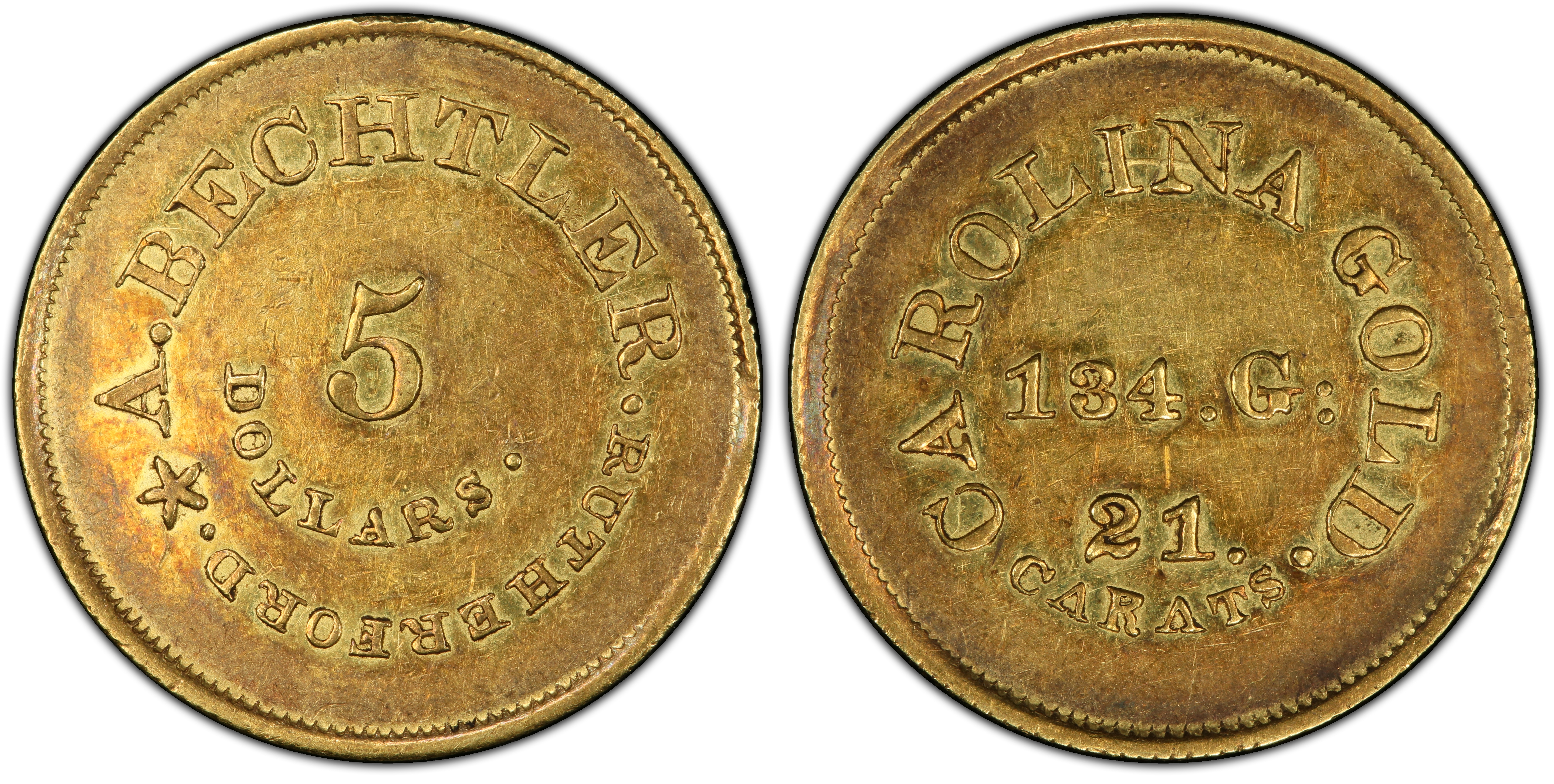
Obverse & Reverse
The Augustus Bechtler $5 gold piece emerged from a unique and vital period in American economic history, bridging the gap between the nation's first gold rush and the establishment of a robust federal minting infrastructure. From the early 1800s until 1848, the most productive gold mines in the United States were not in California, but in the rolling hills of the southern Appalachian Mountains, primarily in North Carolina and Georgia. This 'Carolina Gold Rush' created a significant economic problem: an abundance of raw gold dust and nuggets but a dire shortage of reliable, circulating currency. Transporting gold overland to the sole U.S. Mint in Philadelphia was a perilous and expensive journey, fraught with the risk of robbery. In response to this need, Christopher Bechtler, a skilled German metallurgist and gunsmith, established a private mint in Rutherfordton, North Carolina, in 1831. His operation was known for its integrity and the consistent quality of its coinage, quickly becoming the de facto regional mint. Upon Christopher's death in 1842, his son Augustus Bechtler inherited the business and continued the family's legacy of coinage. Augustus, also a talented craftsman, moved the minting operation into the town of Rutherfordton and continued to strike gold dollars and half eagles ($5 pieces) to serve the local economy. The K-27 variety, weighing 134 grains at a stated fineness of 21 carats, was one of several standards he produced. These coins were not clandestine issues; they were respected and essential instruments of commerce, circulating freely alongside federal money. Even after the U.S. government opened branch mints in Charlotte, NC (1838), and Dahlonega, GA (1838), the Bechtler mint continued to thrive due to its convenience and established reputation. Federal assays of Bechtler coinage confirmed their stated weight and value were generally reliable, further cementing public trust. The operation finally ceased around 1850, as the influx of gold from the California Gold Rush and increased federal coinage rendered private mints obsolete. Augustus Bechtler's coins remain a tangible link to the enterprising spirit of the era and the economic landscape of antebellum America, representing a successful private solution to a critical monetary problem.
Associated EventNorth Carolina Gold Rush
Reason For MintingTo convert locally mined raw gold into a standardized, circulating medium of exchange due to the difficulty and danger of transporting it to the U.S. Mint in Philadelphia.
Minter HistoryAugustus Bechtler (often referred to as A. Bechtler on coinage) was the son of Christopher Bechtler, a German immigrant and metallurgist who founded the highly respected Bechtler Mint in North Carolina in 1831. Augustus took over the family's private coining operation upon his father's death in 1842. A skilled gunsmith and jeweler in his own right, Augustus continued the mint's reputation for honest weight and value, producing gold dollars and five-dollar pieces. He moved the physical mint from its original rural location to the town of Rutherfordton. His coinage was vital to the regional economy until the mint ceased operations around 1850.
Historical SignificanceThe A. Bechtler $5 gold piece is a historically significant territorial coin that represents the peak and conclusion of the most successful private minting operation in the eastern United States. It demonstrates the critical role private enterprise played in providing a much-needed money supply during the nation's first gold rush, co-existing with and even competing against official U.S. branch mints. These coins are a direct artifact of the Carolina gold mining era and the economic self-sufficiency of the American frontier.
K-27
Denomination$5
Minting PeriodUndated (1842-1850)
Assayer/MinterAugustus Bechtler
Geographic OriginRutherfordton, North Carolina
Obverse DescriptionA simple, text-based design. Centered is the weight and fineness '134. G: 21. CARATS' with 'CAROLINA GOLD' around the upper periphery.
Obverse InscriptionCAROLINA GOLD / 134. G: / 21. CARATS
Reverse DescriptionA simple, text-based design. '5 DOLLARS' is centered. The minter's name and location, 'A. BECHTLER. RUTHERFORD.', encircle the periphery, often with a star or other small ornament in the legend.
Reverse InscriptionA. BECHTLER. RUTHERFORD. / 5 DOLLARS
CompositionGold
Stated Fineness21 Carats (0.875 fine)
Actual FinenessGenerally found to be accurate to the stated fineness.
Weight8.68 grams
Diameter24.70 mm
EdgeReeded
Unknown
Survival EstimateApproximately 30-40 known examples
Rarity ScaleR-5+
This coin is highly prized by collectors of U.S. territorial gold and early American coinage. Its appeal lies in its direct connection to the Appalachian gold rush, the famed Bechtler family mint, and its status as a widely circulated, trusted private currency. As one of the more available A. Bechtler five-dollar varieties, it offers a key entry point into this historically rich series.
Key VarietiesAugustus Bechtler produced $5 gold pieces in three main standards: 141 grains (20 carats, K-29), 134 grains (21 carats, K-27), and 128 grains (22 carats, K-28). The K-27 is the most frequently encountered of these varieties. A key collector issue related to the Bechtler series are the 'Chapman Restrikes'. Around 1920, famed numismatist Henry Chapman acquired some of the original Bechtler dies and struck a very small number of Proof restrikes. These pieces are exceptionally rare, have sharp details and reflective surfaces, and are considered distinct numismatic items separate from the original circulation strikes.
Authentication TipsGenuine examples have a characteristic crude but sharp quality from the screw press used. The lettering, while not perfectly uniform, should be distinct and well-formed. Look for a correct reeded edge. Counterfeits may exhibit a soft or 'mushy' appearance to the devices and lettering, incorrect weight, or tool marks from casting or modern engraving. Raised lines or pimples on the surface can be indicative of a counterfeit. The surfaces of genuine pieces often show evidence of circulation and adjustment marks made at the mint prior to striking.
Shopping ConsiderationsFor a 'premium quality' example, a collector should prioritize originality of the surfaces. Look for coins that have not been harshly cleaned, polished, or repaired. A specimen with some remaining mint luster, often described as a soft, satiny glow, is highly desirable. The strike can be inconsistent on these issues; a well-struck example with bold lettering and strong dentils commands a premium. The typical color is a brassy or greenish-gold, but pieces with attractive, undisturbed reddish-gold toning are especially sought after. Common problems to avoid are rim bumps, scratches, and evidence of tooling in the fields to hide damage. Given the coin's rarity and value, authentication by a major grading service (PCGS or NGC) is essential.
A coin's grade is its condition, rated on a 1-70 scale. For rare coins, this is the most critical factor in determining value, as a tiny difference in preservation can mean a huge difference in price.
Relevant Grade TypesOriginal period issues were business strikes intended for circulation and are found in Circulated (1-58) and Mint State (MS, 60-70) grades. No Proofs were struck by the Bechtlers during the original minting period. Extremely rare Proof restrikes were produced circa 1920 by Henry Chapman using original dies; these are graded with a PR/PF designation and are collected as a separate and distinct issue, valued far higher than the business strikes.
Mint State CharacteristicsUncirculated examples are exceptionally rare. A true Mint State K-27 will exhibit a soft, satiny luster that is characteristic of early gold. The strike is often somewhat weak in the centers, but the legends should be sharp. Due to the rudimentary minting process and the softness of the gold, even uncirculated specimens will typically display some light planchet adjustment marks (faint parallel lines made pre-striking) or minor contact marks from handling and storage at the mint.
Circulated Wear PatternsWear first becomes evident on the highest points of the lettering and numbers on both the obverse and reverse. The '134' on the obverse and the '5' on the reverse are particularly susceptible. On mid-grade circulated examples (VF-XF), the finer details of the letters will show flattening, and the fields will exhibit a network of fine scratches. In lower grades, the legends may become soft and begin to merge with the fields.
Key Factors For ValueThe primary driver of value is the coin's certified grade and surface preservation. An example with original, uncleaned surfaces commands a significant premium over one that has been polished or harshly cleaned, even if the latter shows less wear. Strike quality is also critical; a coin with a bold strike will be worth more than a weakly struck example of the same grade. Eye appeal, which includes factors like attractive toning and a lack of distracting marks, plays a major role. Finally, for this series, a sticker from CAC (Certified Acceptance Corporation) indicating premium quality for the grade can add a substantial premium to the coin's value.
PCGS Price Guide
| Grade | Price | Population |
|---|---|---|
| 8 | $4,250.00 | N/A |
| 10 | $4,500.00 | N/A |
| 12 | $4,750.00 | N/A |
| 15 | $5,250.00 | 1 |
| 20 | $5,750.00 | N/A |
| 25 | $6,750.00 | N/A |
| 30 | $7,500.00 | 1 |
| 35 | $8,250.00 | N/A |
| 40 | $10,000.00 | 5 |
| 45 | $13,500.00 | 11 |
| 45+ | $14,000.00 | N/A |
| 50 | $16,500.00 | 15 |
| 50+ | $18,000.00 | N/A |
| 53 | $20,000.00 | 7 |
| 53+ | $21,500.00 | N/A |
| 55 | $23,000.00 | 5 |
| 55+ | $25,000.00 | N/A |
| 58 | $30,000.00 | 4 |
| 58+ | N/A | 1 |
| 60 | N/A | N/A |
| 61 | N/A | N/A |