(1831-34) $2.50 C. Bechtler, 250. / 20.C. Fine Beads (Regular Strike)
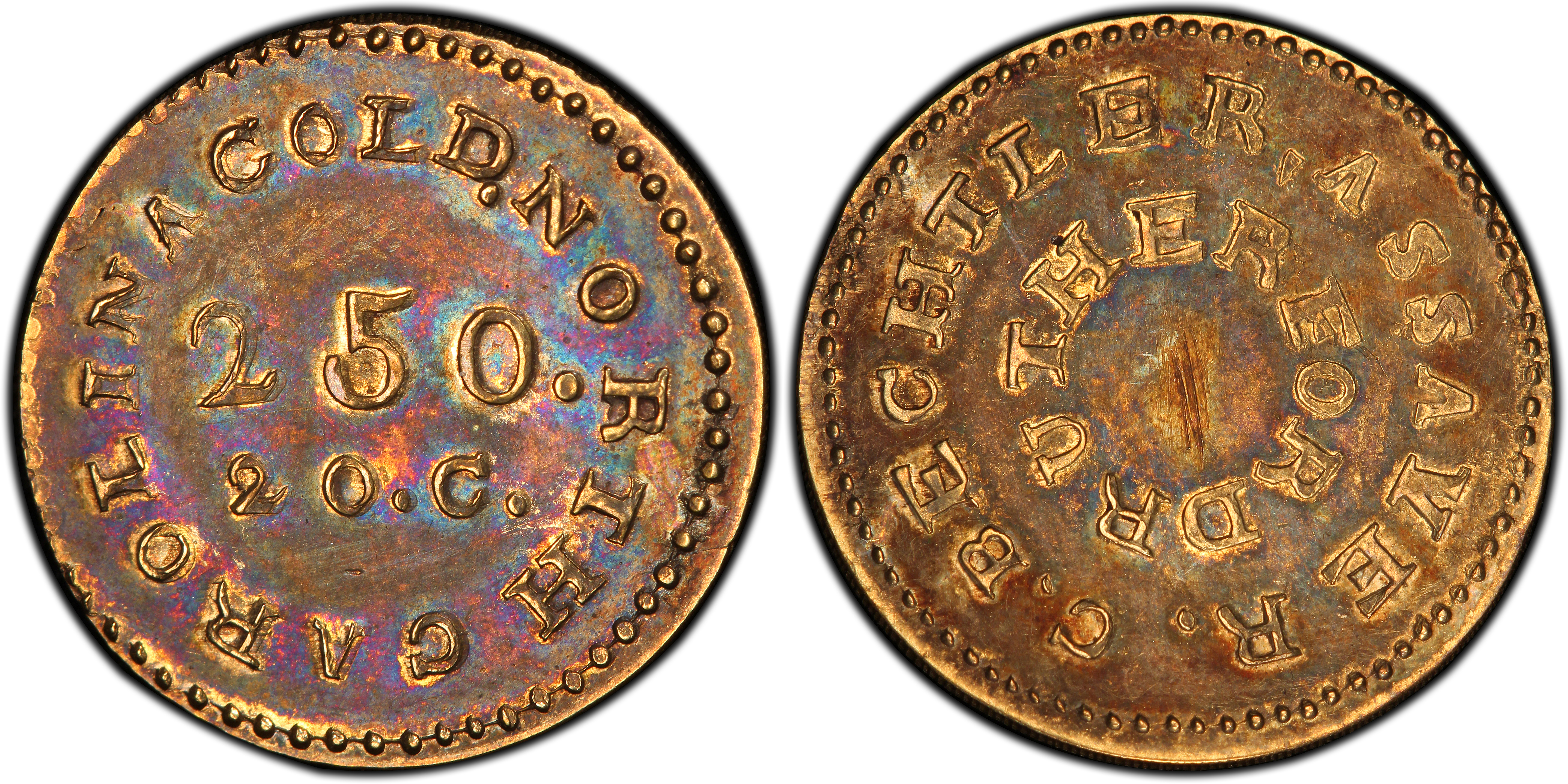
Obverse & Reverse
The Christopher Bechtler quarter eagle stands as a tangible relic of America's first gold rush, a period centered not in California, but in the foothills of the Appalachian Mountains of North Carolina and Georgia. Prior to the 1849 California discovery, this region was the nation's primary source of gold. However, a significant economic problem plagued the miners: a severe shortage of circulating coinage and the lack of a nearby federal mint. The only U.S. Mint was in Philadelphia, a perilous and costly journey of hundreds of miles. Gold dust and nuggets were an impractical medium for daily commerce, being difficult to value accurately and prone to spillage and theft. Responding to this critical need, Christopher Bechtler, a skilled German metallurgist who had immigrated to Rutherfordton, North Carolina, in 1830, established a private mint in 1831. His reputation for honesty and the accuracy of his weights and fineness quickly earned the trust of the local population and merchants. Bechtler's mint was not a clandestine operation; he advertised his services openly, charging a small percentage (seigniorage) to convert raw gold into standardized coins. For over a decade, his mint was the de facto regional monetary authority, coining over $2.24 million in gold from 1831 to 1840 alone—a staggering sum that rivaled the output of the later-established U.S. Branch Mint in Charlotte. The $2.50 piece, or quarter eagle, was a workhorse of the local economy, facilitating land purchases, payment for goods, and daily transactions. Bechtler's coinage was so respected that it circulated widely throughout the southeastern United States, accepted on par with federal issues. The establishment of U.S. branch mints in Charlotte, NC, and Dahlonega, GA, in 1838 eventually diminished the need for Bechtler's services, but his coins continued to circulate for decades, a testament to the quality and integrity of his pioneering enterprise. Today, they are prized by numismatists as the first privately issued gold coins in the East and a direct link to a formative chapter in American economic history.
Associated EventCarolina Gold Rush
Reason For MintingTo convert raw gold dust and nuggets from the Carolina gold rush into a standardized, trustworthy, and convenient medium of exchange for local commerce.
Minter HistoryChristopher Bechtler, Sr. (1782-1842) was a German watchmaker, gunsmith, and metallurgist from the Grand Duchy of Baden. He immigrated to the United States in 1829, initially settling in Philadelphia before moving to Rutherfordton, North Carolina, in 1830, drawn by the burgeoning gold rush. A man of exceptional skill and integrity, he identified the region's desperate need for coinage and, with his son Augustus and nephew Christopher Jr., built his own screw press and dies. He began coining gold in 1831, producing $1.00, $2.50, and $5.00 denominations. Notably, he produced the nation's first gold dollar in 1832, seventeen years before the U.S. Mint. His coins were known for their honest weight and purity, making them universally accepted in regional trade. After his death in 1842, the minting operation was continued by his family until the early 1850s.
Historical SignificanceBechtler's coinage was a crucial economic innovation that solved a severe currency crisis in the southeastern U.S., effectively creating a stable monetary system for the nation's first gold rush and demonstrating the viability of private minting. The success and trustworthiness of his operation directly influenced the federal government's decision to establish branch mints in Charlotte and Dahlonega.
K-8
Denomination$2.50
Minting Period1831-1834
Assayer/MinterChristopher Bechtler, Sr.
Geographic OriginRutherfordton, North Carolina
Obverse DescriptionA simple, utilitarian design dominated by text. The name of the minter, C. BECHTLER., is at the top, with ASSAYER below. At the bottom is the geographic origin, RUTHERFORD COUNTY. The central device is the denomination, 250, representing 250 cents or $2.50, positioned over the stated purity, 20 CARATS. Centered below this is the stated weight, 75 G. for grains. The entire design is encircled by a border of fine beads.
Obverse InscriptionC. BECHTLER. / ASSAYER / 250 / 20 CARATS / 75 G. / RUTHERFORD COUNTY.
Reverse DescriptionThe central motif features the inscription NORTH CAROLINA GOLD. The design is plain and functional, with the text arranged to clearly state the origin of the metal. The field is otherwise unadorned, and the design is enclosed by a border of fine beads.
Reverse InscriptionNORTH CAROLINA GOLD.
CompositionGold
Stated Fineness20 Carats (approximately .833 fine)
Actual FinenessGenerally found to be very close to the stated fineness; Bechtler's reputation was built on his accuracy.
Weight4.86 grams
Diameter18.50 mm
EdgeReeded
Unknown; mintage figures for individual varieties were not recorded.
Survival EstimateFewer than 75 examples believed to exist.
Rarity ScaleR-5 (Very Scarce)
This coin is highly coveted for its historical importance as one of the earliest private gold issues in the U.S., its direct connection to the Carolina Gold Rush, and its crude but charmingly functional design. It appeals to collectors of territorial gold, Southern numismatics, and early American history.
Key VarietiesThe 1831-1834 period for C. Bechtler $2.50 coins includes several die varieties cataloged by Kagin (K-5 through K-9). Variations exist in the placement and size of inscriptions, punctuation, and the specific weight mentioned (e.g., some lack the '75 G.' inscription). This specific variety, K-8, is defined by the '75. G' below the carat designation. No proof or special collector strikings were made during the original period of issue; all are considered business strikes.
Authentication TipsAuthentic examples have a characteristic crude, slightly uneven strike. The lettering is often imperfectly spaced and aligned. Look for a natural, slightly soft luster rather than a modern, brilliant one. Counterfeits are common and may be identified by incorrect weight, a soapy or waxy appearance, incorrect die characteristics (such as wrong letter punches or spacing), or evidence of casting (pitting, sprues). Many fakes are made of gold-plated brass and will fail a specific gravity test. Compare any potential purchase against high-resolution images of certified examples.
Shopping ConsiderationsA premium quality example for its grade will exhibit a bold, well-centered strike, which is uncommon for the issue. Key areas to inspect for strike weakness are the minter's name and the peripheral lettering. Seek out coins with original, uncleaned surfaces, which often display a pleasing reddish-gold or greenish-gold patina. Many surviving examples have been cleaned, repaired, or used in jewelry, so careful inspection for rim damage, tooling, or smoothing in the fields is essential. A coin with minimal distracting marks and superior 'eye appeal' will always command a significant premium. Given the prevalence of counterfeits, purchasing examples certified by a major grading service (PCGS or NGC) is strongly recommended.
A coin's grade is its condition, rated on a 1-70 scale. For rare coins, this is the most critical factor in determining value, as a tiny difference in preservation can mean a huge difference in price.
Relevant Grade TypesAll original Bechtler coins were business strikes intended for circulation and are graded on the 1-70 scale, found in Circulated grades (e.g., VF, XF, AU) and Mint State (MS) grades. No Proofs were struck during the original period of operation. Any coin described as 'Proof' would be a modern copy or fantasy piece and not an authentic Bechtler issue.
Mint State CharacteristicsUncirculated examples are rare. An MS Bechtler quarter eagle will typically exhibit a soft, satiny luster, often with a slightly granular texture resulting from the primitive planchet preparation. The strike is almost never perfectly sharp; expect some softness in the peripheral legends and beads. Due to the softness of the gold alloy, even high-grade Mint State examples will usually show scattered light contact marks from handling and storage in bags with other coins.
Circulated Wear PatternsWear first appears on the highest points of the simple design. On the obverse, look for friction on the numerals '250' and the letters in 'BECHTLER' and 'ASSAYER'. On the reverse, the letters in 'NORTH' and 'GOLD' will show the initial stages of wear. In lower grades (Fine and below), the inscriptions will become weak and the beaded border will begin to merge with the rim.
Key Factors For ValueFor this issue, value is driven by four main factors: 1) Grade and surface preservation – an original, uncleaned coin in a high grade is exponentially more valuable. 2) Strike quality – a sharply struck example with full legends is rare and highly desirable. 3) Eye appeal – coins with an attractive, undisturbed original patina command strong premiums. 4) Certification – A CAC sticker, indicating premium quality for the grade, adds significant value and collector confidence for this frequently counterfeited and altered issue.
PCGS Price Guide
| Grade | Price | Population |
|---|---|---|
| 8 | $13,500.00 | N/A |
| 10 | $15,000.00 | N/A |
| 12 | $17,500.00 | 1 |
| 15 | $19,000.00 | N/A |
| 20 | $21,500.00 | N/A |
| 25 | $23,500.00 | N/A |
| 30 | $25,000.00 | N/A |
| 35 | $27,500.00 | N/A |
| 40 | $35,000.00 | N/A |
| 45 | $40,000.00 | 1 |
| 45+ | $42,500.00 | N/A |
| 50 | $57,500.00 | 3 |
| 50+ | $60,000.00 | N/A |
| 53 | $65,000.00 | N/A |
| 53+ | $70,000.00 | N/A |
| 55 | $82,500.00 | N/A |
| 55+ | $95,000.00 | N/A |
| 58 | $125,000.00 | 1 |
NGC Price Guide
(1831-34) C.BECHTLER 20C, NO 75G, BEADED $2.5 MS
| Grade | Price |
|---|---|
| 63 | $6,550 |
| 63+ | $7,100 |
| 64 | $8,300 |
| 64+ | $9,000 |
| 65 | $12,950 |
| 65+ | $14,000 |
| 66 | $19,400 |
| 66+ | $20,900 |