(1834-37) $5 C. Bechtler, Carolina Gold RUTHERF: (Regular Strike)
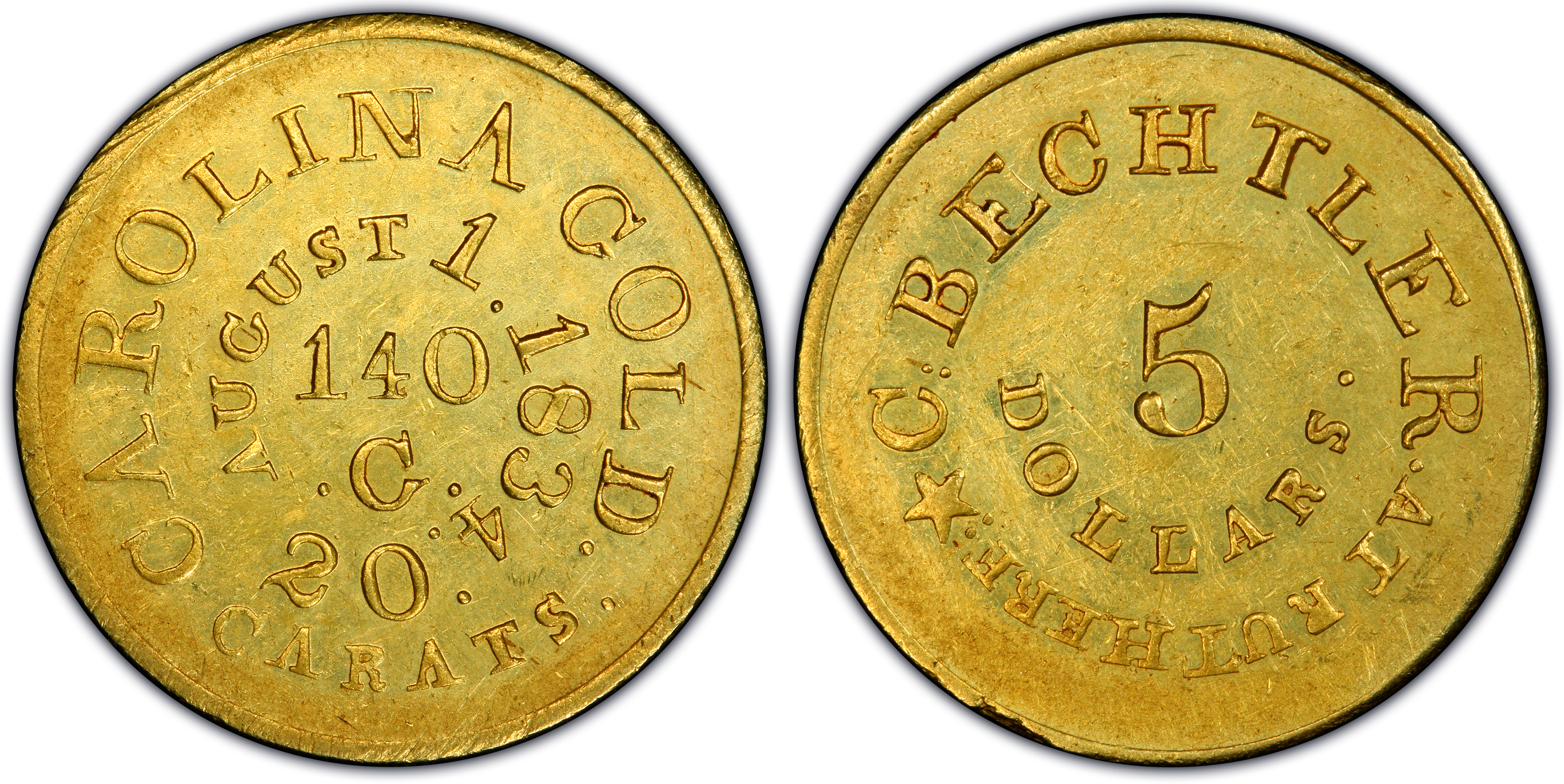
Obverse & Reverse
The gold coinage of Christopher Bechtler represents a pivotal chapter in American economic history, born from the nation's first major gold rush in the Appalachian foothills of North Carolina and Georgia. Before the California frenzy of 1849, this region was the primary source of domestic gold. However, miners faced a significant dilemma: the only Federal mint was in Philadelphia, a perilous and costly journey of hundreds of miles. Gold dust and nuggets circulated as a clumsy medium of exchange, hindering regional commerce. Into this monetary vacuum stepped Christopher Bechtler, a skilled German metallurgist, watchmaker, and gunsmith who had immigrated to the U.S. in 1829 and settled in Rutherford County, North Carolina, by 1830. Recognizing the local economy's plight, and at the urging of local miners and merchants, Bechtler established a private mint on his property in 1831. His operation was a model of efficiency and, crucially, integrity. Miners would bring their gold dust, Bechtler would assay it, refine it, and for a small fee, convert it into reliable, conveniently sized coins. His $1, $2.50, and $5 pieces became the lifeblood of the Southeastern economy, trusted and accepted far more readily than the scarce federal currency or dubious bank notes of the era. The period from 1834-1837 was particularly significant. In response to the Congressional Coinage Act of June 28, 1834, which reduced the weight of federal gold coins, Bechtler began adding the date 'AUGUST 1, 1834' to his $5 pieces. This was a clear signal to the public that his coins were compliant with the new federal standard, a savvy move that reinforced the public's trust in his issues over older, heavier federal coins which were now worth more as bullion. The specific variety with 'RUTHERF:' is an abbreviation of his location, 'Rutherford,' a common practice on his dies. Bechtler's mint produced over $2.24 million in gold coins between 1831 and 1840, a staggering sum that exceeded the output of the U.S. Mint at Charlotte in its early years. Even after the establishment of federal branch mints in Charlotte (1838) and Dahlonega (1838), Bechtler's coins continued to circulate widely, a testament to their honest weight and the public's confidence in his name. His death in 1842 passed the business to his son Augustus and later his nephew, but the coins of Christopher Sr. remain the most historically significant and sought-after relics of this fascinating period of private enterprise in American money.
Associated EventCarolina Gold Rush
Reason For MintingTo convert raw gold dust and nuggets from the Carolina Gold Rush into a reliable, standardized, and convenient medium of exchange for regional commerce.
Minter HistoryChristopher Bechtler, Sr. (1782-1842) was a German-born watchmaker, jeweler, gunsmith, and metallurgist from the Grand Duchy of Baden. He immigrated to the United States in 1829 with his son Augustus and nephew Christopher Jr. After a brief period in Philadelphia, he was drawn to the gold fields of North Carolina, settling in Rutherford County in 1830. A gifted artisan with an impeccable reputation for honesty, he established his private mint in 1831. He manufactured his own press and dies, producing the first U.S. gold dollar in 1832, seventeen years before the federal government. His operation was so successful and trusted that it became the de facto regional mint for the Southeast until the establishment of federal branch mints and continued to operate even after their opening. He died in 1842, leaving a legacy of integrity and ingenuity.
Historical SignificanceBechtler's coinage was the most successful and prolific private currency in the eastern United States, solving a critical monetary shortage during the nation's first gold rush and demonstrating the viability of private minting. His operation's success directly influenced the federal government's decision to establish branch mints in Charlotte, NC, and Dahlonega, GA. Bechtler coins are a tangible link to the pre-Civil War Southern economy and a classic example of American ingenuity.
K-18, K-19, K-20
Denomination$5
Minting Period1834-1837
Assayer/MinterChristopher Bechtler, Sr.
Geographic OriginRutherfordton, North Carolina
Obverse DescriptionThe design is purely utilitarian, consisting entirely of text. Centered is the weight and fineness, '140. G.' (Grains) and '20 CARATS'. On some varieties, the date 'AUGUST 1, 1834' is included in an inner circle. Encircling the central text is the legend 'CAROLINA GOLD'.
Obverse InscriptionCAROLINA GOLD / AUGUST 1, 1834 / 140. G. / 20 CARATS
Reverse DescriptionThe reverse is also purely textual. The denomination '5 DOLLARS' is centered, often on two lines. Encircling the denomination is the minter's name and location, with a star as a separator. This specific coin features the abbreviated location 'RUTHERF:'.
Reverse InscriptionC:BECHTLER. AT RUTHERF: ★ 5 DOLLARS
CompositionGold
Stated Fineness20 CARATS
Actual FinenessBechtler's coins were known for their honesty. While purity could vary slightly with each deposit of raw gold, analysis shows they were generally very close to their stated fineness.
Weight9.07 grams
Diameter24.70 mm
EdgePlain
Unknown for specific varieties, but the total value of all Bechtler coins minted was over $2.24 million.
Survival EstimateFewer than 100 for most varieties; K-19 is estimated at 31-45 known examples.
Rarity ScaleGenerally R-5 to R-6+ (Very Rare to Extremely Rare) depending on the specific Kagin variety.
This coin is a quintessential piece of Americana, representing the nation's first gold rush and a period of trusted private currency. Its simple, handmade aesthetic and direct connection to the Appalachian gold fields make it highly desirable for collectors of Territorial gold, early American history, and Southern numismatics.
Key VarietiesThe 'RUTHERF:' abbreviation itself defines a set of varieties. Key variations include: * **K-18**: Standard 'RUTHERF:' variety. * **K-19**: The '20 Distant' variety, where the '20' in '20 CARATS' is positioned far from the word 'CARATS'. This is a highly sought-after diagnostic. High R.6 rarity. * **K-20**: A '21 CARATS' variety, struck from gold of a higher purity, with a stated weight of 134 grains. * **Chapman Restrikes**: In the early 20th century, famed coin dealer Henry Chapman acquired some original Bechtler dies and produced a small number of proof restrikes. These are identified as K-31 for the 'RUTHERF:' reverse. They are numismatically distinct, extremely rare, and prized as collector issues in their own right.
Authentication TipsAuthentic Bechtler coins have a unique, slightly crude but sharp appearance from the hand-operated screw press. Lettering is often uneven in alignment and depth. Surfaces may show fine parallel striations from the rolling process used to prepare the planchets. Look for tell-tale signs of casting on counterfeits, such as a soft, soapy appearance, porosity, or a casting seam on the edge. Weights should be very close to the stated 140 grains (9.07 grams). Be wary of added mintmarks or alterations. Third-party certification by PCGS or NGC is highly recommended.
Shopping ConsiderationsA premium quality Bechtler $5 is one that shows minimal circulation wear and retains its original surface texture. Many surviving examples were cleaned or damaged over the years, so coins with original 'skin' and a pleasing, often reddish or greenish-gold patina, command significant premiums. The strike can be uneven; look for examples where the critical inscriptions—the name, location, and denomination—are as bold as possible. Avoid pieces with significant rim bumps, scratches, or evidence of tooling or repairs in the fields. Given the softness of the gold, even high-grade examples will likely show some contact marks, but these should not be overly distracting. An example with a CAC sticker is highly desirable, as it indicates premium quality for the assigned grade.
A coin's grade is its condition, rated on a 1-70 scale. For rare coins, this is the most critical factor in determining value, as a tiny difference in preservation can mean a huge difference in price.
Relevant Grade TypesAll original Bechtler issues were business strikes intended for vigorous circulation. They are found in Circulated grades (AG-3 to AU-58) and, very rarely, in Mint State (MS-60 and above). No proofs were struck by the Bechtlers during the original minting period. The only proof examples known are the later Chapman restrikes (c. 1908), which are considered separate numismatic items and are exceptionally rare.
Mint State CharacteristicsAn uncirculated Bechtler $5 is a major rarity. Its quality is defined by its luster, strike, and surface preservation. The luster is typically soft and satiny rather than frosty. The strike is often somewhat weak or uneven in areas, a characteristic of the private minting process; a coin with an unusually sharp and balanced strike is highly desirable. Due to the soft, high-purity gold, contact marks are common even on uncirculated examples. The key is finding a piece with minimal, non-distracting marks and pristine, undisturbed surfaces.
Circulated Wear PatternsWear first appears on the highest points of the simple text-based design. On both obverse and reverse, the letters and numbers in the center of the coin will show initial friction and begin to flatten. As wear progresses, the legends around the periphery will lose their sharpness, starting with the letters of 'BECHTLER' and 'CAROLINA'. In lower grades (VG and below), the date and finer details like the grain weight can become faint or partially obliterated.
Key Factors For ValueFor a Bechtler $5, value is driven by three main factors: grade, surface quality, and variety. A higher grade (e.g., AU-55 vs. XF-40) brings exponentially higher value. Equally important is the originality of the surfaces; an example with original, uncleaned skin and attractive reddish or greenish-gold toning is far more valuable than a cleaned, brighter-looking coin of the same grade. Strike sharpness is a key component of eye appeal. Finally, specific rare varieties, like the K-19 '20 Distant,' carry a significant premium over more common types. A CAC sticker confirming the quality for the grade adds another substantial layer of value.
PCGS Price Guide
| Grade | Price | Population |
|---|---|---|
| 40 | $18,500.00 | 1 |
| 45 | $20,000.00 | N/A |
| 45+ | $21,500.00 | N/A |
| 50 | $24,000.00 | N/A |
| 50+ | $25,000.00 | N/A |
| 53 | $27,500.00 | 2 |
| 53+ | $32,500.00 | N/A |
| 55 | $37,500.00 | 1 |