(1837-42) $2.50 C. Bechtler, 64 Grains, 22 Carats (Regular Strike)
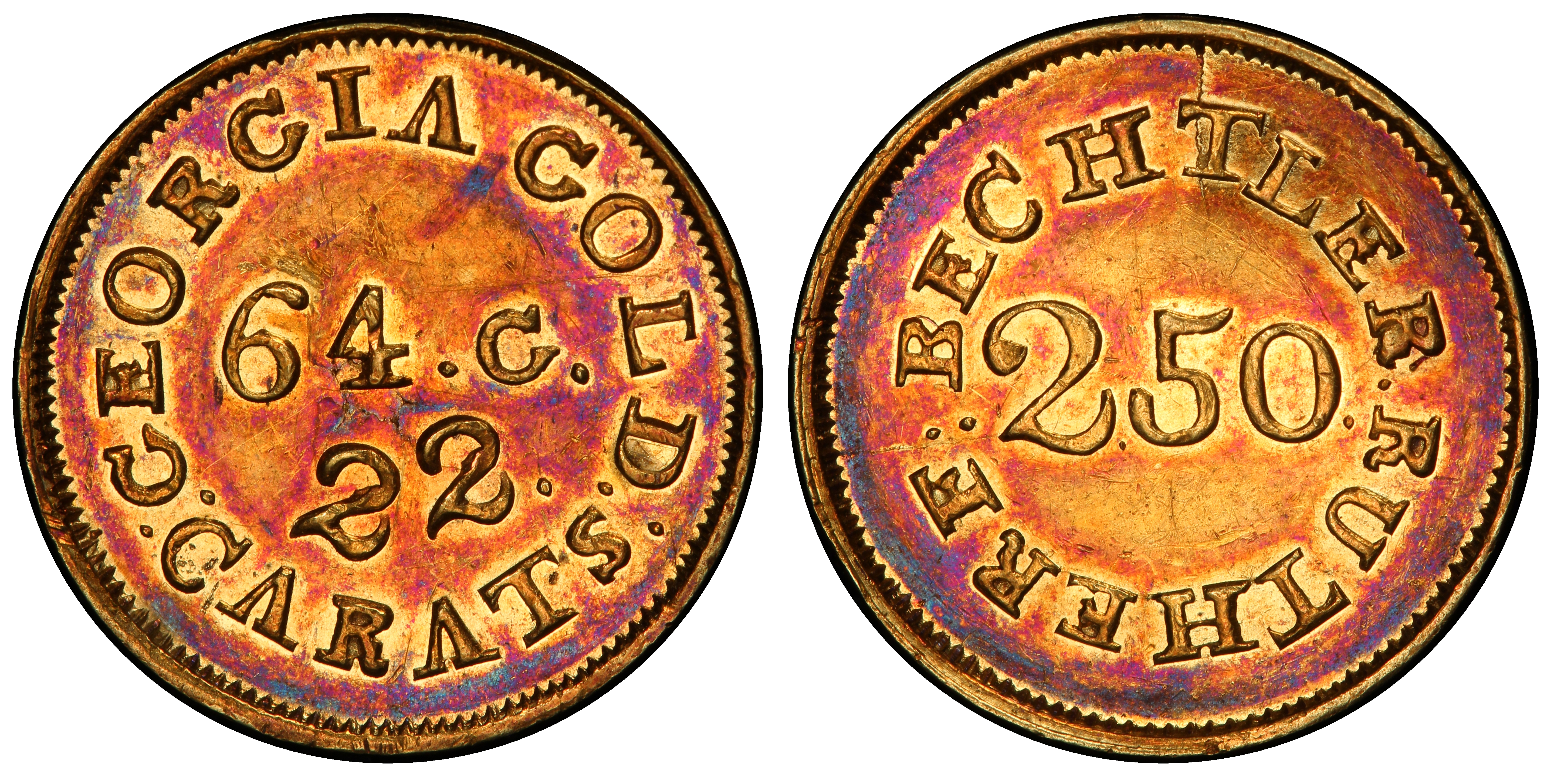
Obverse & Reverse
The Bechtler coinage is a direct product of America's first gold rush, which occurred not in California, but in the rolling hills of the southern Appalachian Mountains. From the late 1820s, significant gold discoveries in Georgia and North Carolina created a crisis of commerce. Miners, merchants, and the general populace were awash in raw gold dust and nuggets but starved for a reliable, fungible medium of exchange. Transporting gold overland to the sole U.S. Mint in Philadelphia was a perilous, expensive, and time-consuming journey, rendering the vast majority of the region's wealth inert for daily transactions. Into this economic vacuum stepped Christopher Bechtler, Sr., a German immigrant and master metallurgist who had settled in Rutherford County, North Carolina, in 1830. Recognizing the local miners' plight, and at their urging, he established a private mint on his property in 1831. Unlike the ill-fated venture of Templeton Reid in Georgia, Bechtler's operation was founded on unimpeachable honesty and technical skill. He charged a modest fee (around 2.5%) to assay and coin gold, providing a vital service that instantly lubricated the regional economy. His coins, known for their consistent weight and purity, were eagerly accepted and became the de facto currency of the Southeast. The $2.50 Quarter Eagle, along with his $1 and $5 pieces, were struck using locally sourced gold, including from Georgia, as advertised on this specific variety. The Bechtler mint was so successful and trusted that it continued to operate for years even after the U.S. government established branch mints in Charlotte (1838) and Dahlonega (1838) to serve the same region. The 'GEORGIA GOLD' inscription on this coin was likely a marketing tool to appeal to miners and merchants from that prolific region, assuring them of the source or at least the standard of the gold used. These coins circulated heavily for decades, a testament to their quality and the trust placed in the Bechtler name. Even during the Civil War, Confederate contracts were sometimes specified to be paid in 'Bechtler Gold,' a remarkable endorsement of a private coinage long after its production had ceased.
Associated EventAppalachian Gold Rush (North Carolina/Georgia)
Reason For MintingTo convert raw gold dust and nuggets from the Appalachian gold fields into a standardized, usable currency for local and regional commerce.
Minter HistoryChristopher Bechtler, Sr. (1782-1842) was a German goldsmith, watchmaker, and metallurgist from the Grand Duchy of Baden. He immigrated to the United States in 1829 with his sons, Augustus and Charles, and a nephew. After a brief period in Philadelphia, he was drawn to the gold-rich region of North Carolina, settling in Rutherford County in 1830. A highly skilled craftsman, he manufactured his own coining press, rollers, and dies. His reputation for producing coins of honest weight and stated fineness was impeccable, making his private mint the most successful and prolific in U.S. history, striking over $2.24 million in gold coins from 1831 until his death in 1842. The operation was continued by his son, Augustus, and later his nephew, though with a less stellar reputation for quality control.
Historical SignificanceBechtler's coinage was the most important and successful private money in American history, solving a critical currency shortage during the nation's first gold rush and predating the U.S. government's first gold dollar by 17 years. It stands as a powerful example of private enterprise filling a crucial economic need that the federal government was too slow to address, and the coins themselves are tangible relics of a foundational period in Southern economic history.
K-11 and K-12
Denomination$2.50
Minting Period1837-1842
Assayer/MinterChristopher Bechtler, Sr.
Geographic OriginRutherfordton, North Carolina
Obverse DescriptionA simple, utilitarian design devoid of portraiture or major vignettes. The coin's stated physical standards—its weight and fineness—dominate the field, arranged in three lines.
Obverse InscriptionGEORGIA GOLD / 64. G. / 22. CARATS.
Reverse DescriptionSimilar to the obverse in its functional simplicity. The name of the assayer and the denomination are centered, encircled by the location of the private mint.
Reverse InscriptionC. BECHTLER. / 2.50 / AT RUTHERF:
CompositionGold
Stated Fineness22 Carats (approximately .9167 fine)
Actual FinenessBelieved to be very close to the stated fineness, as Christopher Bechtler, Sr.'s reputation was built on his integrity. However, due to the refining technology of the time, slight variations were inevitable.
Weight4.15 grams
Diameter18.00 mm
EdgePlain
Unknown
Survival EstimateFewer than 75 (combined K-11 and K-12)
Rarity ScaleR-5+
This coin is highly sought after as a key artifact from America's first gold rush, representing the most successful private minter in U.S. history. Its crude but honest appearance, direct connection to the Appalachian gold fields, and immense historical importance make it a centerpiece for any collection of territorial gold or early American currency.
Key VarietiesTwo primary varieties exist for this type: Kagin-11, which is identified by an 'Uneven 22' in the word CARATS where the first '2' is punched slightly lower than the second; and Kagin-12, where the numerals '22' are evenly aligned. No proof or special collector strikes were made during the original period of issue, and there are no known later-date restrikes of this specific variety.
Authentication TipsGenuine Bechtler coins possess a characteristic crude, handmade quality. The planchets are often slightly irregular and may show file or adjustment marks. The lettering style is distinctive and not of U.S. Mint quality. Look for a soft, original luster rather than a bright, modern shine. Counterfeits from the era were typically gold-plated base metal and are often crudely cast. Modern forgeries may be of the correct weight but fail on the specific die characteristics, such as the exact positioning and style of the lettering on known genuine examples. The 'Uneven 22' on K-11 is a key diagnostic.
Shopping ConsiderationsA premium quality example for its grade will show a bold, well-centered strike, which is uncommon for the series. Look for original, uncleaned surfaces, often with a deep reddish-gold or orange-peel toning. Many surviving examples are on defective planchets with laminations or splits; coins on clean planchets command a premium. Avoid examples that have been harshly cleaned, polished, or show evidence of tooling or repairs in the fields. The sharpness of the central inscriptions ('64. G.', '2.50') is a key indicator of a strong strike and minimal wear. Due to their rarity and historical importance, even impaired or heavily circulated examples are highly collectible.
A coin's grade is its condition, rated on a 1-70 scale. For rare coins, this is the most critical factor in determining value, as a tiny difference in preservation can mean a huge difference in price.
Relevant Grade TypesAll original Bechtler coins were business strikes intended for robust commercial use, so they are found in Circulated grades (AG-3 to AU-58) and, very rarely, in Mint State (MS, 60-70). No Proofs (PR/PF) were struck by Christopher Bechtler during the original minting period, and no later-date Proof restrikes of this variety exist. Any coin claiming to be a 'Proof' would be highly suspect.
Mint State CharacteristicsAn uncirculated Bechtler $2.50 is exceptionally rare. Such a piece would exhibit original, slightly satiny mint luster, often with a subtle cartwheel effect. Strike quality is paramount; most were weakly struck, so a sharp, fully defined example is a great prize. The planchets were not prepared to U.S. Mint standards, so minor natural imperfections or light adjustment marks may be present and are considered characteristic, not necessarily detrimental. Contact marks from bag handling are expected but should be minimal for a high grade.
Circulated Wear PatternsWear first appears on the highest points of the simple design: the numerals '64' and '22' on the obverse, and the '2.50' and the name 'BECHTLER' on the reverse. As wear progresses, the peripheral legends 'GEORGIA GOLD' and 'AT RUTHERF:' will begin to soften and fade, starting with the letters closest to the rim. In lower grades (VG and below), the central weight and fineness details will become indistinct.
Key Factors For ValueFor this issue, value is driven by three main factors: 1) Surface Preservation: An example with original, uncleaned 'skin' and attractive luster is far more valuable than a cleaned or polished coin of the same technical grade. 2) Strike Quality: A sharply and evenly struck coin is the exception and commands a significant premium over the more typical weak or off-center strikes. 3) Planchet Quality: Coins struck on smooth, problem-free planchets are more desirable than those with inherent flaws like laminations or severe striations. Certification by a major grading service (PCGS or NGC) is standard for the market, and a CAC sticker, indicating premium quality for the grade, adds a substantial premium.
PCGS Price Guide
| Grade | Price | Population |
|---|---|---|
| 8 | $5,500.00 | N/A |
| 10 | $6,250.00 | N/A |
| 12 | $7,250.00 | N/A |
| 15 | $8,000.00 | N/A |
| 20 | $9,000.00 | N/A |
| 25 | $10,500.00 | N/A |
| 30 | $11,500.00 | N/A |
| 35 | $12,750.00 | N/A |
| 40 | $14,500.00 | N/A |
| 45 | $16,000.00 | 3 |
| 45+ | $17,500.00 | N/A |
| 50 | $20,000.00 | 7 |
| 50+ | $21,500.00 | N/A |
| 53 | $23,000.00 | 3 |
| 53+ | $25,000.00 | N/A |
| 55 | $27,000.00 | 4 |
| 55+ | $30,000.00 | N/A |
| 58 | $32,500.00 | 3 |
| 58+ | $37,500.00 | N/A |
| 60 | $42,500.00 | 2 |
| 61 | $45,000.00 | 3 |
| 62 | $52,500.00 | 3 |