(1842-52) $5 A. Bechtler, 141 Grains, 20 Carats (Regular Strike)
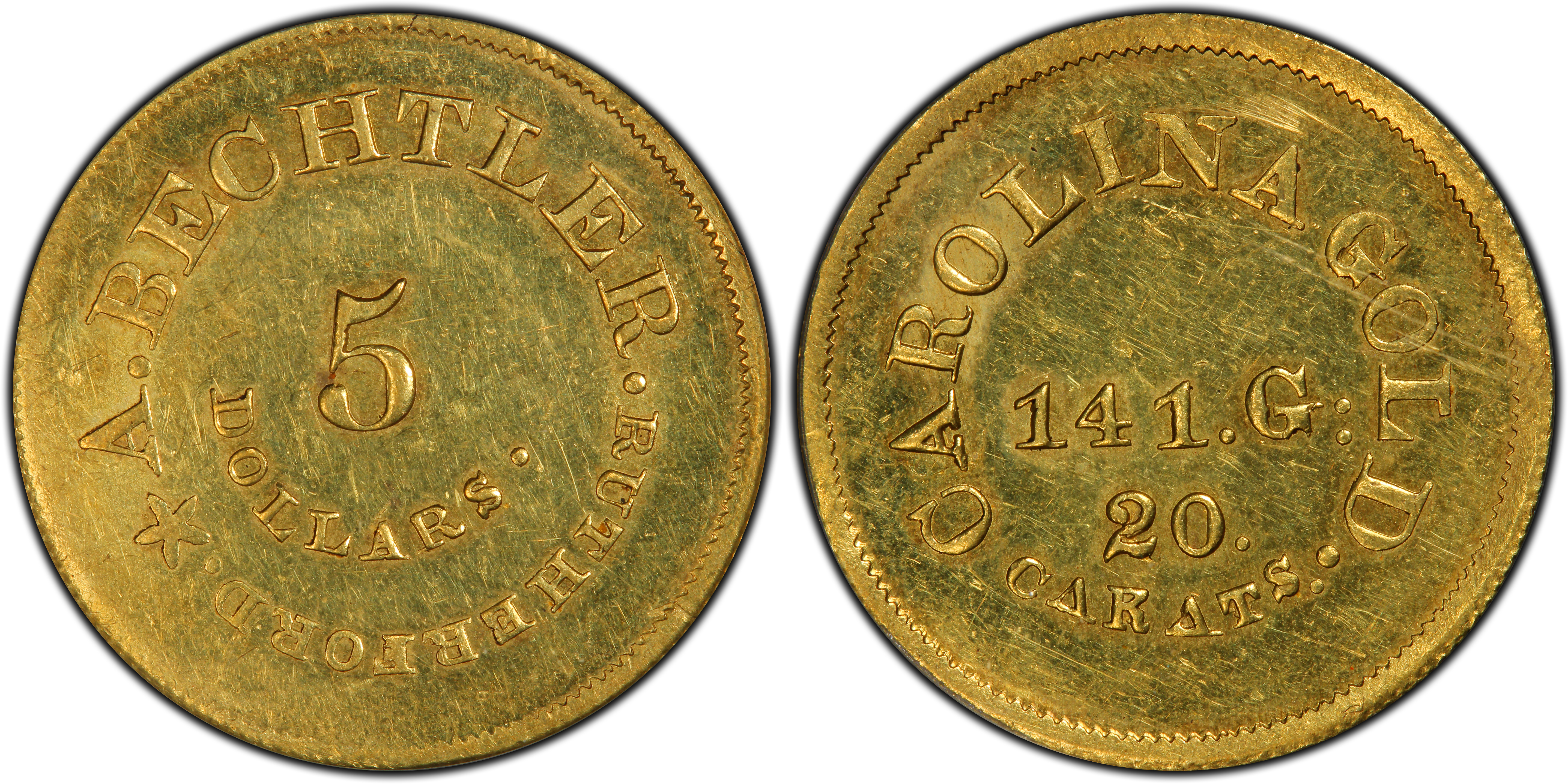
Obverse & Reverse
The Augustus Bechtler five-dollar gold piece, Kagin-29, emerged from a pivotal and transitional period in American economic history, deeply rooted in the nation's first major gold rush. Long before the California strikes of 1849, the foothills of the Appalachian Mountains in North Carolina and Georgia were the primary source of domestic gold. The discovery of gold in the late 1790s and early 1800s created a unique dilemma for miners and merchants: a surplus of raw gold dust and nuggets but a severe shortage of reliable, circulating coinage. Transporting gold to the sole U.S. Mint in Philadelphia was a long, perilous, and expensive journey, effectively removing capital from the region for extended periods. This void was brilliantly filled by Christopher Bechtler, a German immigrant metallurgist, who established a private mint in Rutherford County, North Carolina, in 1831. His reputation for honesty and accurately valued coins made his operation an indispensable part of the regional economy. Upon Christopher Bechtler's death in 1842, the respected and highly successful minting operation passed to his son, Augustus. Operating under the name 'A. BECHTLER,' Augustus continued his father's work, but under evolving circumstances. The U.S. government, finally acknowledging the need for coinage in the gold regions, had established branch mints in Charlotte, North Carolina (1838), and Dahlonega, Georgia (1838). Despite this official competition, the Bechtler mint continued to thrive, a testament to the family's entrenched reputation and the public's trust in their product. Augustus introduced his own distinct coin designs, moving away from his father's earlier motifs. The K-29 variety, with its stark, utilitarian design focused solely on the coin's vital statistics—its weight and purity—was a product of this era. It was a purely functional piece, intended to communicate its intrinsic value directly and unambiguously. However, the landscape shifted dramatically with the California Gold Rush beginning in 1849, which drew miners and capital westward, diminishing the output of the Carolina mines. Coinage at the A. Bechtler mint dwindled, and the operation is believed to have ceased around 1852. The K-29 is one of the final and rarest issues from this period, a tangible artifact from the closing chapter of America's first gold rush and the most successful private mint in U.S. history.
Associated EventCarolina Gold Rush
Reason For MintingTo convert locally mined gold dust into a reliable, circulating medium of exchange for commerce in the southeastern United States.
Minter HistoryAugustus Bechtler was the son of Christopher Bechtler, the founder of the most successful private mint in U.S. history. He inherited the family business in 1842 and continued coining operations in Rutherfordton, North Carolina. While his father was universally praised for the accuracy of his coins, U.S. Mint assays of Augustus's pieces sometimes found them to be slightly deficient in value, though they still circulated widely based on the family's strong reputation. His tenure coincided with the establishment of official U.S. branch mints in Charlotte and Dahlonega and the decline of the Carolina gold fields after the California discovery. He is believed to have ceased coining operations in the early 1850s, marking the end of the Bechtler era.
Historical SignificanceThe A. Bechtler K-29 is a key representative of the final phase of the most prolific and trusted private coiner in American history. It demonstrates the continued need for private coinage even after the establishment of nearby branch U.S. Mints and serves as an important link between the Carolina and California gold rushes. Its extreme rarity makes it a numismatic prize and a direct connection to the waning days of the Eastern gold mining boom.
K-29
Denomination$5
Minting Period1842-1852
Assayer/MinterAugustus Bechtler
Geographic OriginRutherfordton, Rutherford County, North Carolina
Obverse DescriptionA purely typographic design. The legend 'CAROLINA GOLD.' is at the top, above the central inscription of '141 . G .' (for 141 Grains) which is on one line above '20 . CARATS .' on a second line. There are no images, portraits, or significant design motifs.
Obverse InscriptionCAROLINA GOLD. / 141 . G . / 20 . CARATS .
Reverse DescriptionA purely typographic design similar to the obverse. The legend '* A. BECHTLER .' is at the top, above '5 DOLLARS .' in the center. The location 'RUTHERFORD .' is inscribed along the bottom.
Reverse Inscription* A. BECHTLER . / 5 DOLLARS . / RUTHERFORD .
CompositionGold
Stated Fineness20 Carats (0.8333)
Actual FinenessU.S. Mint assays of August Bechtler's coinage reported deficiencies of up to 1.5%, suggesting an actual fineness potentially as low as 0.8208.
Weight9.14 grams
Diameter24.70 mm
EdgeReeded
Unknown
Survival EstimateFewer than 15 examples known
Rarity ScaleR-7
This coin is highly sought after for its extreme rarity (R-7) and its direct connection to the historic Bechtler mint during its final years under Augustus Bechtler. As the rarest of the three regular-issue A. Bechtler half eagles, it is a significant prize for advanced collectors of territorial and private gold.
Key VarietiesThe primary variety is the original business strike (K-29). Numismatists must also be aware of the K-30, a Proof restrike made by Philadelphia coin dealer Henry Chapman circa 1922 using a new set of dies that closely copied the original K-29 design. These Chapman restrikes are themselves very rare and are considered a distinct, later collector's issue, not to be confused with the original circulation strikes.
Authentication TipsAuthentic examples are die-struck, not cast. Look for sharp, well-defined letter edges, though the overall strike may be weak. The surfaces should exhibit original mint luster, not a uniform, porous, or pimpled texture characteristic of cast counterfeits. Pay close attention to the style and placement of the letters and periods, comparing them to known genuine examples. The reeded edge should be sharp and parallel. Given the coin's high value and the existence of contemporary counterfeits, authentication by a leading third-party grading service is essential.
Shopping ConsiderationsFor a 'premium quality' example, a collector should prioritize sharpness of strike and surface preservation. Many Bechtler coins were struck on imperfect planchets and can show weakness in the center. A coin with a bold, even strike on all inscriptions (especially '141 . G .' and 'A. BECHTLER') commands a significant premium. Look for original, uncleaned surfaces with some remaining luster; a warm, reddish-gold toning is often considered attractive. Avoid examples with significant planchet flaws, distracting marks, evidence of cleaning (hairline scratches), tooling (re-engraving of letters), or edge damage.
A coin's grade is its condition, rated on a 1-70 scale. For rare coins, this is the most critical factor in determining value, as a tiny difference in preservation can mean a huge difference in price.
Relevant Grade TypesOriginal period issues were business strikes intended for circulation and are found in Circulated (1-58) and Mint State (MS, 60-70) grades. No Proofs were struck during the original minting period. A very rare, later-date Proof restrike (the K-30 Chapman issue) exists, but this is a separate numismatic item created for collectors decades after the original mint closed and should not be confused with original business strikes.
Mint State CharacteristicsUncirculated examples of the K-29 are exceptionally rare. A true Mint State specimen would be defined by its luster and strike. The luster is typically satiny and a bit subdued, not deeply frosty or prooflike. The strike is a critical factor; due to the primitive equipment used, many Bechtler coins are weakly struck. An MS example with a sharp, well-defined strike across all the letters and dentils is extremely desirable. Small, inherent planchet flaws or minor adjustment marks made before striking are common and may not preclude a Mint State grade, but significant post-strike contact marks will.
Circulated Wear PatternsWear first appears on the highest points of the simple design, which are the letters and numbers of the central inscriptions. Look for the initial flattening and loss of detail on '141 . G .', '20 . CARATS .', '5 DOLLARS', and 'A. BECHTLER'. In lower grades (VG and below), these legends will become progressively weaker and begin to merge with the fields. The peripheral legends ('CAROLINA GOLD.', 'RUTHERFORD.') are slightly more protected and will often remain legible longer than the central details.
Key Factors For ValueFor the K-29, value is driven by three main factors beyond the numerical grade itself. First is rarity; as an R-7 coin, any example is valuable. Second is strike quality; a specimen with a bold, full strike is far more desirable than a weakly struck one of the same grade. Third is surface quality and eye appeal; an example with clean, original surfaces and attractive toning will always command a premium over one that has been cleaned, polished, or has distracting marks. A CAC sticker indicating superior quality for the grade would add a significant premium to this rarity.
PCGS Price Guide
| Grade | Price | Population |
|---|---|---|
| 8 | $5,500.00 | N/A |
| 10 | $6,000.00 | N/A |
| 12 | $7,250.00 | N/A |
| 15 | $8,250.00 | N/A |
| 20 | $9,500.00 | N/A |
| 25 | $11,000.00 | N/A |
| 30 | $12,000.00 | N/A |
| 35 | $13,250.00 | N/A |
| 40 | $15,000.00 | 2 |
| 45 | $17,500.00 | 3 |
| 45+ | $18,000.00 | N/A |
| 50 | $21,000.00 | 1 |
| 50+ | $22,500.00 | N/A |
| 53 | $27,500.00 | 3 |
| 53+ | $30,000.00 | N/A |
| 55 | $32,500.00 | N/A |
| 55+ | $35,000.00 | N/A |
| 58 | $40,000.00 | N/A |
| 58+ | $47,500.00 | N/A |
| 60 | $65,000.00 | N/A |
| 61 | $75,000.00 | 1 |
| 64 | N/A | N/A |
Graysheet Price Guide
| Coin | Price Range |
|---|---|
| (1842-52) G$5 A.Bechtler, 141 GR, 20C, K-29 MS | $15,000 - $65,000 |