(1837-42) $5 C. Bechtler, Georgia Gold RUTHERF: (Regular Strike)
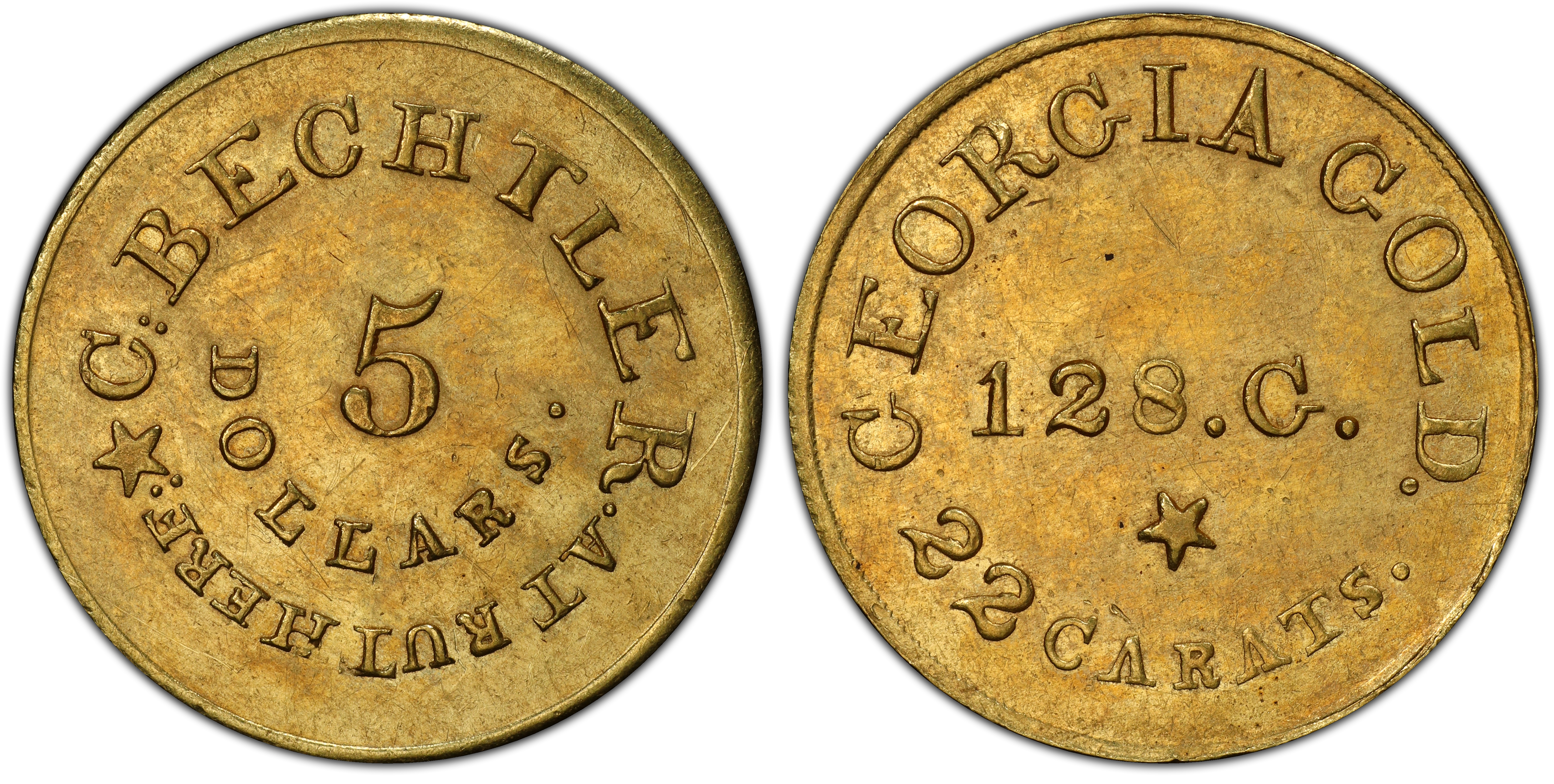
Obverse & Reverse
The Christopher Bechtler five-dollar gold piece stands as a monumental testament to American ingenuity and the economic realities of the nation's first major gold rush. Prior to the California frenzy of 1849, the Appalachian Mountains of North Carolina and Georgia were the epicenter of American gold production. Miners in this region faced a significant logistical and economic dilemma: a severe shortage of circulating currency and the immense difficulty of transporting their gold dust over 500 perilous miles to the sole U.S. Mint in Philadelphia. The journey was not only dangerous but also time-consuming, and the federal mint's high seigniorage fees and slow turnaround times cut deeply into miners' profits. Into this void stepped Christopher Bechtler, a skilled German metallurgist, gunsmith, and watchmaker who immigrated to the U.S. in 1829 and settled in Rutherford County, North Carolina, in 1830. Recognizing the opportunity, Bechtler established a private mint on his property in 1831. His reputation for scrupulous honesty, combined with a modest 2.5% fee for assaying and coining, quickly earned him the trust of the entire region. The Bechtler mint became the de facto regional monetary authority, converting raw gold dust into reliable, spendable coins. The 'GEORGIA GOLD' designation on this particular series was a mark of quality, indicating that the planchets were produced from the finest grade of gold that came to his mint, assaying at a stated 22 carats. This was in contrast to his 'CAROLINA GOLD' (21 carats) and 'N. CAROLINA GOLD' (20 carats) issues, creating a tiered system of purity that was well-understood in local commerce. The coins were simple and utilitarian, bearing only the essential information: the minter's name and location, the denomination, and the weight and purity of the gold. Despite their crude appearance by federal standards, they were universally accepted and formed the backbone of the Southeastern economy for over a decade. Bechtler's operation was so successful and integral that even after the U.S. government established branch mints in Charlotte (1838) and Dahlonega (1838) to serve the gold regions, his private coinage continued to circulate alongside federal issues without interference, a testament to its trusted status. From 1831 to 1840 alone, Bechtler's mint coined over $2.24 million in gold, a staggering sum that exceeded the output of the Charlotte Mint during its early years. Christopher Bechtler died in 1842, and the minting operation was continued by his son August and later his nephew, also named Christopher, until the early 1850s, by which time the Southern Appalachian gold rush had waned. Today, these coins are cherished as tangible links to a vibrant period of American economic history, representing a successful private enterprise that solved a critical monetary problem long before the federal government could effectively respond.
Associated EventAppalachian Gold Rush (Georgia and North Carolina)
Reason For MintingTo provide a reliable and convenient medium of exchange for miners and merchants by converting locally mined gold dust into standardized coins, overcoming the difficulty of transacting with the distant Philadelphia Mint.
Minter HistoryChristopher Bechtler, Sr. (1782-1842) was a German goldsmith, watchmaker, and metallurgist from the Grand Duchy of Baden who immigrated to the United States in 1829. After a brief period in Philadelphia, he moved his family to Rutherford County, North Carolina, in 1830, placing himself at the center of the first U.S. gold rush. A brilliant and honest craftsman, he established a private assay office and mint in 1831. He produced the nation's first gold dollar in 1832, seventeen years before the U.S. Mint. His operation, assisted by his son August and nephew Christopher Jr., was renowned for its integrity, producing over a million gold coins whose stated weight and fineness were consistently reliable, making them a trusted currency throughout the Southeast.
Historical SignificanceThe Bechtler $5 coin was a vital component of the regional economy in the antebellum Southeast, representing one of history's most successful private minting operations. It proved that private enterprise could fill a crucial currency void and set a standard of quality that rivaled and, in the eyes of locals, surpassed that of the federal government. Its existence and popularity were primary catalysts for the establishment of the U.S. branch mints in Charlotte and Dahlonega.
K-23
Denomination$5.00
Minting PeriodUndated (Struck circa 1837-1842)
Assayer/MinterChristopher Bechtler, Sr.
Geographic OriginRutherfordton, Rutherford County, North Carolina
Obverse DescriptionThe design is purely informational and without artistic devices. The periphery is inscribed GEORGIA GOLD. and 22 CARATS. A single five-pointed star is typically present between the phrases at the bottom. The center of the coin features the stated weight, 128.G.
Obverse InscriptionGEORGIA GOLD. / 128.G. / 22 CARATS.
Reverse DescriptionSimilar to the obverse, the design is purely typographic. The name and location of the minter, C:BECHTLER.AT RUTHERF:, encircles the upper two-thirds of the periphery, with the abbreviation 'RUTHERF:' being a key diagnostic for the K-23 variety. The denomination, 5 DOLLARS., is displayed prominently in the center. A single five-pointed star is often seen on either side of the central denomination.
Reverse InscriptionC:BECHTLER.AT RUTHERF: / 5 DOLLARS.
CompositionGold
Stated Fineness22 Carats (.9167 fine)
Actual FinenessGenerally found to be very close to the stated fineness, a key reason for the public's trust in Bechtler's coinage.
Weight8.29 grams
Diameter21.60 mm
EdgePlain
Unknown
Survival EstimateApproximately 40-50 examples are believed to exist for the K-23 variety.
Rarity ScaleHigh R-6
This coin is highly sought after as a product of the first major U.S. gold rush, a tangible piece of Southern economic history, and a classic example of successful private coinage. Its crude but honest appeal, historical importance, and rarity make it a cornerstone of any Territorial gold collection.
Key VarietiesThe 'Georgia Gold' $5 pieces by C. Bechtler come in three major varieties: K-21 (R-7) is the rarest, distinguished by the use of colons in the obverse legend (:GEORGIA GOLD. and 128.G:); K-22 (R-6) is similar to K-23 but with RUTHERFORD spelled out fully; and K-23 (High R-6) is the variety identified by the 'RUTHERF:' abbreviation on the reverse. No proof specimens were struck during the original period of issue, nor are there any known later-date collector restrikes (like the Chapman issues for other Bechtler types) for this specific 'Georgia Gold' series.
Authentication TipsAuthentic pieces exhibit a specific style of hand-punched lettering with known imperfections. The 'A's in 'CARATS' are often made from an inverted 'V' punch. The spacing and alignment of the letters and numerals should be compared to known genuine examples. The surfaces should have the correct texture for gold planchets of this era, not the porous or tool-marked look of many cast counterfeits. Weight and specific gravity tests are crucial, as many forgeries are made of debased gold or plated base metal.
Shopping ConsiderationsA premium quality example for its grade will possess original, uncleaned surfaces with some remaining mint luster, often described as satiny or slightly prooflike. The strike can be uneven, so examples with bold legends and central devices are highly desirable. Avoid specimens that are heavily abraded, have been harshly cleaned, show signs of tooling in the fields, or have edge damage. Attractive natural toning, which often presents as a deep reddish-gold or orange-peel hue, adds significantly to eye appeal and value. Given the rarity and value, purchase only from reputable dealers and prefer coins certified by top-tier grading services (PCGS or NGC).
A coin's grade is its condition, rated on a 1-70 scale. For rare coins, this is the most critical factor in determining value, as a tiny difference in preservation can mean a huge difference in price.
Relevant Grade TypesAll original Bechtler issues were business strikes intended for commerce and are found in Circulated (1-58) and Mint State (MS, 60-70) grades. No Proof (PR/PF) examples were struck during the original minting period, and no later restrikes of this specific variety are known to exist. Any coin described as a 'Proof' should be regarded with extreme skepticism and is likely a prooflike business strike or an altered piece.
Mint State CharacteristicsUncirculated examples of this issue are very rare. A typical Mint State Bechtler $5 will often exhibit a slightly soft strike in areas, particularly on the peripheral letters. Luster is typically soft and satiny rather than deeply frosty. Due to the softness of the 22-karat gold and the way the coins were handled, even high-grade specimens will usually show scattered light contact marks or 'bag marks'. A truly choice piece will have minimal marks, a strong strike for the issue, and pleasing original luster.
Circulated Wear PatternsWear first becomes apparent on the highest points of the coin: the central numerals '5' and '128' and the letters of 'DOLLARS' and 'GEORGIA'. As wear progresses, the peripheral inscriptions, particularly 'C:BECHTLER.AT RUTHERF:', will begin to lose definition. In lower grades (VG and below), the inscriptions will be significantly worn, with the finer details of the letters becoming faint or merging with the fields.
Key Factors For ValueOriginality of the surfaces is paramount; a coin with its natural 'skin' and luster is far more valuable than one that has been cleaned or polished. Sharpness of the strike is a major factor, with well-struck examples commanding substantial premiums. Eye appeal, driven by attractive toning and mark-free surfaces, is critical. Finally, a CAC sticker on a certified coin provides third-party verification of quality for the grade and often results in a significant price premium, as it indicates a coin is solid or high-end for its designated grade.
PCGS Price Guide
| Grade | Price | Population |
|---|---|---|
| 8 | $4,500.00 | N/A |
| 10 | $5,000.00 | N/A |
| 12 | $6,250.00 | N/A |
| 15 | $6,750.00 | N/A |
| 20 | $7,500.00 | N/A |
| 25 | $8,500.00 | N/A |
| 30 | $9,750.00 | N/A |
| 35 | $11,000.00 | 1 |
| 40 | $12,500.00 | 6 |
| 45 | $14,000.00 | 3 |
| 45+ | $15,000.00 | N/A |
| 50 | $18,500.00 | 2 |
| 50+ | $19,500.00 | N/A |
| 53 | $21,000.00 | 2 |
| 53+ | $22,500.00 | N/A |
| 55 | $24,500.00 | 8 |
| 55+ | $27,500.00 | N/A |
| 58 | $35,000.00 | 4 |
| 58+ | $37,500.00 | N/A |
| 60 | $40,000.00 | N/A |
| 61 | $42,500.00 | 2 |
| 62 | $55,000.00 | N/A |
| 63 | N/A | N/A |