(1837-42) $5 C. Bechtler, Georgia Gold, "128.G:" (Regular Strike)
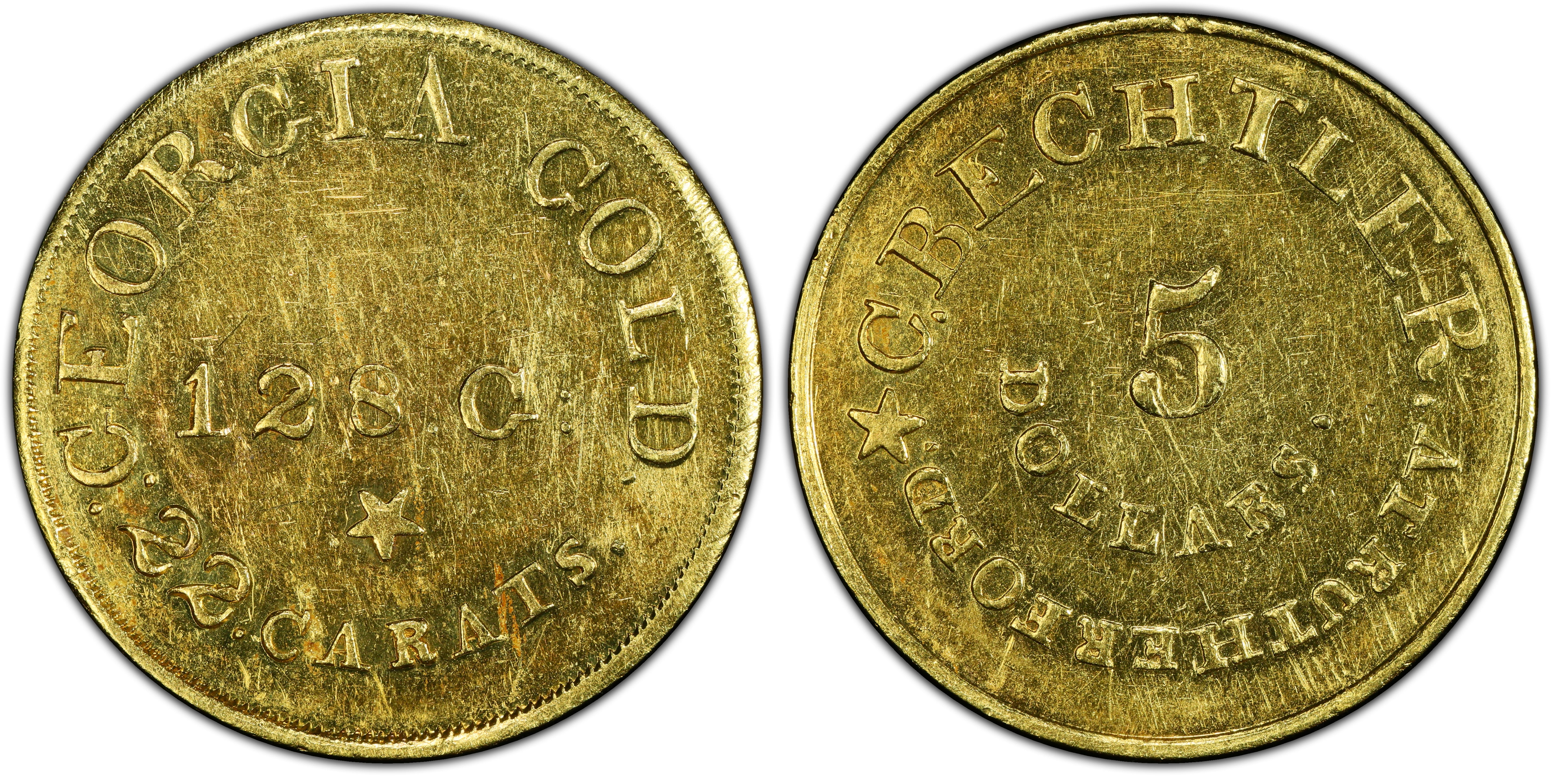
Obverse & Reverse
The C. Bechtler $5 'Georgia Gold' piece is a seminal issue in the history of American private coinage, born from the nation's first major gold rush in the Appalachian mountains of Georgia and North Carolina. Prior to the California Gold Rush of 1849, the primary source of domestic gold was in the American South. Miners and merchants in this region faced a significant dilemma: the nearest United States Mint was a perilous 900-mile round trip away in Philadelphia, a journey fraught with danger and expense. This created a severe shortage of circulating specie and a desperate need for a reliable means to convert raw gold dust and nuggets into a usable monetary form. Into this void stepped Christopher Bechtler, a skilled German metallurgist who had immigrated to Rutherfordton, North Carolina, in the heart of the gold-producing region. Between 1831 and the early 1850s, he, his son August, and nephew Christopher operated a private mint that became renowned for its integrity and the accuracy of its assays. Their coins were of such reliable weight and fineness that they were widely accepted in commerce throughout the Southeast, circulating alongside federal issues. The Bechtlers produced coins in $1, $2.50, and $5 denominations, with the source of the gold often designated on the coin itself. The inscription 'GEORGIA GOLD' was used to denote gold of the highest purity, approximately 22 carats, that came from the rich Georgia deposits near Dahlonega. This specific variety, Kagin-21, is distinguished by its unique punctuation, featuring a colon after the 'G' in '128.G:' and often another before 'GEORGIA'. It is considered the earliest and by far the rarest of the 'Georgia Gold' $5 varieties. The success and widespread acceptance of Bechtler's coinage ultimately prompted the U.S. government to establish branch mints in Dahlonega, Georgia, and Charlotte, North Carolina, in 1838, in part to reclaim the seigniorage Bechtler was earning and to provide a federal solution to the problem he had so effectively solved. Despite this federal competition, the Bechtler mint continued to operate for over a decade more, a testament to the public's enduring trust in their name and product.
Associated EventGeorgia and North Carolina Gold Rush
Reason For MintingTo convert raw gold dust from the Georgia Gold Rush into a standardized, reliable circulating currency for local commerce due to the great distance to the U.S. Mint in Philadelphia.
Minter HistoryChristopher Bechtler, Sr. (1782-1842) was a German watchmaker, gunsmith, and gifted metallurgist who emigrated to the United States and settled in Rutherfordton, North Carolina, around 1830. Recognizing the needs of local gold miners, he established a private assay office and mint in 1831. Assisted by his son August and nephew Christopher Jr., he produced what is considered the most successful and prolific private coinage in U.S. history prior to the Civil War. The Bechtlers earned an unimpeachable reputation for honesty and accurate weights, and their coins, including the first gold dollar in American history (1832), became a trusted medium of exchange. The operation continued under August after Christopher Sr.'s death in 1842, and later under Christopher Jr., until the early 1850s.
Historical SignificanceThe Bechtler coinage was the most important circulating medium in the southeastern United States for nearly a decade, providing a vital economic service that facilitated regional commerce. Its success directly influenced the U.S. government's decision to establish the Charlotte and Dahlonega branch mints. Numismatically, it represents the pinnacle of early private minting enterprise, respected for its integrity and essential role in the nation's economic development.
K-21
Denomination$5
Minting PeriodUndated (c. 1834-1837)
Assayer/MinterChristopher Bechtler, Sr.
Geographic OriginRutherfordton, North Carolina
Obverse DescriptionThe central device is the inscription '128.G:'. The periphery is inscribed with ':GEORGIA GOLD.' at the top and '22. CARATS.' at the bottom, separated by a five-pointed star. The use of colons is the key diagnostic for the K-21 variety.
Obverse Inscription:GEORGIA GOLD. / 128.G: / 22. CARATS.
Reverse DescriptionThe denomination '5 / DOLLARS' is in the center. The periphery is inscribed with the minter's name and location, 'C. BECHTLER. AT RUTHERFORD', separated by a five-pointed star at the bottom. The full spelling of 'RUTHERFORD' is characteristic of this variety.
Reverse InscriptionC. BECHTLER. AT RUTHERFORD / 5 DOLLARS
CompositionGold
Stated Fineness22 Karats
Actual FinenessApproximately 0.917 (22 Karat)
Weight8.29 grams
Diameter21.00 mm
EdgePlain
Unknown
Survival EstimateFewer than 15 known examples
Rarity ScaleR-7
This coin is a premier rarity in the Territorial gold series, representing the highest-purity gold coined by the legendary Bechtler family. As the rarest of the 'Georgia Gold' varieties, its appeal lies in its extreme scarcity, historical importance, and direct connection to America's first gold rush. It is a centerpiece for advanced collectors of U.S. private coinage.
Key VarietiesThe Bechtler $5 '128 G' issues are defined by punctuation and reverse legend variations. K-21 (this coin) is the 'Colon' variety ('128.G:'). K-22 is the 'Period' variety ('128.G.'), with 'RUTHERFORD' spelled out; it is rare (R-7) but more available than K-21. K-23 uses the abbreviated 'RUTHERF:' on the reverse and is the most available of the three, though still very rare (R-6+). No proof or special collector strikes were made during the period of issue. The Chapman brothers produced restrikes of some Bechtler dies in 1908, but not of this specific Georgia Gold variety.
Authentication TipsAuthentic examples exhibit a somewhat crude but sharp strike from hand-cut dies. The lettering is distinctive, often with irregularly spaced characters; for instance, the 'A's in 'CARATS' are sometimes made from an inverted 'V' punch. The planchets were not perfectly uniform and may show adjustment marks or slight irregularities. Counterfeits are known; many are cast and will show a soft, porous appearance under magnification. Others are die-struck but fail to replicate the unique character of the Bechtler letter punches. Due to its high value and rarity, third-party authentication by PCGS or NGC is essential.
Shopping ConsiderationsFor a premium quality example, seek a specimen with minimal circulation wear and pleasing, original surfaces. Many surviving Bechtlers are heavily circulated or have been cleaned, so a coin with original 'skin' and reddish-gold or greenish-gold toning commands a significant premium. Strike weakness can be an issue; look for boldness on the central weight and purity inscriptions and the minter's name. Check for hidden problems such as rim bruises, tooling to 'improve' details, or scratches, as these are common. An example with a CAC sticker is highly desirable, confirming its quality for the assigned grade.
A coin's grade is its condition, rated on a 1-70 scale. For rare coins, this is the most critical factor in determining value, as a tiny difference in preservation can mean a huge difference in price.
Relevant Grade TypesAll original Bechtler issues were business strikes intended for circulation. They are found in Circulated grades (AG-3 to AU-58) and, very rarely, in Mint State (MS-60 to 70). No Proofs (PR/PF) were struck by the Bechtlers during the original minting period, and there are no known later-date Proof restrikes of this specific variety.
Mint State CharacteristicsA true Mint State example of K-21 is a monumental rarity, with perhaps only one or two known. Luster on Bechtler gold is typically soft and satiny rather than deeply frosty. The fields may show some light reflectivity. Planchet quality was inconsistent, so even an uncirculated piece might exhibit minor natural imperfections or adjustment marks. Contact marks are common due to the softness of the high-karat gold, and any uncirculated example would likely be celebrated regardless of minor marks.
Circulated Wear PatternsWear first appears on the highest points of the obverse inscriptions, specifically the numbers '128' and the letters in 'CARATS'. On the reverse, the highest points are the letters in 'BECHTLER' and the number '5'. As wear progresses, the peripheral legends begin to soften, and the fields will show a network of fine hairlines and contact marks. In lower grades (VG and below), the inscriptions may become partially obliterated.
Key Factors For ValueRarity is paramount, as K-21 is an R-7 issue. After that, grade and surface quality are the primary value drivers. An example with original, uncleaned surfaces and attractive reddish or greenish-gold toning is highly prized. Strike quality is also important; coins with a bold, well-centered strike are more desirable than those with softness on the legends. Finally, a strong provenance to a famous collection (e.g., Norweb, Kagin) can add a significant premium. A CAC sticker confirming solid-for-the-grade attributes is a major value-add.
PCGS Price Guide
| Grade | Price | Population |
|---|---|---|
| 12 | $20,000.00 | N/A |
| 15 | $25,000.00 | N/A |
| 20 | $30,000.00 | N/A |
| 25 | $32,500.00 | N/A |
| 30 | $38,500.00 | N/A |
| 35 | $45,000.00 | N/A |
| 40 | $52,500.00 | N/A |
| 45 | $60,000.00 | 1 |
| 45+ | $65,000.00 | N/A |
| 50 | $82,500.00 | 2 |
| 50+ | $87,500.00 | N/A |
| 53 | $92,500.00 | N/A |
| 53+ | $100,000.00 | N/A |
| 55 | $125,000.00 | 1 |
| 55+ | $140,000.00 | N/A |
| 58 | $200,000.00 | 3 |
| 58+ | $215,000.00 | N/A |
| 60 | $240,000.00 | N/A |
| 61 | $260,000.00 | N/A |