(1837-42) $2.50 C. Bechtler, Carolina at Top (Regular Strike)
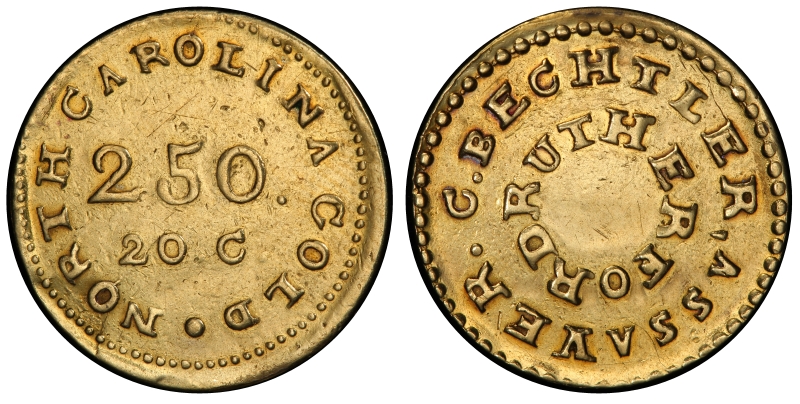
Obverse & Reverse
The Christopher Bechtler $2.50 'Carolina Gold' coinage is a direct and vital artifact of America's first gold rush, a period centered not in California, but in the Appalachian foothills of North Carolina and Georgia. Prior to the massive strikes out west in 1848, this region was the nation's primary source of gold. However, a significant economic bottleneck plagued the miners: the only Federal Mint was in Philadelphia, a perilous and costly 500-mile journey away. Transporting raw gold dust and nuggets was fraught with danger from bandits and the simple risks of 19th-century travel. Consequently, most of the locally mined gold languished as a non-liquid asset, often traded by weight in goose quills or deerskin pouches, stifling the regional economy. Into this vacuum stepped Christopher Bechtler, a German immigrant jeweler, gunsmith, and metallurgist of remarkable skill and integrity. Arriving in Rutherford County in 1830, he quickly recognized the community's need. By July 1831, he began advertising his services to assay and coin local gold for a modest fee, a venture that was met with immediate and overwhelming success. Unlike the disastrously underweight coins of Templeton Reid in Georgia a year prior, Bechtler's coinage was trusted implicitly. His reputation for honesty was so profound that his coins were not only accepted locally but circulated widely throughout the Southeast, often preferred over the scarce federal issues. The K-13 variety, struck after the Federal Coinage Act of June 28, 1834, which altered the official weight standard for gold, represents a more mature phase of his operation. These smaller-diameter, thicker 'pill-style' planchets were a response to the new federal standards. Even after the U.S. government established branch mints in Charlotte (1838) and Dahlonega (1838) to serve the gold regions, Bechtler's private mint continued to thrive, a testament to the public's confidence in his name and product. His operation provided an indispensable service, transforming raw dust into a reliable medium of exchange that fueled commerce and development across the American South for two decades. The Bechtler mint ultimately struck over $2.24 million in gold, a staggering sum for a private enterprise of the era, and his issues remain a cornerstone of the American Territorial Gold series.
Associated EventAppalachian Gold Rush (North Carolina/Georgia)
Reason For MintingTo convert locally mined gold dust into a reliable, standardized medium of exchange due to the great distance and danger of shipping gold to the U.S. Mint in Philadelphia.
Minter HistoryChristopher Bechtler, Sr. (1782-1842) was a German metallurgist and craftsman from the Grand Duchy of Baden who immigrated to the U.S. in 1829. After a brief stay in Philadelphia, he settled in Rutherfordton, North Carolina, in 1830, drawn by the local gold rush. A skilled watchmaker, gunsmith, and jeweler, he applied his metallurgical expertise to establish the most successful private mint in U.S. history. He built his own presses, prepared his own dies, and established a reputation for unimpeachable honesty and accuracy in his assays and coin weights. His business was so successful it continued to operate for years even after federal branch mints opened nearby. Following his death in 1842, the minting operation was continued by his son Augustus, and later his nephew, also named Christopher, until the early 1850s.
Historical SignificanceBechtler's coinage was the economic lifeblood of the southeastern goldfields, providing the first reliable circulating medium of exchange for an entire region and solving a critical problem for miners. His mint produced the first $1 gold coin in American history in 1832, 17 years before the U.S. government. The longevity and high quality of his issues set the standard for private coinage and underscore a pivotal, often overlooked, chapter of American economic history.
K-13
Denomination$2.50
Minting PeriodUndated (c. 1837-1842)
Assayer/MinterChristopher Bechtler, Sr.
Geographic OriginRutherfordton, North Carolina
Obverse DescriptionThe design consists entirely of text. Centrally located is '70 . G :', with '20.' below it and 'CARATS' below that. The legend 'CAROLINA GOLD .' is arranged peripherally around the top.
Obverse InscriptionCAROLINA GOLD . / 70 . G : / 20. / CARATS
Reverse DescriptionThe design is purely text-based. The denomination '250.' is in the center, with 'BECHTLER .' arched above and 'RUTHERF :' arched below.
Reverse InscriptionBECHTLER . / 250. / RUTHERF :
CompositionGold
Stated Fineness20 Carats (.8333 fine)
Actual FinenessGenerally found to be very close to the stated fineness, a key reason for the public's trust in Bechtler's coinage.
Weight4.54 grams
EdgePlain
Unknown
Survival EstimateApproximately 30 examples are believed to exist.
Rarity ScaleR-6
This coin is highly prized as a tangible link to America's first gold rush. Its crude, handmade charm, coupled with the sterling reputation of its issuer and its high rarity, makes it a cornerstone piece for specialists in Southern gold or U.S. Territorial issues.
Key VarietiesThe primary variety for K-13 features an inverted 'V' used for the 'A' in CAROLINA and CARATS, a diagnostic created by the minter's hand-punching of the dies. No later-date proof restrikes or special collector issues are known for this specific variety; all known examples are original business strikes from the operational period of the mint.
Authentication TipsAuthentic examples exhibit crudely hand-punched letters with characteristic uneven spacing and alignment. The planchets are often irregular in shape and may show adjustment marks or laminations. The gold has a distinctive reddish-yellow hue common to Appalachian gold. Counterfeits are often identified by a mushy, cast-like appearance, incorrect weight, regular and perfectly aligned lettering from modern engraving, or a different gold color. A key diagnostic for K-13 is the use of an inverted 'V' for the letter 'A'.
Shopping ConsiderationsA premium quality example for its grade will exhibit a bold strike, especially on the central weight and purity figures, which can sometimes be weak. Look for pleasing, original surfaces with minimal distracting marks. The natural, uncleaned 'skin' of these coins ranges from a bright yellow-gold to a deeper reddish-orange hue; coins with attractive, original color command significant premiums. Avoid examples that have been harshly cleaned, tooled to hide damage, or have significant rim bumps. Given their circulation, some honest wear is expected and accepted, but severe surface impairment drastically reduces value.
A coin's grade is its condition, rated on a 1-70 scale. For rare coins, this is the most critical factor in determining value, as a tiny difference in preservation can mean a huge difference in price.
Relevant Grade TypesAll original Bechtler coins were struck as business strikes intended for commerce and are found in Circulated (1-58) and Mint State (MS, 60-70) grades. No Proofs were struck during the original minting period, and there are no known later-date Proof restrikes of the K-13 variety. Any coin claiming to be a 'Proof' would be highly suspect.
Mint State CharacteristicsUncirculated examples are exceptionally rare. A true Mint State specimen would display full, frosty, or cartwheel luster, though it may be slightly subdued due to the gold's purity. Strikes are typically uneven, so a coin with sharp, well-defined legends and central devices is highly desirable. Minor planchet flaws, laminations, or adjustment marks made before striking are common and generally accepted as part of the coin's character and do not preclude a Mint State grade.
Circulated Wear PatternsWear first appears on the highest points of the letters and numbers. On the obverse, the '70' and '20' will show initial friction. On the reverse, the central '250' and the letters in 'BECHTLER' will begin to flatten. In lower grades (VG and below), the peripheral legends become weak and parts of the inscriptions may merge with the fields.
Key Factors For ValueFor the K-13, value is driven primarily by rarity and grade. Surface quality is paramount; an example with original, uncleaned surfaces and attractive reddish-gold toning is far more valuable than a cleaned coin of the same grade. Strike sharpness is also critical, with collectors paying a premium for coins where all inscriptions are fully readable. Given the small surviving population, any example without significant impairments is highly sought after. A CAC sticker, verifying quality for the assigned grade, adds a substantial premium.