(1834-37) $5 C. Bechtler, 20 Distant RUTHERF: (Regular Strike)
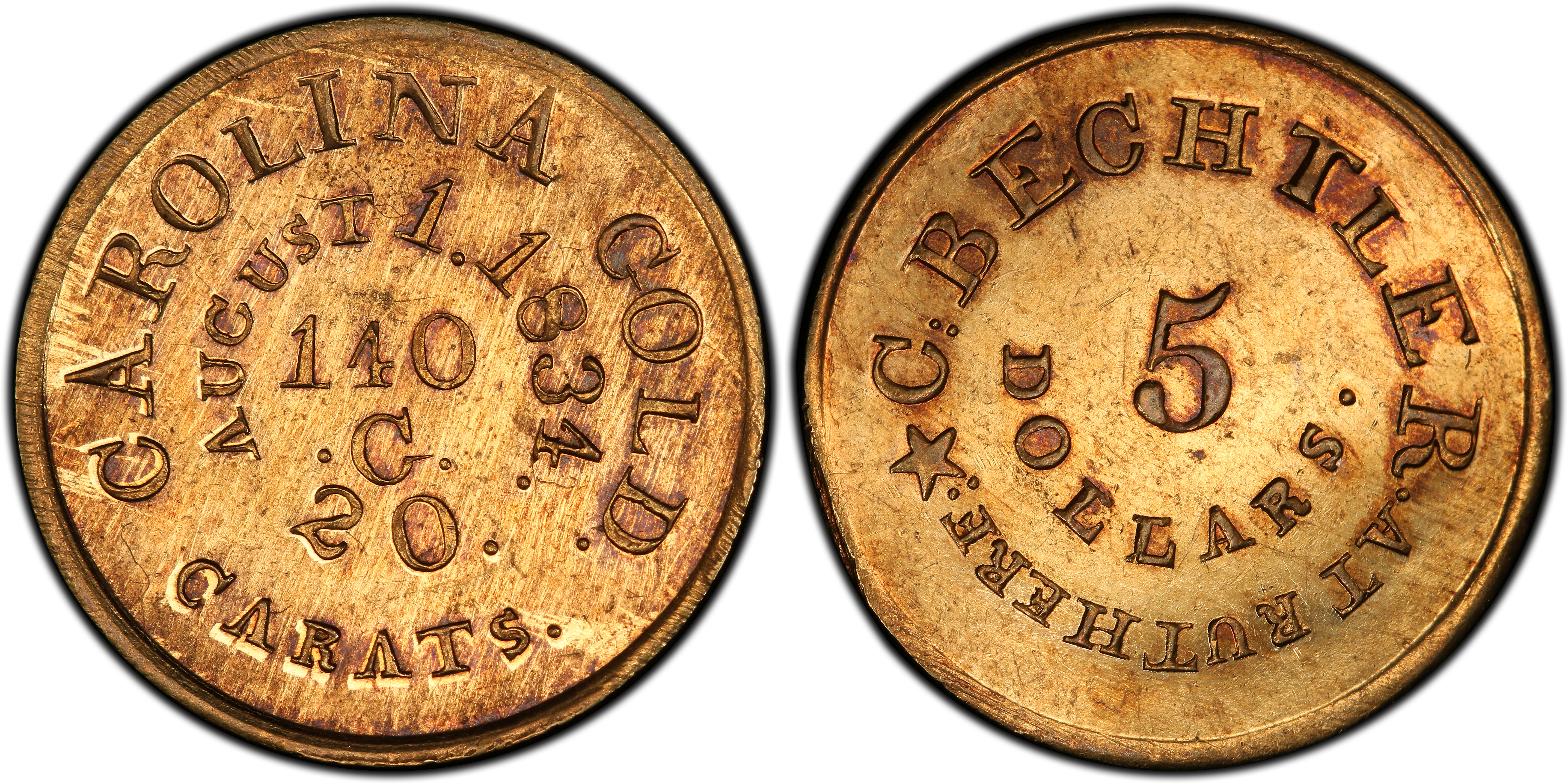
Obverse & Reverse
The Christopher Bechtler five-dollar gold piece, specifically the K-19 variety, stands as a tangible artifact of America's first gold rush, a period of immense economic transformation in the antebellum South. Before the California frenzy of 1849, the rolling hills of the southern Appalachians, particularly in North Carolina and Georgia, were the epicenter of the nation's gold production. Miners faced a significant logistical and economic dilemma: converting their raw gold dust and nuggets into a usable medium of exchange. The only federal mint was in Philadelphia, a treacherous and time-consuming journey away. Shipping gold to Philadelphia incurred high costs for transportation and insurance, and the turnaround time for receiving coined money could take months, paralyzing local commerce. Into this monetary vacuum stepped Christopher Bechtler, a German immigrant with remarkable skills as a goldsmith, watchmaker, and metallurgist. After settling in Rutherfordton, North Carolina, in the heart of the gold region, Bechtler began his private coining operation in 1831. His reputation for scrupulous honesty and the reliably accurate gold content of his coins quickly earned the public's trust, a stark contrast to the failed venture of Templeton Reid in Georgia. Bechtler's coins became the lifeblood of the regional economy, circulating more freely than federal specie. The specific context for the K-19 variety is the U.S. Coinage Act of June 28, 1834, which reduced the weight of gold in federal coins, thereby increasing its dollar value by over 6%. To signify that his coins conformed to this new federal standard, Bechtler added the date 'AUGUST 1, 1834' to the obverse die of this and related varieties. This was a brilliant marketing and trust-building measure, assuring users that his coins were of honest value relative to the new U.S. gold. The Bechtler mint was a family enterprise, and Christopher Sr.'s precision and integrity were legendary. He built all his own equipment, from the rollers to the coin press itself. From 1831 to 1840, his mint coined over $2.24 million in gold, a staggering sum for a private entity. Even after the federal government opened branch mints in Charlotte (1838) and Dahlonega (1838) to serve the gold region, the Bechtler mint continued to thrive due to its efficiency and the public's unwavering confidence. The K-19 variety, with its unique 'RUTHERF:' abbreviation and the specific spacing of '20' from 'CARATS,' represents a specific die pairing used during this dynamic period. Today, these pieces are highly prized by numismatists not just for their rarity, but for the story they tell of American ingenuity, private enterprise solving a critical economic need, and the foundational chapter of the nation's relationship with gold.
Associated EventAppalachian Gold Rush (North Carolina/Georgia)
Reason For MintingTo convert raw gold dust from the Appalachian Gold Rush into a trusted, spendable form of currency, bypassing the distant Philadelphia Mint.
Minter HistoryChristopher Bechtler, Sr. (1782-1843) was a German-born metallurgist, gunsmith, and watchmaker from the Grand Duchy of Baden. He immigrated to the United States in 1829 with his son Augustus and nephew Christopher Jr. After a brief period in Philadelphia, he moved to Rutherfordton, North Carolina, in 1830 to be at the center of the nation's first gold rush. At the request of local miners, he established his private mint in 1831. Renowned for his meticulous work and unimpeachable integrity, Bechtler's coinage operation was highly successful, processing millions of dollars in gold. He personally engineered and built his own coining equipment, including the dies and press. His death in 1842 led to the business being continued by his son and nephew, though their coinage did not always maintain the sterling reputation for accuracy established by the elder Bechtler.
Historical SignificanceBechtler's coinage was the first large-scale and successful private minting operation in U.S. history, providing a vital and trusted medium of exchange that fueled the economy of the Southeast for two decades. His mint produced the nation's first gold dollars, 15 years before the U.S. Mint. The success and integrity of his operation highlighted the severe coinage shortage in the region and directly prompted the federal government to establish the Charlotte and Dahlonega branch mints.
K-19
Denomination$5
Minting Period1834-1837
Assayer/MinterChristopher Bechtler, Sr.
Geographic OriginRutherfordton, North Carolina
Obverse DescriptionA primarily text-based design. The central inscription gives the weight and purity, '140. G.' (Grains) and '20 CARATS', with the '20' spaced distinctly high above and away from 'CARATS.' The date 'AUGUST 1. 1834.' is included above the weight. The periphery is inscribed 'CAROLINA GOLD.'
Obverse InscriptionCAROLINA GOLD. / AUGUST 1. 1834. / 140. G. / 20 CARATS
Reverse DescriptionA simple design featuring the denomination '5 DOLLARS.' in the center, encircled by the minter's name and location, with a characteristic abbreviation: '*C:BECHTLER. AT RUTHERF:'. A small star punch is typically seen at the beginning of the legend.
Reverse Inscription*C:BECHTLER. AT RUTHERF: / 5 DOLLARS.
CompositionGold
Stated Fineness20 CARATS
Actual FinenessApproximately .833 fine, though Bechtler was known for his accuracy and often his coins contained slightly more gold than advertised.
Weight9.07 grams
Diameter24.00 mm
EdgePlain
Unknown
Survival EstimateFewer than 30 known
Rarity ScaleHigh R-6
The K-19 is a classic and highly coveted issue within the Territorial gold series. Its appeal stems from its direct connection to the first U.S. gold rush, the legendary integrity of Christopher Bechtler, its status as a distinct die variety, and its extreme rarity. It is a key piece for advanced collectors of pioneer gold and Southern Americana.
Key VarietiesThe primary distinguishing features of the K-19 variety are the abbreviation 'RUTHERF:' on the reverse and the high, distant placement of '20' relative to 'CARATS' on the obverse. This distinguishes it from the more common K-17 which has 'RUTHERFORD' spelled out. The K-20 variety shares the K-19 reverse die but has a different obverse die that lacks the 'AUGUST 1 1834' date. No proof restrikes or patterns are known for this specific variety.
Authentication TipsGenuine Bechtler coins possess a characteristic crude but sharp style. The lettering and numerals, while not perfectly uniform, should be well-defined. Look for the correct die markers for K-19, including the exact punctuation and spacing. Counterfeits often have a soft, 'mushy' appearance to the details, or may exhibit tool marks or casting bubbles under magnification. The surfaces of authentic examples often show a unique, slightly grainy luster from the primitive rolling and striking process. Weight and specific gravity tests are crucial, as many forgeries are made of base metals with gold plating. The edges should be plain and show no signs of a casting seam.
Shopping ConsiderationsA 'premium quality' example of a K-19 is one that retains strong definition on the central inscriptions, particularly the date and weight on the obverse and '5 DOLLARS' on the reverse, which are often softly struck. Original, uncleaned surfaces with a hint of reddish-gold or greenish-gold toning are highly desirable. Given the softness of the gold and the heavy circulation these coins endured, expect to see some contact marks and minor rim imperfections even on higher-grade specimens. Avoid examples that have been harshly cleaned, polished, tooled, or show evidence of repairs. A coin with honest, even wear is far preferable to a damaged or improperly conserved piece. Due to the high value and prevalence of counterfeits, authentication and grading by a top-tier service like PCGS or NGC is essential.
A coin's grade is its condition, rated on a 1-70 scale. For rare coins, this is the most critical factor in determining value, as a tiny difference in preservation can mean a huge difference in price.
Relevant Grade TypesAll original Bechtler K-19 coins were struck as business strikes intended for commerce. They are found in Circulated grades (AG-3 to AU-58) and, very rarely, in Mint State (MS, 60-70). The vast majority of surviving examples are in circulated grades. No proofs were struck during the original period of issue, and no later-date restrikes of this variety are known to exist.
Mint State CharacteristicsUncirculated examples are exceptionally rare. A true Mint State K-19 would exhibit original mint luster, often described as soft and satiny rather than bright and flashy. The strike is a critical factor; they are frequently found with areas of weakness, especially on the 'CAROLINA' legend and the date. The planchets were not always perfectly flat, so some minor unevenness in the strike is expected. Due to the soft, high-purity gold, even uncirculated specimens will likely display some light contact marks or 'bag marks' from handling at the time of minting. The finest known certified is a single MS-61.
Circulated Wear PatternsWear first appears on the highest and broadest design elements. On the obverse, friction will first dull the luster and flatten the tops of the numerals in '140' and '20'. On the reverse, the highest points are the letters in 'DOLLARS' and 'BECHTLER.' With progressive wear, the finer details of the peripheral lettering will begin to weaken and merge with the fields. In lower grades (VG and below), the date and smaller letters can become partially or completely obliterated.
Key Factors For ValueFor the K-19, rarity is paramount, but within a given grade, value is driven by surface quality and eye appeal. An example with original, undisturbed surfaces commands a significant premium over one that has been cleaned, polished, or exhibits distracting marks. The sharpness of the strike is also crucial; a well-struck coin showing more detail, particularly in the date and minter's name, is more valuable than a weakly struck counterpart of the same grade. Eye appeal, encompassing attractive natural toning and a lack of significant, distracting marks, plays a major role. A CAC sticker for this issue would denote premium quality for the grade and add a substantial premium.
PCGS Price Guide
| Grade | Price | Population |
|---|---|---|
| 4 | $3,500.00 | 1 |
| 6 | $4,000.00 | N/A |
| 8 | $5,250.00 | N/A |
| 10 | $5,750.00 | N/A |
| 12 | $6,500.00 | N/A |
| 15 | $7,250.00 | 1 |
| 20 | $8,500.00 | N/A |
| 25 | $9,000.00 | N/A |
| 30 | $9,750.00 | 3 |
| 35 | $11,000.00 | N/A |
| 40 | $13,500.00 | 4 |
| 45 | $14,500.00 | 2 |
| 45+ | $16,000.00 | N/A |
| 50 | $17,500.00 | 7 |
| 50+ | $20,000.00 | N/A |
| 53 | $23,500.00 | 1 |
| 53+ | $30,000.00 | N/A |
| 55 | $32,500.00 | 3 |
| 55+ | $42,500.00 | N/A |
| 58 | $57,500.00 | 2 |
| 58+ | $62,500.00 | N/A |
| 60 | $70,000.00 | N/A |
| 61 | $75,000.00 | 1 |
| 62 | $87,500.00 | 1 |