(1837-42) $5 C. Bechtler, Georgia Gold Rutherford (Regular Strike)
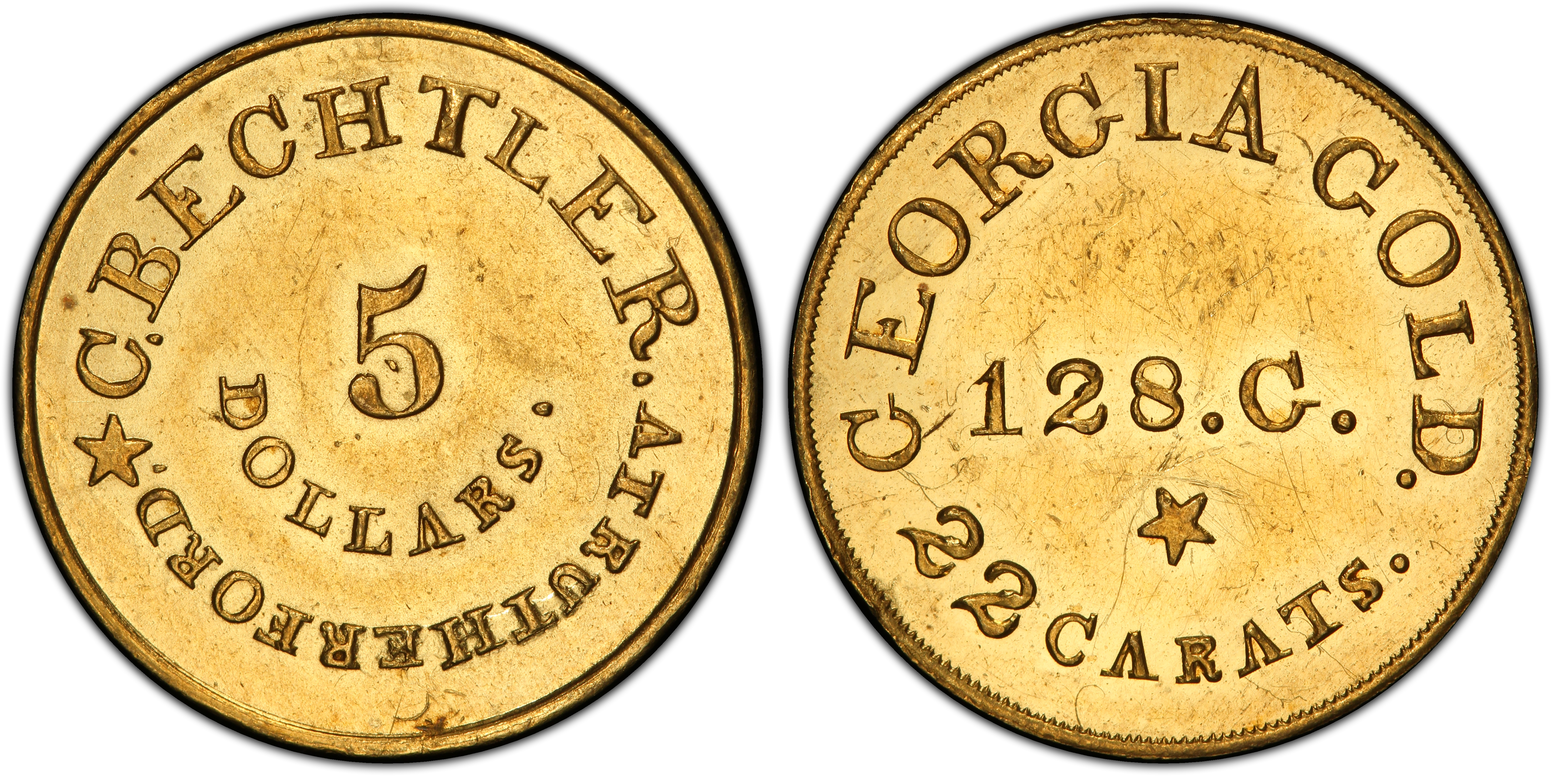
Obverse & Reverse
The C. Bechtler $5 'Georgia Gold' coin stands as a critical artifact from America's first gold rush, a period centered not in California, but in the Piedmont regions of North Carolina and Georgia. Prior to the establishment of the Dahlonega and Charlotte branch mints in 1838, miners who struck gold faced a perilous and impractical journey to the U.S. Mint in Philadelphia to convert their dust and nuggets into usable currency. This logistical nightmare created a vacuum in the regional economy, which Christopher Bechtler, a German immigrant and skilled metallurgist, astutely filled. Arriving in Rutherford County, North Carolina, in 1830, Bechtler established a private mint that quickly became the de facto monetary authority for the entire region. His reputation for honesty, accuracy, and fairness was impeccable, a stark contrast to the earlier, less successful venture of Templeton Reid in Georgia. Bechtler's integrity was so trusted that his coins circulated with more confidence than many foreign coins and even some of the official U.S. issues of the day. The 'Georgia Gold' designation on this particular $5 piece did not necessarily mean the gold was exclusively mined in Georgia, but rather that it was of the highest purity Bechtler processed—22 carats. This was his way of branding different fineness levels, with 'CAROLINA GOLD' typically denoting 21-carat fineness and 'NORTH CAROLINA GOLD' indicating 20 carats. This system provided transparency and reliability for merchants and the public. The Bechtler mint was a family affair, involving his son Augustus and nephew Christopher Jr., and their operation was so successful and respected that the federal government, despite its constitutional authority over coinage, never interfered. The Bechtler mint coined over $2.2 million in gold between 1831 and 1840 alone, a staggering sum for a private enterprise of the era. The coinage of Christopher Bechtler, Sr., ceased with his death in 1842, though his son and nephew continued the operation until the early 1850s. The legacy of these coins is immense; they were the lifeblood of the Southeastern economy for two decades and represent a fascinating chapter of successful, de facto private currency in American history.
Associated EventAppalachian Gold Rush (Georgia and North Carolina Gold Rushes)
Reason For MintingTo provide a reliable and convenient medium of exchange for miners and merchants by converting locally mined gold dust into standardized coins, avoiding the dangerous journey to the Philadelphia Mint.
Minter HistoryChristopher Bechtler, Sr. (1782-1842) was a German-born metallurgist, gunsmith, and jeweler who immigrated to the United States in 1829. Settling in Rutherfordton, North Carolina, in the heart of the Appalachian gold fields, he leveraged his skills to establish a highly respected and prolific private mint in 1831. Known for his scrupulous honesty and the consistent quality of his assays and coinage, Bechtler produced the nation's first gold dollar in 1832, 17 years before the U.S. Mint. His mint processed gold from both North Carolina and Georgia, creating a trusted currency that fueled the regional economy until his death in 1842, after which the business was continued by his family.
Historical SignificanceBechtler's coinage was the most successful and trusted private currency of its era, serving as the primary circulating medium in the Southeast during America's first gold rush. These coins legitimized private minting through sheer integrity and quality, providing a vital economic service that the federal government had not yet extended to the region and demonstrating a functional model of private enterprise in currency.
K-22
Denomination$5
Minting Periodc. 1834-1837
Assayer/MinterChristopher Bechtler, Sr.
Geographic OriginRutherfordton, North Carolina
Obverse DescriptionThe design is purely informational and utilitarian. Centered in three lines is the weight '128. G.' with the stated fineness '22 CARATS' below it, separated by a five-pointed star. The legend 'GEORGIA GOLD.' is inscribed along the upper periphery.
Obverse InscriptionGEORGIA GOLD. / 128. G. / 22 CARATS
Reverse DescriptionThe minter's name and location are inscribed along the periphery. 'C. BECHTLER.' is at the top and 'AT RUTHERFORD' is at the bottom, separated from the central denomination by stars or other ornaments. The denomination '5 DOLLARS' is in the center, typically on two lines, often with the '5' being larger.
Reverse InscriptionC. BECHTLER. / 5 / DOLLARS / AT RUTHERFORD
CompositionGold
Stated Fineness22 carats (.9167 fine)
Actual FinenessGenerally found to be very close to the stated fineness, a testament to Bechtler's honest reputation.
Weight8.27 grams
Diameter21.60 mm
EdgePlain
Unknown; no precise records were kept. However, it is considered a scarce and highly collectible issue.
Survival EstimateFewer than 150 are believed to exist across all grades.
Rarity ScaleR-5 (Very Scarce)
This coin is prized for its direct connection to America's first gold rush, the legendary integrity of its issuer, and its status as a widely circulated and trusted private territorial issue. It appeals to collectors of territorial gold, Southern numismatics, and early American history.
Key VarietiesThe three primary varieties of the Christopher Bechtler $5 'Georgia Gold' issue are distinguished by minor punctuation and spelling differences: 1. **K-21**: Colon after 'G' in '128.G:' and often a colon before 'GEORGIA'. This is the rarest of the three varieties (High R-7). 2. **K-22**: (This coin, the 'Regular Strike') Period after 'G' in '128.G.' and 'RUTHERFORD' is spelled out completely. This is the most frequently encountered variety, though still scarce. 3. **K-23**: Period after 'G', but the location is abbreviated to 'RUTHERF.' A very rare variety. It is also important for collectors to be aware of the **Chapman Restrikes**, which were proof strikings made in 1908 from original, rusted Bechtler dies. These are typically of the Carolina Gold design (K-30, K-31), are numismatically distinct from the original business strikes, and are identified by their sharp prooflike surfaces contrasted with die rust.
Authentication TipsGenuine Bechtler coins possess a characteristic crude, somewhat uneven strike but consistent die characteristics for each variety. The lettering is often simple and may show slight misalignment. Weights should be very close to the stated 127.6 grains (approx. 8.27 grams). The surface texture should reflect the primitive rolling and planchet preparation of the era, often showing fine parallel striations. Counterfeits may appear too perfect, have incorrect lettering fonts, be underweight, or have a soapy, cast-like appearance. Non-magnetic properties and specific gravity tests are essential for authentication.
Shopping ConsiderationsA premium quality example for its grade will exhibit a bold, well-centered strike, which is uncommon as many were struck off-center with areas of weakness. Look for original, uncleaned surfaces with some remaining mint luster; a reddish or greenish-gold toning is often seen and considered attractive. Minor, mint-made planchet flaws or adjustment marks are common and generally accepted by specialists. Avoid examples that have been harshly cleaned, polished, or show evidence of tooling or engraving, as these significantly impair value. Pay close attention to the legends and central inscriptions; on a desirable coin, these elements will be as sharp and complete as possible for the issue.
A coin's grade is its condition, rated on a 1-70 scale. For rare coins, this is the most critical factor in determining value, as a tiny difference in preservation can mean a huge difference in price.
Relevant Grade TypesOriginal period issues were business strikes intended for circulation and are found in Circulated grades (AG-3 to AU-58) and, very rarely, in Mint State (MS, 60-70). No proofs were struck by Christopher Bechtler during the original minting period. The later-date Chapman restrikes (c. 1908) are Proof (PR/PF) issues and are collected as separate numismatic items, distinct from these original circulating coins.
Mint State CharacteristicsAn uncirculated Bechtler $5 is exceptionally rare. Quality is defined by the strength of the strike; a full, sharp strike on all letters and numbers is highly desirable but almost never seen. Luster is typically soft and satiny rather than deeply prooflike. Due to the rudimentary minting process and soft gold, even high-grade examples will typically display some light handling marks, planchet striations, or minor die imperfections. The overall eye appeal, combining luster, strike, and surface preservation, is paramount.
Circulated Wear PatternsWear first appears on the highest points of the lettering and numbers on both the obverse and reverse. The numerals '128' and the word 'DOLLARS' are particularly susceptible. On the reverse, the minter's name 'C. BECHTLER' will show initial friction. In lower grades (VG and below), the legends begin to merge with the fields, and the finer details of the stars and punctuation become indistinct.
Key Factors For ValueThe primary drivers of value are grade and surface originality. An example with original 'skin' and luster, free from harsh cleaning or polishing, will command a significant premium over a cleaned coin of the same grade. Strike quality is crucial; a coin with a sharp, well-centered impression is far more valuable than a weakly struck or off-center example. Eye appeal, including attractive original toning, plays a major role. Finally, due to the prevalence of counterfeits and problem coins, certification by a top-tier grading service (PCGS or NGC) is standard, and a CAC sticker, indicating premium quality for the grade, adds a substantial premium.
PCGS Price Guide
| Grade | Price | Population |
|---|---|---|
| 8 | $5,000.00 | N/A |
| 10 | $5,750.00 | N/A |
| 12 | $7,250.00 | 1 |
| 15 | $8,500.00 | N/A |
| 20 | $9,000.00 | 1 |
| 25 | $10,500.00 | N/A |
| 30 | $11,250.00 | 2 |
| 35 | $12,000.00 | N/A |
| 40 | $14,000.00 | 1 |
| 45 | $15,000.00 | 2 |
| 45+ | $16,000.00 | N/A |
| 50 | $18,000.00 | N/A |
| 50+ | $20,000.00 | N/A |
| 53 | $23,500.00 | 2 |
| 53+ | $26,500.00 | N/A |
| 55 | $32,500.00 | 3 |
| 55+ | $37,500.00 | N/A |
| 58 | $52,500.00 | 1 |
| 58+ | $57,500.00 | N/A |
| 60 | $62,500.00 | N/A |
| 61 | $67,500.00 | N/A |
| 61+ | N/A | N/A |
| 62 | $75,000.00 | N/A |
| 62+ | $82,500.00 | N/A |
| 63 | $95,000.00 | 2 |