(1837-42) G$1 C. Bechtler, 28.G Centered N Reversed (Regular Strike)
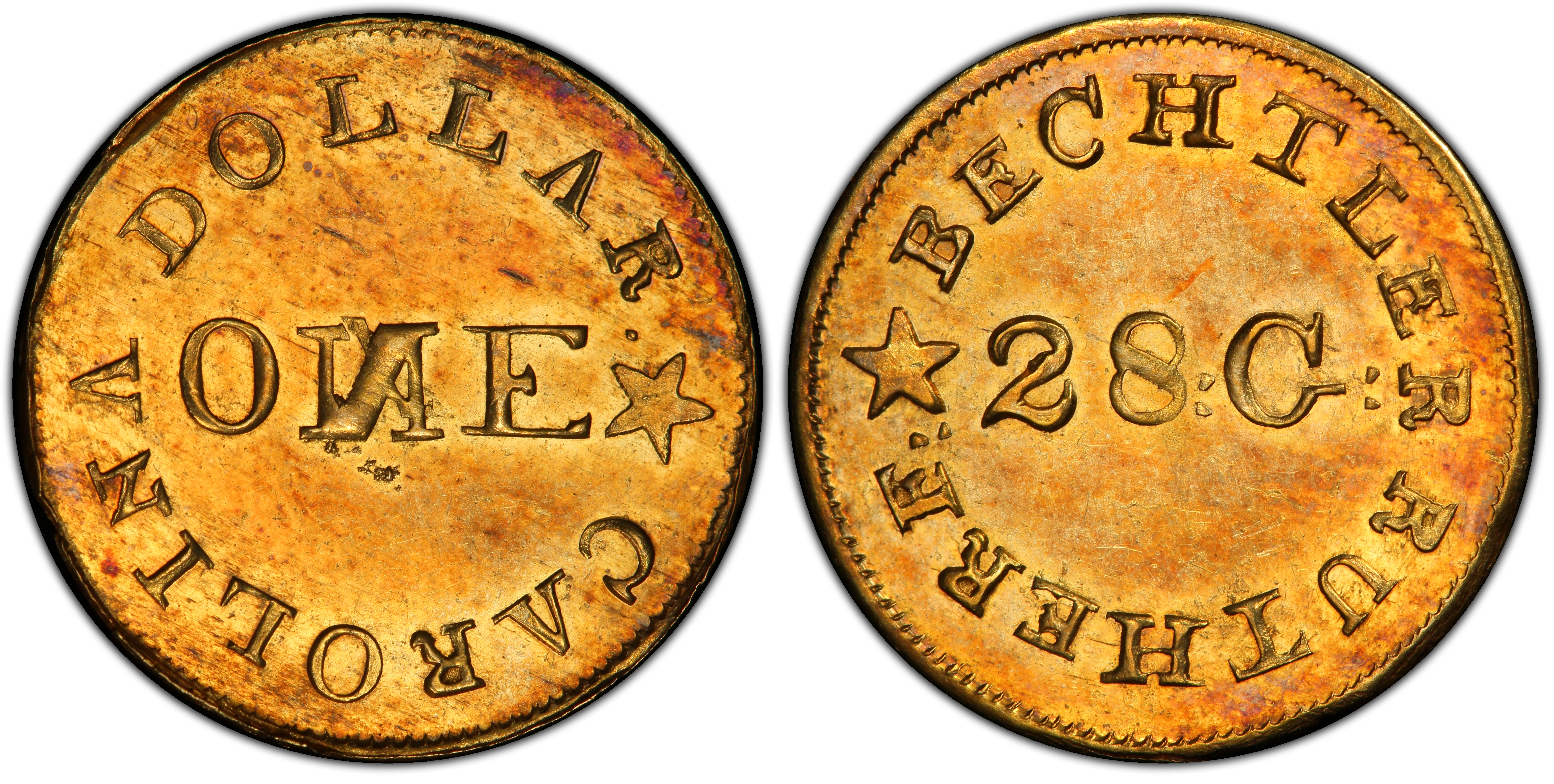
Obverse & Reverse
The Bechtler gold dollar of the '28.G Centered N Reversed' variety (Kagin-4) stands as a tangible artifact of America's first gold rush in the Appalachian mountains of North Carolina and Georgia. Prior to the California Gold Rush of 1849, this region was the primary source of domestic gold. However, miners faced a significant challenge: converting their raw gold dust and nuggets into a spendable medium. The only United States Mint was in Philadelphia, a treacherous and time-consuming journey away. This economic vacuum created a fertile ground for private enterprise. Enter Christopher Bechtler, Sr., a German immigrant and skilled metallurgist who settled in Rutherfordton, North Carolina, in 1830. Recognizing the miners' plight, he established a private mint in 1831, offering to assay and coin gold for a modest fee, typically around 2.5%. Bechtler's integrity and the consistent quality of his coins quickly earned the public's trust. His coinage, including the revolutionary one-dollar gold piece first struck in 1832—a full 17 years before the U.S. Mint would issue its own—became the de facto currency of the entire Southeast. These coins were so trusted that they circulated widely and were even specified in contracts. The K-4 variety, produced between 1837 and 1842, represents a mature phase of his operation, shortly before his death in 1842. The simple, utilitarian design reflects its primary purpose: commerce, not artistry. The reversed 'N' in 'ONE' on the reverse is a defining characteristic, likely an engraver's error that went uncorrected for a period, creating a collectible variety. The existence and success of the Bechtler mint directly pressured the U.S. government to establish its own branch mints in the region, leading to the opening of facilities in Charlotte, North Carolina, and Dahlonega, Georgia, in 1838. Yet, even with federal competition, Bechtler's operation continued to thrive, a testament to his established reputation for honesty and reliability. After his death, the mint was continued by his son August and later his nephew, but the quality and integrity of the coinage declined, and the operation ceased around 1850.
Associated EventAppalachian Gold Rush (Carolina and Georgia Gold Rush)
Reason For MintingTo provide a reliable and convenient medium of exchange for miners by converting raw gold dust into standardized coins, overcoming the great distance to the U.S. Mint in Philadelphia.
Minter HistoryChristopher Bechtler, Sr. (1782-1842) was a German metallurgist, gunsmith, and watchmaker who immigrated to the United States in 1829. He settled in Rutherford County, North Carolina, in 1830, strategically placing himself in the heart of the nation's first gold rush. At the request of local miners, he opened his private assay office and mint in 1831. Bechtler was known for his meticulous work and unwavering honesty, producing coins of consistent weight and fineness. He manufactured all his own equipment, including presses and dies. His operation was the most successful and prolific private mint in U.S. history, coining over $2.2 million in gold between 1831 and 1840. He pioneered the U.S. gold dollar, producing it nearly two decades before the federal government. His death in 1842 marked the beginning of the end for the mint, as his successors lacked his skill and integrity.
Historical SignificanceThis coin is historically significant as a product of the most successful private mint in American history and as part of the first series of gold dollars ever struck in the United States, predating the federal version by 17 years. The Bechtler mint's success highlighted the severe shortage of circulating currency in the Southeast and directly prompted the establishment of the Charlotte and Dahlonega branch mints.
K-4
Denomination$1
Minting Period1837-1842
Assayer/MinterChristopher Bechtler, Sr.
Geographic OriginRutherfordton, North Carolina
Obverse DescriptionThe central design element is the assayer's name, 'C. BECHTLER.', arranged in an arc. Below this is the weight, '28.G.', centered within the field. A circle of beads or denticles surrounds the periphery.
Obverse InscriptionC. BECHTLER. / 28.G.
Reverse DescriptionThe denomination 'ONE' is displayed horizontally across the center. A defining feature of this variety is that the letter 'N' is engraved backwards. Above is the location, 'RUTHERFORD', in an arc, and below is the word 'DOLLAR'. A circle of beads or denticles surrounds the periphery.
Reverse InscriptionRUTHERFORD / ONE / DOLLAR
CompositionGold
Stated Fineness Actual FinenessApproximately 20 Carats (.833 fine), though Bechtler's fineness could vary slightly.
Weight1.81 grams
Diameter17.50 mm
EdgePlain
Unknown for this specific variety; part of the overall production from 1837-1842.
Survival EstimateFewer than 200 estimated to exist.
Rarity ScaleR-5
This coin is highly prized for its direct connection to America's first gold rush, its status as one of the first gold dollars, and the intriguing and easily identifiable 'Reversed N' error. It represents a pivotal moment when private enterprise filled a crucial gap left by the federal government.
Key VarietiesThe primary variety is the K-4, defined by the reversed 'N' in 'ONE'. A much scarcer companion variety, K-3, features a normal 'N' and was struck during a similar period. There are no known proof restrikes or special collector issues of Bechtler coinage; all pieces were originally struck for circulation.
Authentication TipsAuthentic examples often exhibit a crude, somewhat uneven strike and may have planchet flaws, waviness, or minor laminations characteristic of the Bechtler minting process. The lettering style is distinct and should be carefully compared to known genuine examples. The reversed 'N' should appear as engraved, not tooled or altered. Counterfeits from the era were often made of gold-plated brass. Modern forgeries may be cast, showing a soft or porous texture, or may be die-struck with incorrect lettering, weight, or specific gravity.
Shopping ConsiderationsWhen acquiring a K-4 Bechtler dollar, prioritize originality of the surfaces. A premium quality example will have minimal distracting marks and retain some of its original, slightly subdued luster. Many survivors have been cleaned over the years; look for examples with intact 'skin' and attractive, honest wear. The strike is often weak in the centers, so a coin with a bold '28.G.' and clear lettering on both sides is desirable. Check the edges for evidence of prior mounting in jewelry, a common fate for these historic coins. A wavy or slightly buckled planchet is not uncommon for the issue and should not be considered a major defect unless it is severe.
A coin's grade is its condition, rated on a 1-70 scale. For rare coins, this is the most critical factor in determining value, as a tiny difference in preservation can mean a huge difference in price.
Relevant Grade TypesAll original Bechtler coins were business strikes intended for circulation. They are found in Circulated grades (AG-3 to AU-58) and, more rarely, in Mint State (MS-60 to MS-70). No Proof (PR/PF) examples were struck by the Bechtlers during the original period of operation, and no later restrikes are known to exist. Any coin described as a 'Proof' should be regarded with extreme suspicion.
Mint State CharacteristicsUncirculated examples are very scarce. They typically exhibit a soft, satiny luster rather than a hard, frosty one. The strike is almost never perfectly sharp across the entire coin; some weakness in the central devices or peripheral lettering is expected. Due to the relatively soft, unalloyed gold and crude planchet preparation, even Mint State examples will often display minor planchet flakes, striations, or adjustment marks made prior to striking. Contact marks, while affecting the grade, are common and should be evaluated for their severity and location.
Circulated Wear PatternsWear first appears on the highest points: the '28.G.' on the obverse and the central letters of 'ONE' on the reverse. As wear progresses, the lettering in the arcs ('C. BECHTLER.' and 'RUTHERFORD') will begin to flatten. On lower-grade examples, the inscriptions become faint, and the beaded borders may merge with the rim.
Key Factors For ValueOriginality of the surfaces is paramount; an uncleaned coin in a lower grade is often preferred to a harshly cleaned higher-grade example. The quality of the strike is a major factor, with well-struck coins commanding significant premiums. Eye appeal, driven by attractive original color (often a rich reddish-gold) and problem-free surfaces, greatly influences value. For this issue, a CAC sticker is highly valued by collectors as it confirms both the accuracy of the grade and the quality of the coin for that grade.
PCGS Price Guide
| Grade | Price | Population |
|---|---|---|
| 12 | $1,750.00 | N/A |
| 15 | $2,000.00 | N/A |
| 20 | $2,350.00 | N/A |
| 25 | $2,750.00 | N/A |
| 30 | $3,250.00 | N/A |
| 35 | $3,750.00 | 2 |
| 40 | $4,750.00 | 5 |
| 45 | $5,000.00 | 11 |
| 45+ | $5,250.00 | N/A |
| 50 | $5,750.00 | 16 |
| 50+ | $6,000.00 | N/A |
| 53 | $6,250.00 | 18 |
| 53+ | $6,500.00 | N/A |
| 55 | $7,000.00 | 30 |
| 55+ | $7,750.00 | N/A |
| 58 | $9,500.00 | 8 |
| 58+ | $10,000.00 | N/A |
| 60 | $11,000.00 | 1 |
| 61 | $11,500.00 | 7 |
| 62 | $14,500.00 | 6 |
| 62+ | $18,500.00 | N/A |
| 63 | $30,000.00 | 1 |
| 63+ | $35,000.00 | N/A |
| 64 | $45,000.00 | 2 |