(1837-42) $2.50 C. Bechtler, 70 Grains, 20 Carats (Regular Strike)
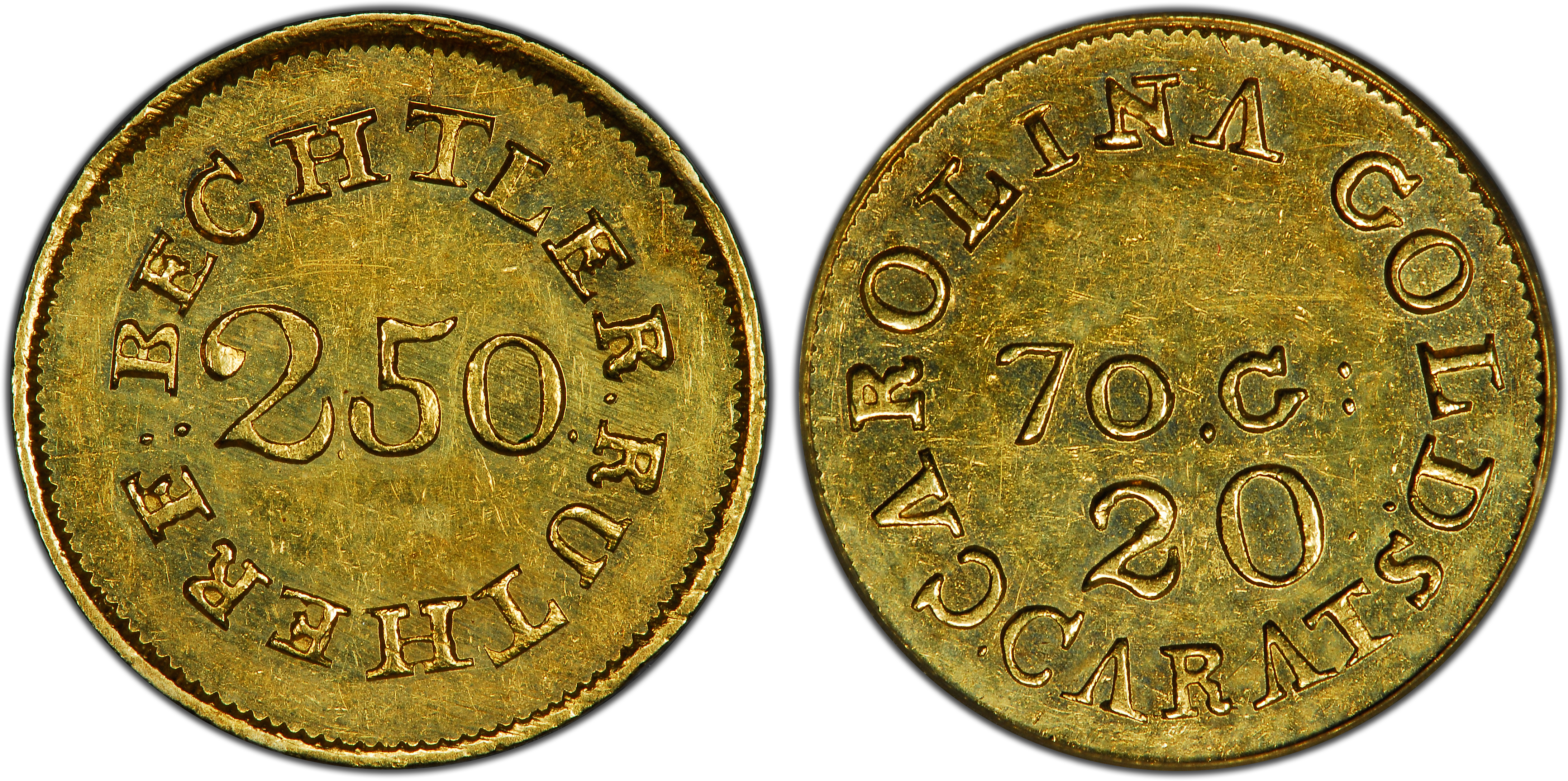
Obverse & Reverse
The Christopher Bechtler $2.50 Quarter Eagle, Kagin-13, is a profound artifact of America's first gold rush, a period centered not in California, but in the rolling hills of the southern Appalachian Mountains. Long before the forty-niners, a discovery in North Carolina in 1799 sparked a regional gold boom. By the 1820s, miners across North Carolina and Georgia were extracting significant quantities of the precious metal. However, they faced a critical logistical problem: the only U.S. Mint was in distant Philadelphia, and the journey to transport raw gold and receive coins in return was perilous, time-consuming, and expensive. This economic friction created a vacuum, leaving the region starved for a circulating medium of exchange beyond unreliable paper scrip and raw gold dust. Enter Christoph Bechtler, a German immigrant and master metallurgist who settled in Rutherfordton, North Carolina, in 1830. Recognizing the local need, Bechtler, with his son Augustus and nephew Christopher Jr., established a private mint in 1831. Operating with a simple, hand-cranked screw press, they offered a vital service: converting miners' gold into standardized coins for a modest fee of about 2.5%. The Bechtler mint was a model of efficiency and, crucially, integrity. While the U.S. government initially cast doubt on their private enterprise, the Bechtler family's coinage quickly earned widespread public trust due to its consistent weight and reliable gold content. Their coins became the de facto currency of the Southeast, circulating from Virginia to Alabama, and were so well-regarded that some Confederate contracts during the Civil War would later specify payment in Bechtler gold. The K-13 variety was struck after the Coinage Act of 1834, which altered the official gold-to-silver ratio and led Bechtler to adjust his coin specifications. These small, thick 'pill-style' quarter eagles were utilitarian pieces, meant to facilitate commerce, and as such, they saw extensive and hard use, a fact reflected in the typically low grade of surviving specimens. The success and proliferation of Bechtler's coinage directly spurred the federal government to establish Branch Mints in Charlotte, NC, and Dahlonega, GA, in 1838, yet the private Bechtler mint continued to operate successfully for years, a testament to its founder's sterling reputation.
Associated EventCarolina Gold Rush
Reason For MintingTo convert raw gold from the Carolina and Georgia gold fields into a trusted, circulating medium of exchange due to the great distance to the U.S. Mint in Philadelphia.
Minter HistoryChristoph Bechtler, Sr. (1782-1842) was a German goldsmith, gunsmith, and metallurgist from the Grand Duchy of Baden. He immigrated to the United States in 1829, initially settling in Philadelphia before moving to Rutherfordton, North Carolina, in 1830, drawn by the burgeoning gold rush. A brilliant and industrious craftsman, he manufactured his own dies and presses. From 1831 until his death in 1842, his private mint was the most prolific and respected in U.S. history, producing over a million gold coins. His reputation for honesty was impeccable, making his coinage the standard for commerce throughout the Southeast. The business was continued by his son Augustus and later his nephew.
Historical SignificanceThe Bechtler mint was the most important and successful private coiner in American history, providing a stable and trusted currency that fueled the economy of the antebellum South. It produced the first U.S. gold dollar (1832) seventeen years before the federal government. The mint's success highlighted the need for federal coinage facilities in the gold regions, directly leading to the creation of the Charlotte and Dahlonega branch mints.
K-13
Denomination$2.50
Minting PeriodUndated (Struck circa 1837-1842)
Assayer/MinterChristopher Bechtler, Sr.
Geographic OriginRutherfordton, North Carolina
Obverse DescriptionA utilitarian design with no central device. The legend 'CAROLINA GOLD' is arranged around the periphery, with a distinctive inverted 'V' used for the 'A'. The center is dominated by the inscriptions of weight '70 . G :' and fineness '20 . CARATS', arranged in two lines.
Obverse InscriptionCAROLINA GOLD . 70 . G : 20 . CARATS
Reverse DescriptionThe minter's name and location, 'BECHTLER . RUTHERF :', are arched along the upper periphery. The denomination, '250', is boldly punched in the center, representing 250 cents or $2.50.
Reverse InscriptionBECHTLER . RUTHERF : 250.
CompositionGold
Stated Fineness20 Carats (0.833 fine)
Actual FinenessAssays of Christopher Bechtler's issues from this period often showed them to be slightly deficient in gold content, averaging around 3% below their stated value, though still considered honest for the technology of the time. This would equate to a fineness of approximately 0.808.
Weight4.54 grams
EdgePlain
Unknown
Survival EstimateApproximately 30-40 examples are believed to exist.
Rarity ScaleR-6 (Very Rare)
This coin is highly prized as a tangible artifact from America's first gold rush and the nation's most successful private mint. Its crude, handmade appearance, historical importance, and sheer rarity make it a cornerstone piece for specialists in territorial gold or early American coinage.
Key VarietiesThe primary diagnostic for the K-13 variety is the use of an inverted 'V' for the letter 'A' in CAROLINA on the obverse. No major sub-varieties of K-13 are recognized. While the Bechtler family produced many different die pairings and varieties across their denominations, K-13 is a distinct and sought-after variety. No patterns, proofs, or special restrikes are known for this specific issue.
Authentication TipsGenuine examples were struck on a manual screw press, resulting in a somewhat crude and uneven strike, especially at the borders; a perfectly sharp, modern-looking strike is highly suspect. The planchets are often irregular and may show adjustment marks or flaws. The lettering is hand-punched and shows a charming lack of uniformity. Specifically, verify the distinctive inverted 'V' for 'A' in CAROLINA. Counterfeits may be cast, showing a porous or granular surface, or may be struck with incorrect weight and dimensions. Contemporary counterfeits were often gold-plated brass.
Shopping ConsiderationsWhen acquiring a K-13, a premium-quality example is defined by a bold strike, particularly on the central denomination '250' and the weight/fineness inscriptions. Seek out examples with minimal planchet flaws, which are common but less distracting on higher-end pieces. Original, uncleaned surfaces displaying the characteristic greenish-gold or reddish-gold patina are paramount and valued far more than the technical grade alone. Avoid coins that have been harshly cleaned, polished, or show evidence of tooling or repairs in the fields. Given the rarity, any example without significant impairments is a prize, but those certified by a top-tier grading service with a CAC sticker command significant premiums, confirming both authenticity and superior eye appeal for the grade.
A coin's grade is its condition, rated on a 1-70 scale. For rare coins, this is the most critical factor in determining value, as a tiny difference in preservation can mean a huge difference in price.
Relevant Grade TypesAll original Bechtler issues, including the K-13, were business strikes intended for commerce. They are found in Circulated grades (AG-3 to AU-58) and, very rarely, in Mint State (MS-60 to 70). No proof examples were struck during the original period of issue, and there are no known later-date Proof restrikes of this specific variety.
Mint State CharacteristicsAn uncirculated K-13 will exhibit a soft, satiny luster, often with a slightly prooflike or reflective quality in the fields if from fresh dies. The strike is characteristically weak in areas, especially around the peripheries, due to the nature of the screw press. The planchets are made of relatively soft, unrefined gold, making them highly susceptible to contact marks, even on coins that never circulated. A choice MS example is prized for its originality and luster rather than for technical perfection.
Circulated Wear PatternsWear first appears on the highest points of the design, which are the numerals '250' on the reverse and the central '70 . G :' on the obverse. As wear progresses, the lettering in the legends 'CAROLINA GOLD' and 'BECHTLER . RUTHERF :' will become soft and begin to merge with the fields. On heavily worn examples, the finer details of the inscriptions will be partially or completely obliterated.
Key Factors For ValueFor the Bechtler K-13, originality of the surfaces is the most critical factor; a coin with honest wear and original skin is far more desirable than a higher-grade but harshly cleaned specimen. Strike quality is next in importance, with boldly impressed central details commanding a premium. Eye appeal, encompassing attractive color and minimal distracting marks, is key. Finally, certification by a major grading service is essential for authenticity and market acceptance, with a CAC sticker adding a significant premium by signifying top quality for the assigned grade.
PCGS Price Guide
| Grade | Price | Population |
|---|---|---|
| 8 | $5,500.00 | N/A |
| 10 | $6,000.00 | N/A |
| 12 | $6,750.00 | N/A |
| 15 | $7,500.00 | N/A |
| 20 | $8,500.00 | N/A |
| 25 | $9,250.00 | N/A |
| 30 | $10,500.00 | N/A |
| 35 | $12,000.00 | N/A |
| 40 | $13,500.00 | N/A |
| 45 | $15,000.00 | 3 |
| 45+ | $16,000.00 | N/A |
| 50 | $17,000.00 | 1 |
| 50+ | $18,500.00 | N/A |
| 53 | $19,500.00 | N/A |
| 53+ | $21,000.00 | N/A |
| 55 | $22,500.00 | 3 |
| 55+ | $25,000.00 | N/A |
| 58 | $30,000.00 | 2 |
| 58+ | $32,500.00 | N/A |
| 60 | $40,000.00 | N/A |
| 61 | $50,000.00 | 2 |
| 62 | $75,000.00 | 4 |
| 62+ | $82,500.00 | N/A |
| 63 | $95,000.00 | 1 |